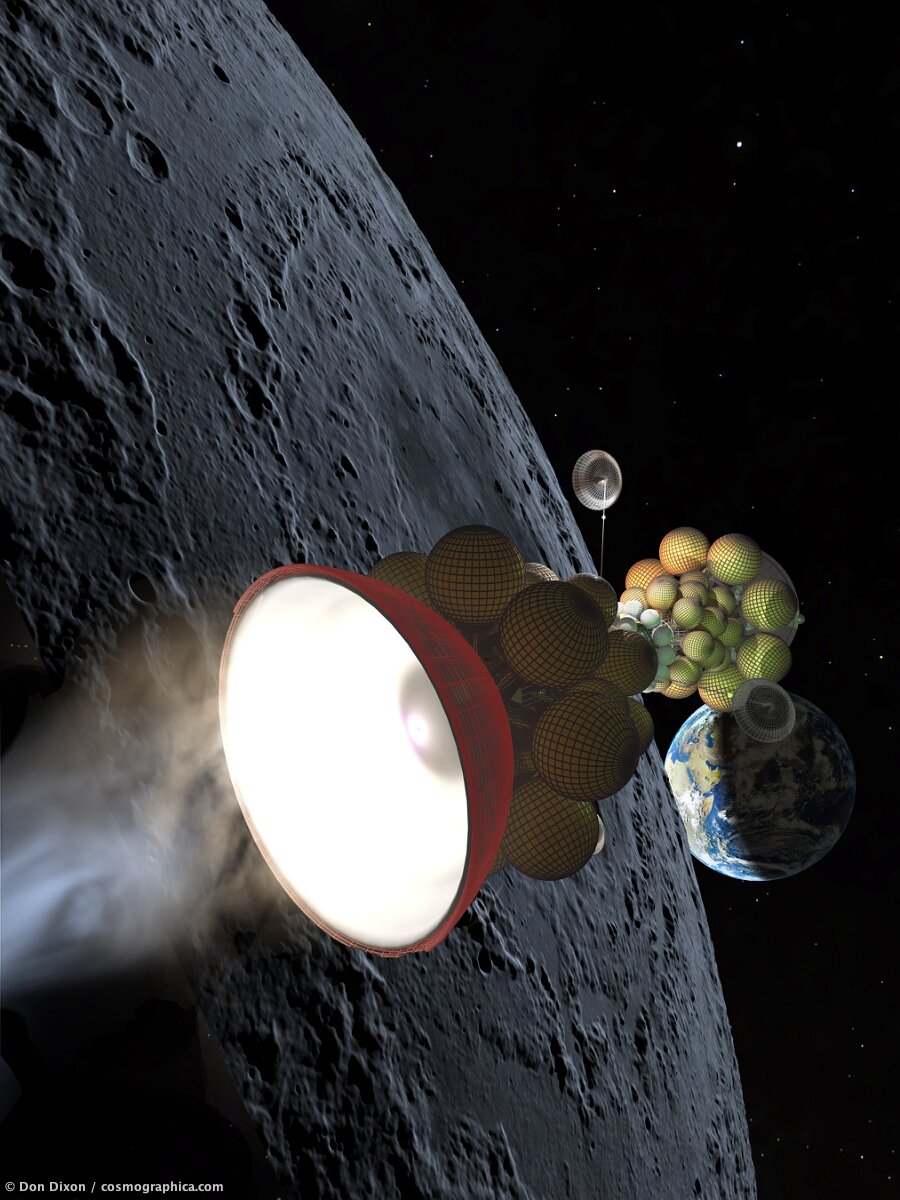
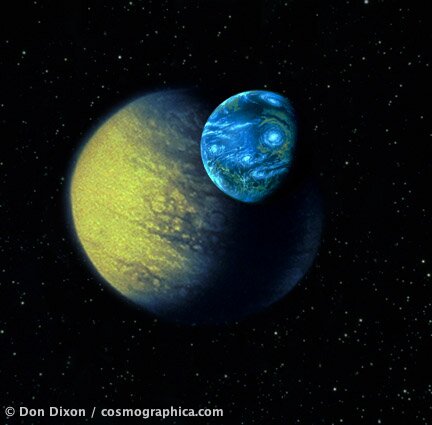
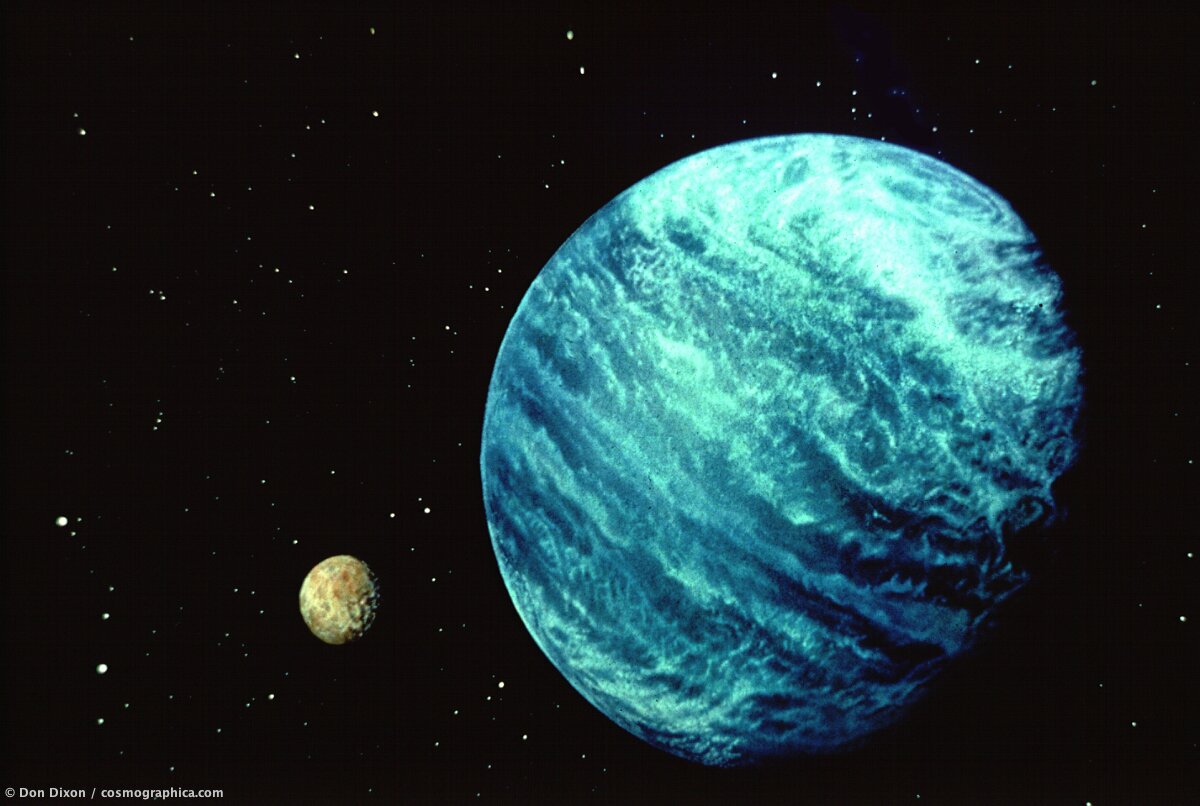
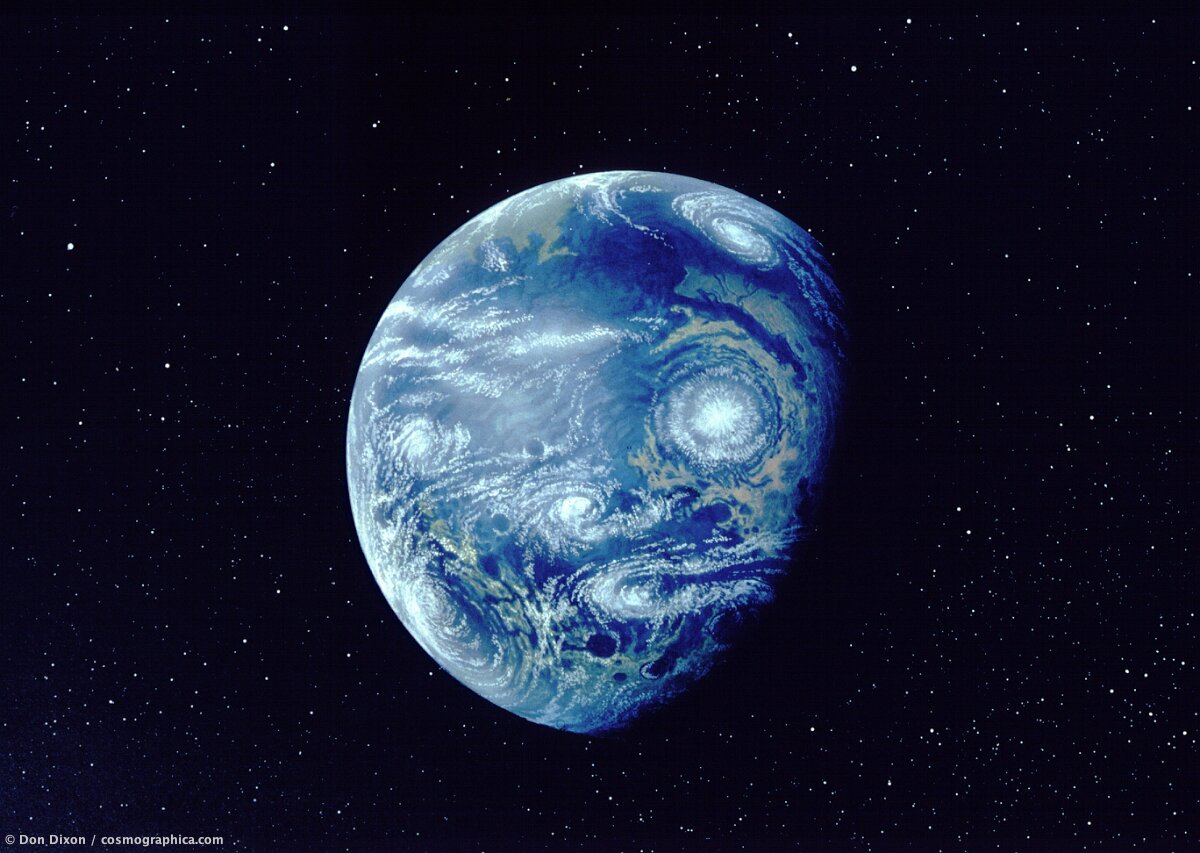
This illustration by Don Dixon depicts a large, banded gas giant planet partially eclipsed by a smaller, terrestrially active moon. The moon features a visible atmosphere with complex cyclonic cloud patterns and surface features suggestive of liquid oceans and continental masses. Both bodies are set against a dense starfield, with the gas giant exhibiting atmospheric turbulence and a distinct terminator line.
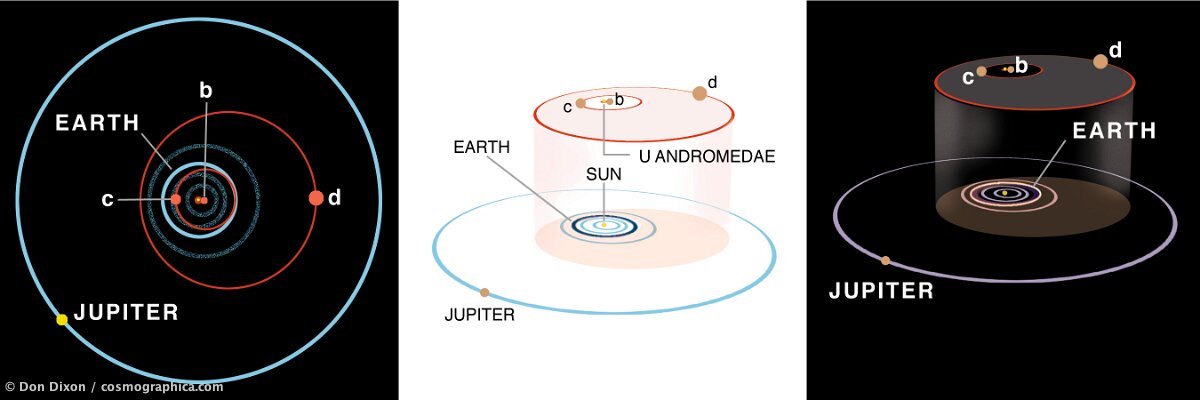
[368] Upsilon Andromedae Planetary System Comparison — This technical diagram, with illustration by Don Dixon, provides a comparative analysis between the Solar System and the extrasolar planetary system orbiting Upsilon Andromedae. The graphic utilizes three distinct perspectives—top-down, oblique wireframe, and high-contrast volumetric—to illustrate the orbital scales of planets b, c, and d relative to the orbits of Earth and Jupiter. The visualization highlights the compact nature of the inner Upsilon Andromedae system, where multiple high-mass planets reside within a distance comparable to Earth's orbital radius. ; painting by Don Dixon for Scientific American
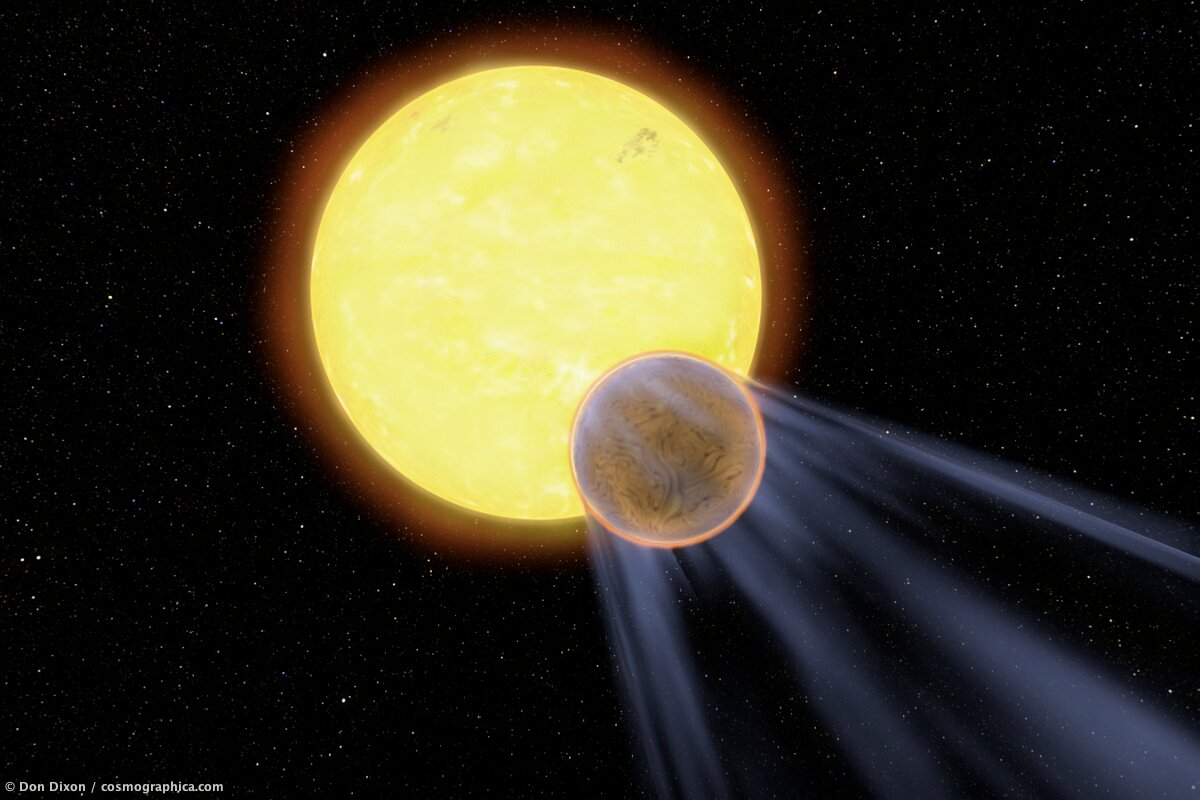
This illustration by Don Dixon depicts a "Hot Jupiter" exoplanet in extreme proximity to its host star. The planet’s atmosphere is shown undergoing hydrodynamic escape, forming a prominent cometary tail of ionized gas as it is buffeted by stellar radiation and solar winds. The gas giant exhibits intense atmospheric banding and heat-induced luminosity, while the primary star displays characteristic photospheric granulation and a vibrant corona. Digital painting © 2007 Don Dixon/cosmographica.com
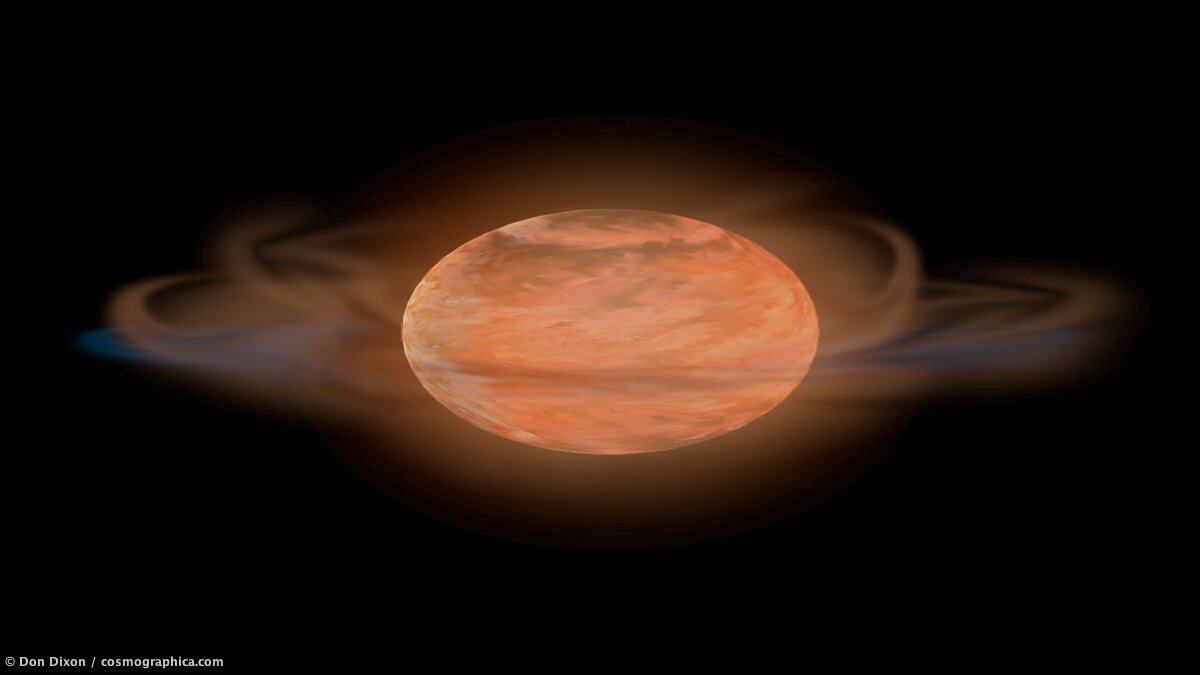
459-super-jovian-forming
[459] Super-Jovian Protoplanet —
This illustration by Don Dixon depicts a massive "Super-Jovian" planet in the late stages of formation within a circumplanetary disk. The central oblate body glows with internal heat from gravitational contraction, surrounded by a diffuse ring of accreting gas and dust. Swirling nebular structures suggest the conservation of angular momentum and the ongoing influx of material from the surrounding primordial environment. digital artwork for Scientific American 2007
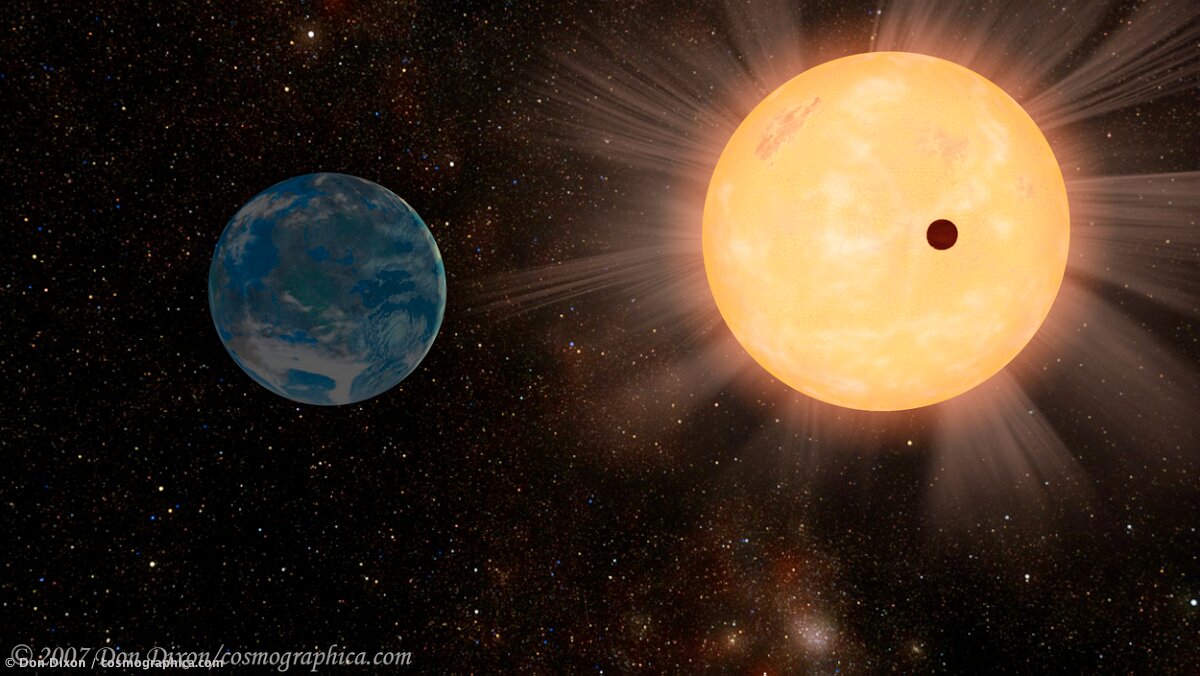
466-extrasolar-planet-Gliese581c-far-view
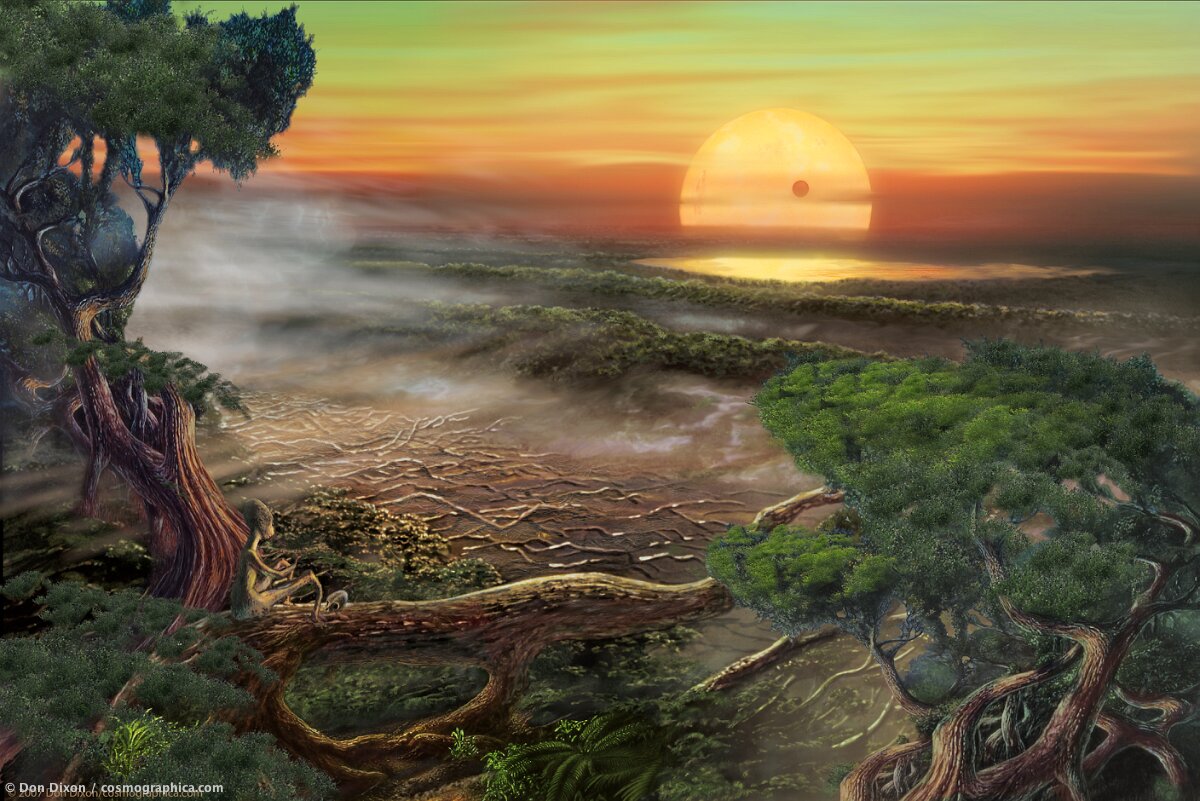
[466] Gliese 581 c and Gliese 581 System — This illustration by Don Dixon depicts the extrasolar planet Gliese 581 c as a terrestrial world with visible surface liquid and complex cloud cover, suggesting potential habitability. In the background, the red dwarf host star Gliese 581 dominates the frame, with another inner planet shown in transit across the stellar disk. The composition emphasizes the compact nature of M-dwarf planetary systems and the proximity of the habitable zone to the parent star.
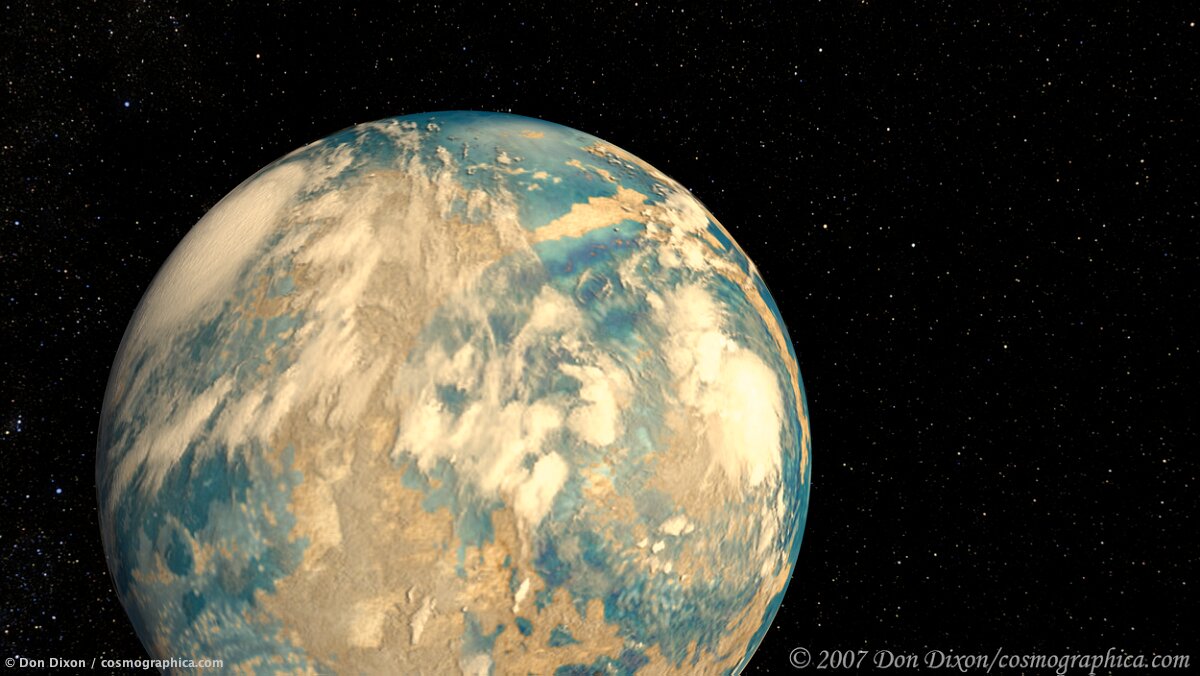
467-extrasolar-planet-Gliese581c-subsolar
If the planet is tidally locked, with the same face turned permanently toward its sun, any ocean near the subsolar point would likely simmer under a perpetual haze of steam. Weather patterns might tend to radiate from this equatorial teakettle. Digital artwork © 2007 Don Dixon / cosmographica.com
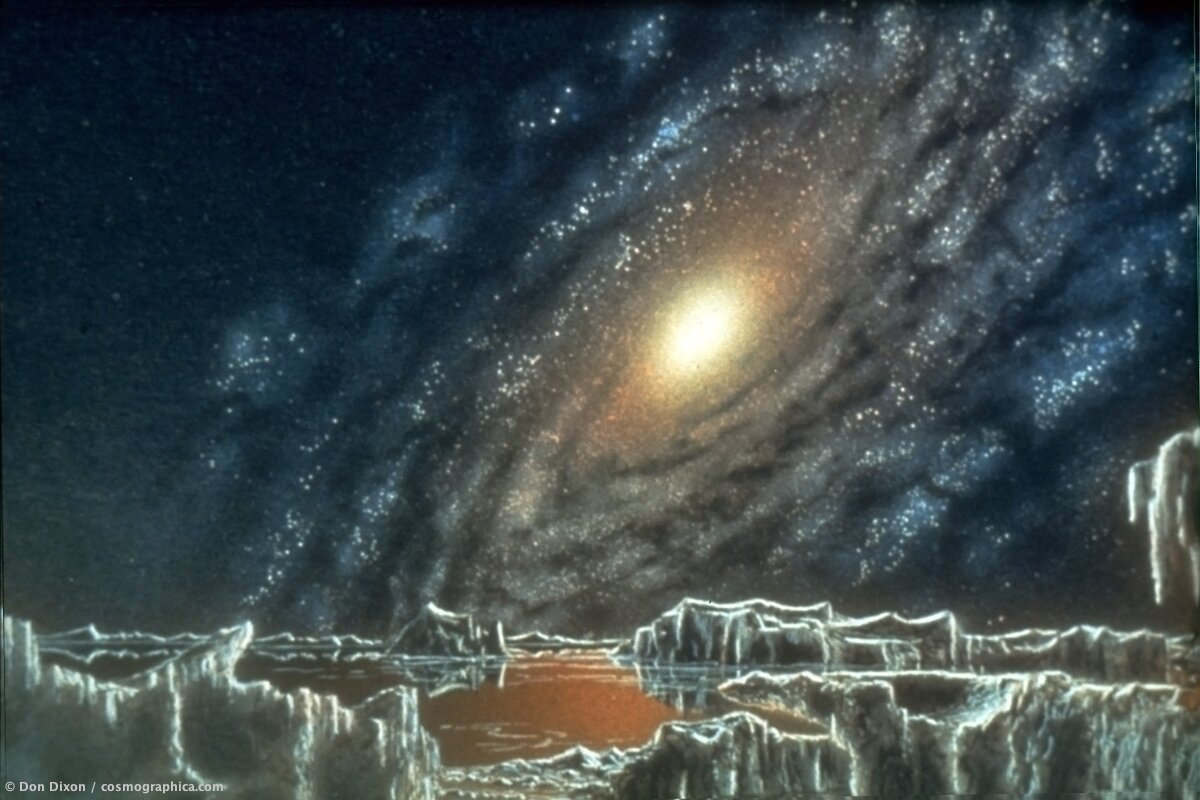
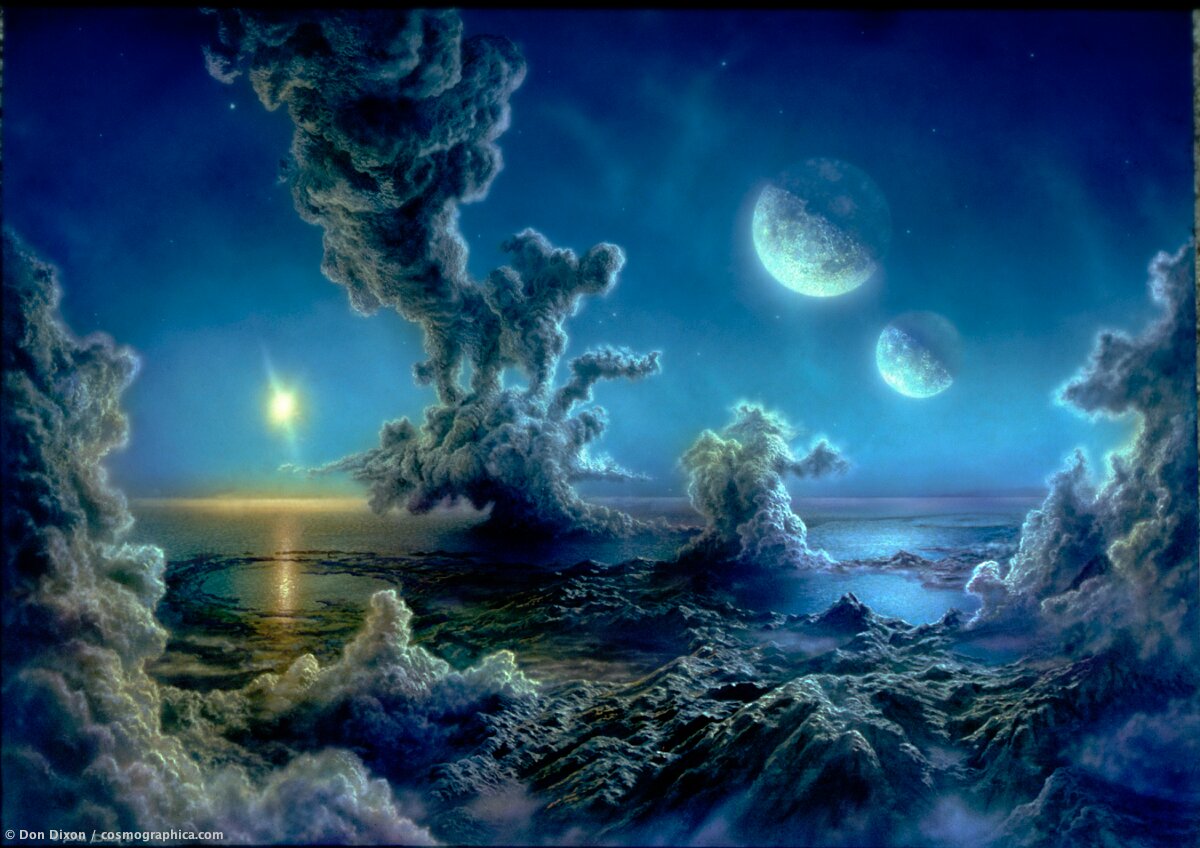
This scene depicts a perspective from the surface of a frozen planetary body, looking out toward a prominent spiral galaxy. The foreground is dominated by jagged icy formations and a reflective liquid or frozen plain, while the sky features a tilted galactic disk with a brilliant central bulge and distinct spiral arms rich in star clusters and dark dust lanes. The composition illustrates a deep-space vista emphasizing the scale of galactic structures as viewed from an external, high-latitude vantage point. Illustration by Don Dixon.
176-Ice-World-2
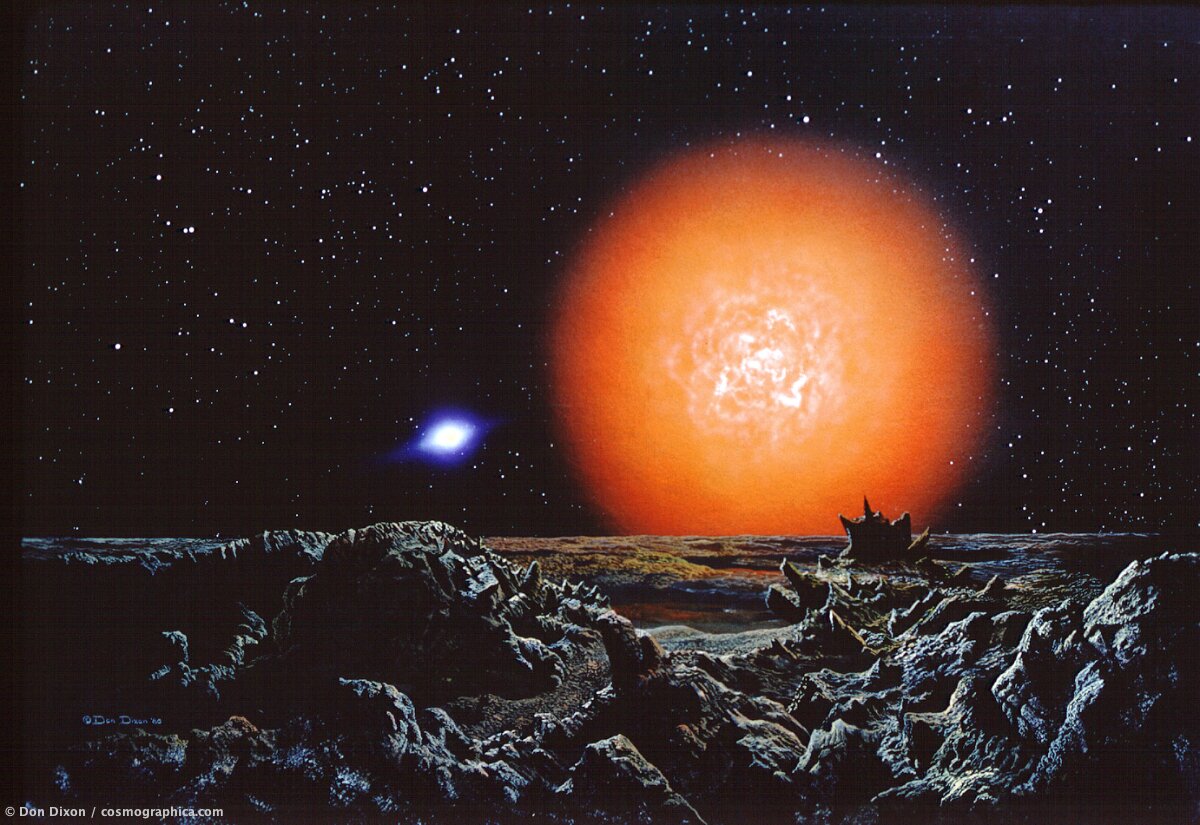
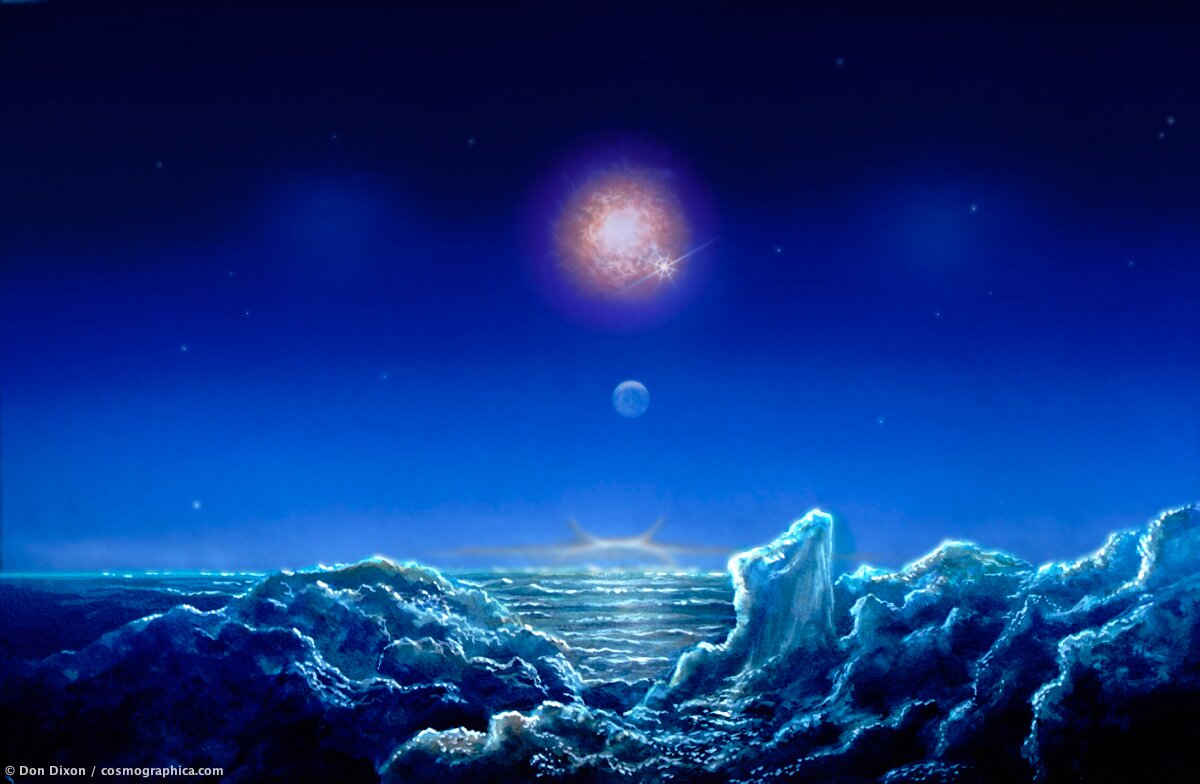
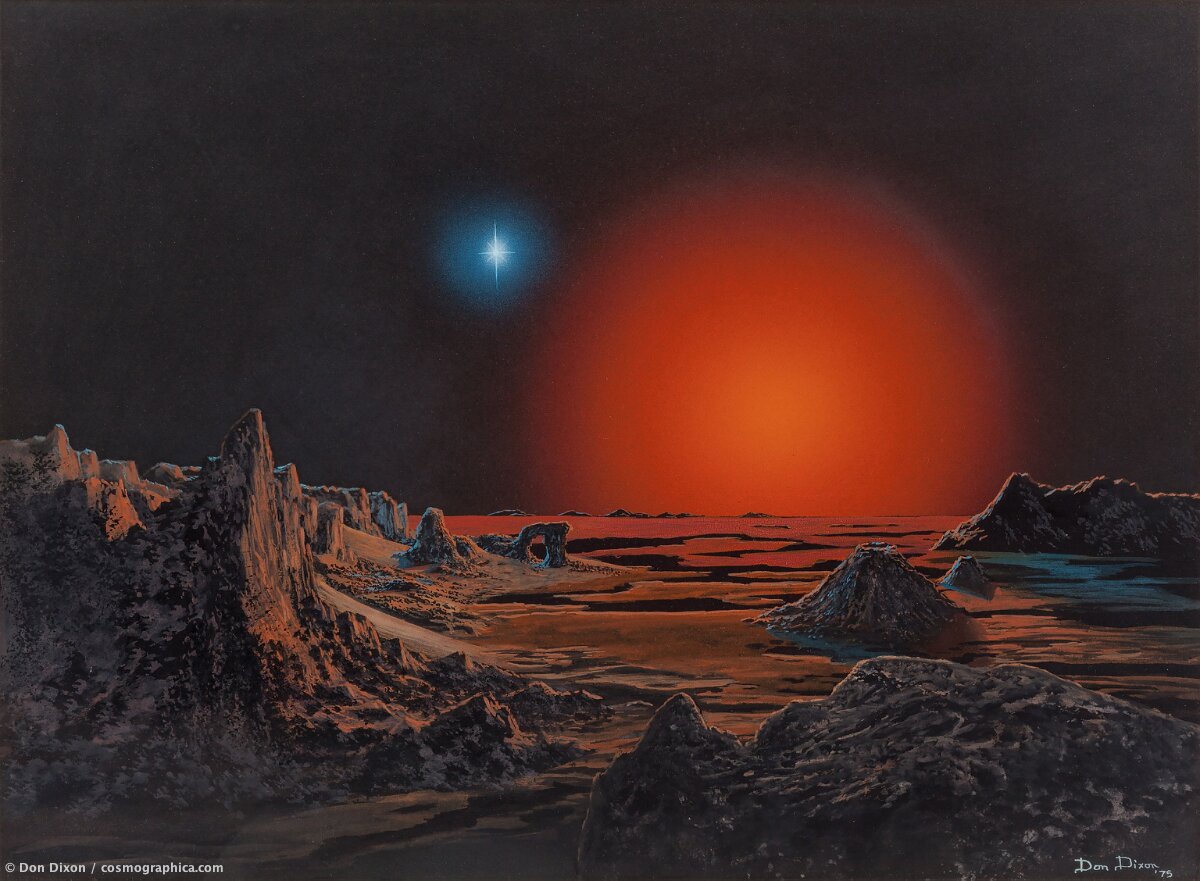
[176] Ice World 2 – A planet far from its red dwarf sun is eternally frozen. This illustration by Don Dixon depicts a nocturnal vista from the surface of a glaciated exoplanet or moon. The foreground consists of jagged, crystalline ice formations overlooking a dark, reflective sea, while the deep blue sky features a prominent binary star system consisting of a red giant and a bright, compact companion. A small, blue-tinted moon is positioned below the primary stars, and a faint, double-arched light phenomenon on the horizon suggests complex atmospheric refraction; acrylic and gouache on board, 1983
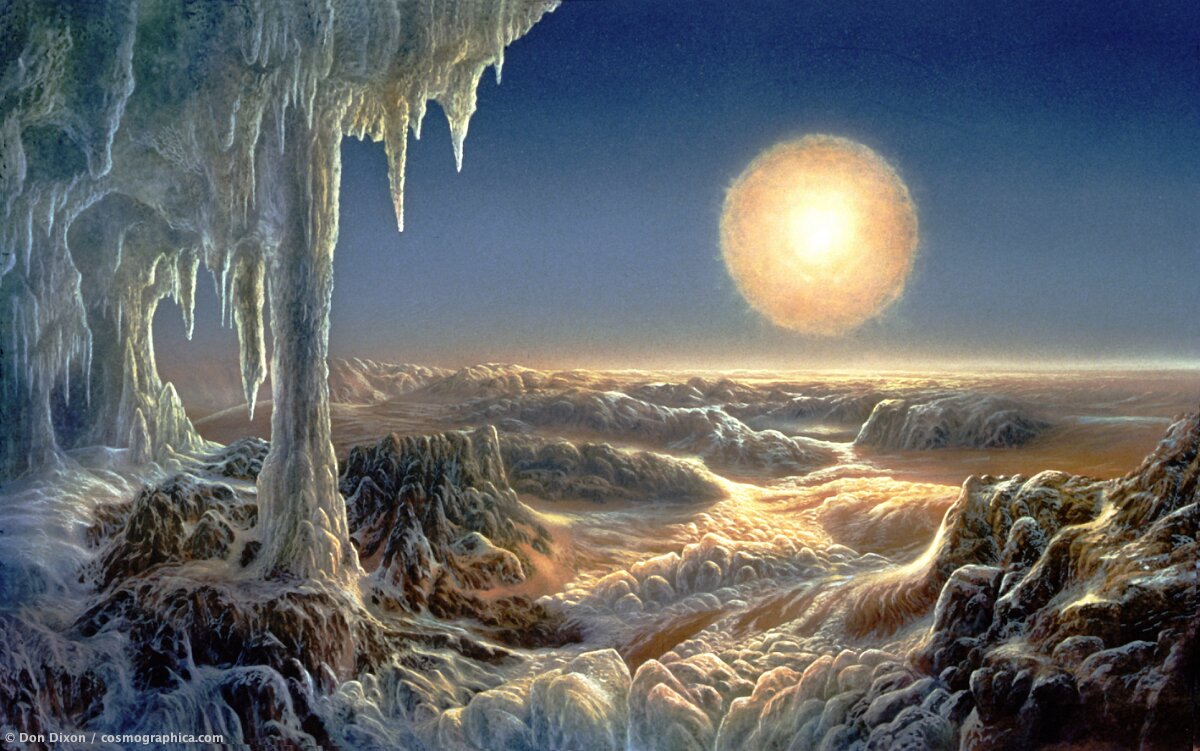
175-Ice-World-1
[175] Ice World 1 - a frozen planet of a red dwarf star glistens in its deceptively warm glow. This illustration by Don Dixon depicts the cryosphere of a hypothetical exoplanet situated at a significant distance from its host star. The foreground features an icy cavern with detailed stalactites and stalagmites, opening onto a vast, glaciated landscape of rolling ice hills and frozen terrain. A distant, pale sun hangs in a clear dark blue sky, providing weak illumination that reflects off the crystalline surfaces, illustrating the low-insolation conditions of an outer-system "ice world." acrylic and gouache on board, 1982
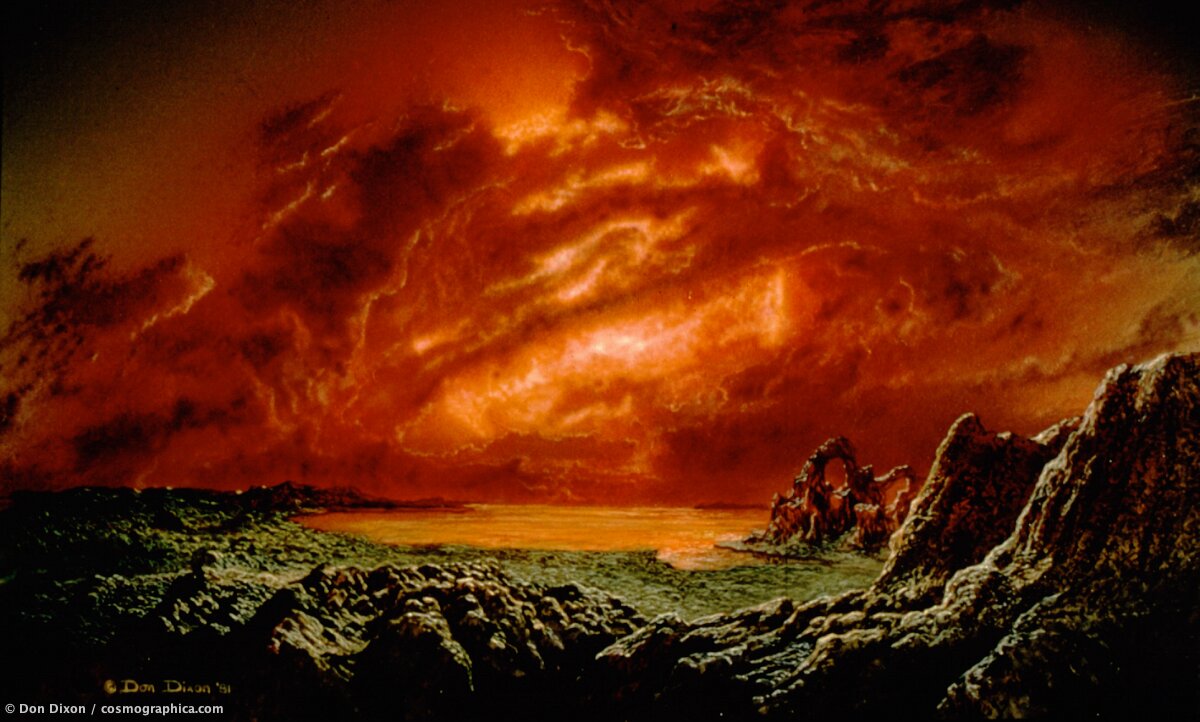
171-Barnards-Star
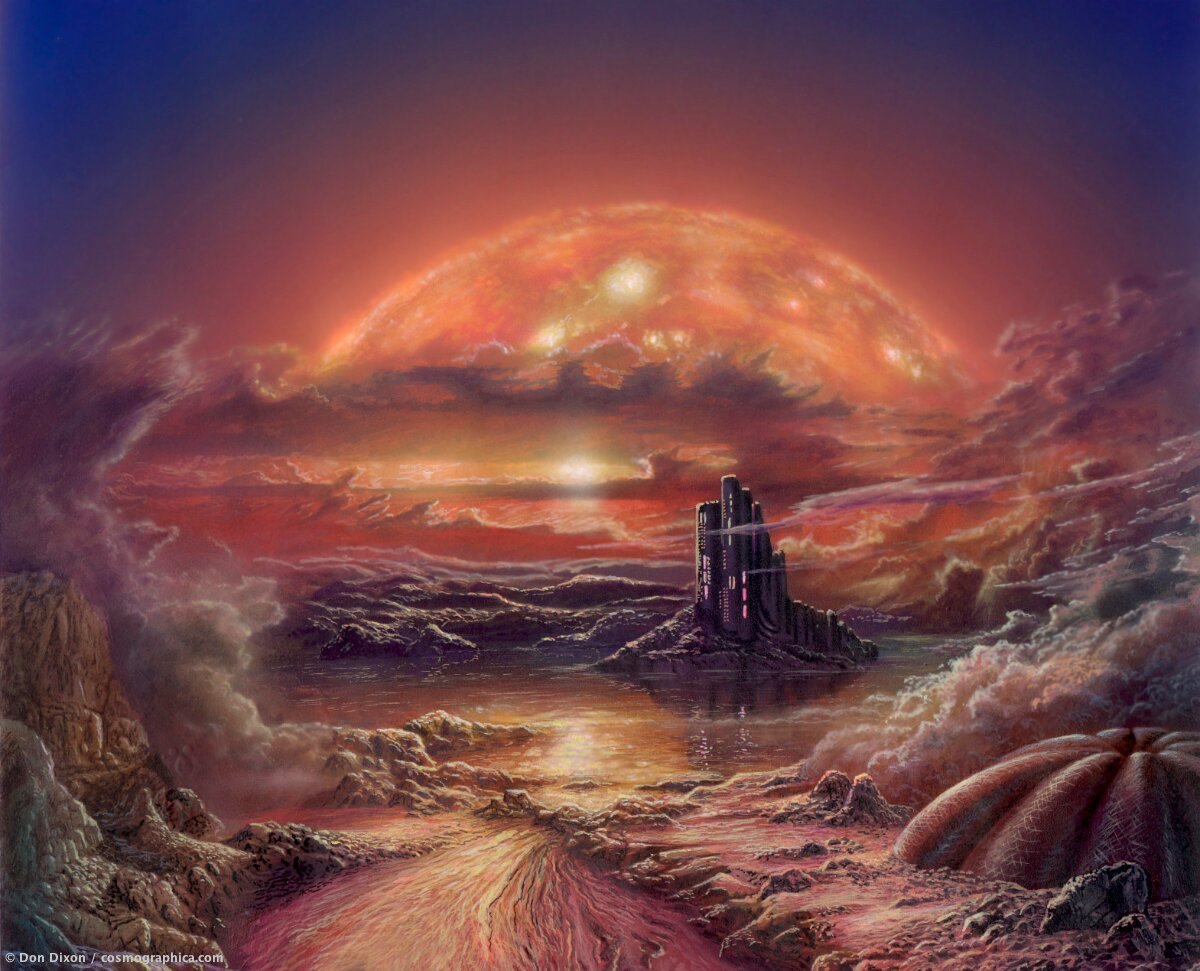
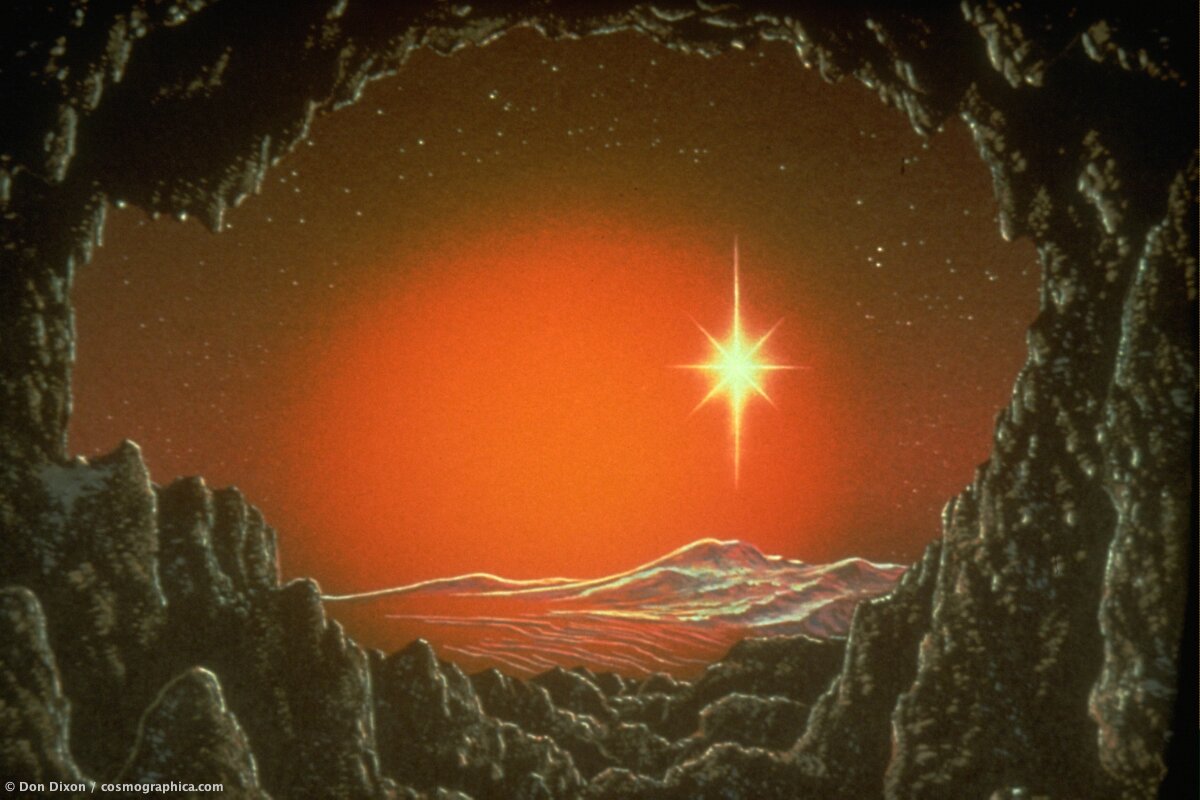
[171] Barnard's Star - 6 light years away, might serve as a dim orange sun for a family of planets. This illustration by Don Dixon presents a surface view from a hypothetical planet orbiting Barnard's Star, a low-mass red dwarf. The composition features a rugged, rocky terrain in the foreground overlooking a calm body of water, while the sky is dominated by dense, turbulent orange-red clouds illuminated by the star's low-energy output. The scene reflects the scientific speculation of the era regarding the "wobble" of Barnard's Star and the potential for a planetary system within the habitable zone of an M-class main-sequence star. © Don Dixon, featured in Omni Magazine
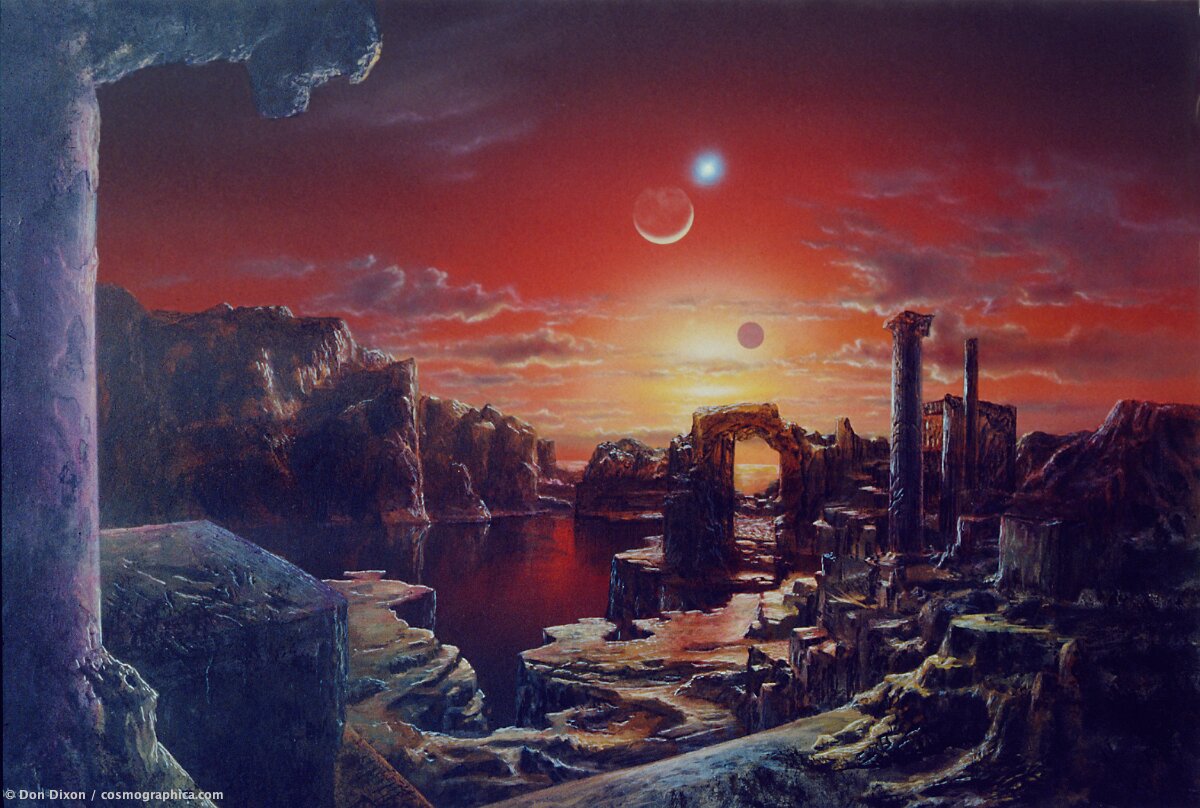
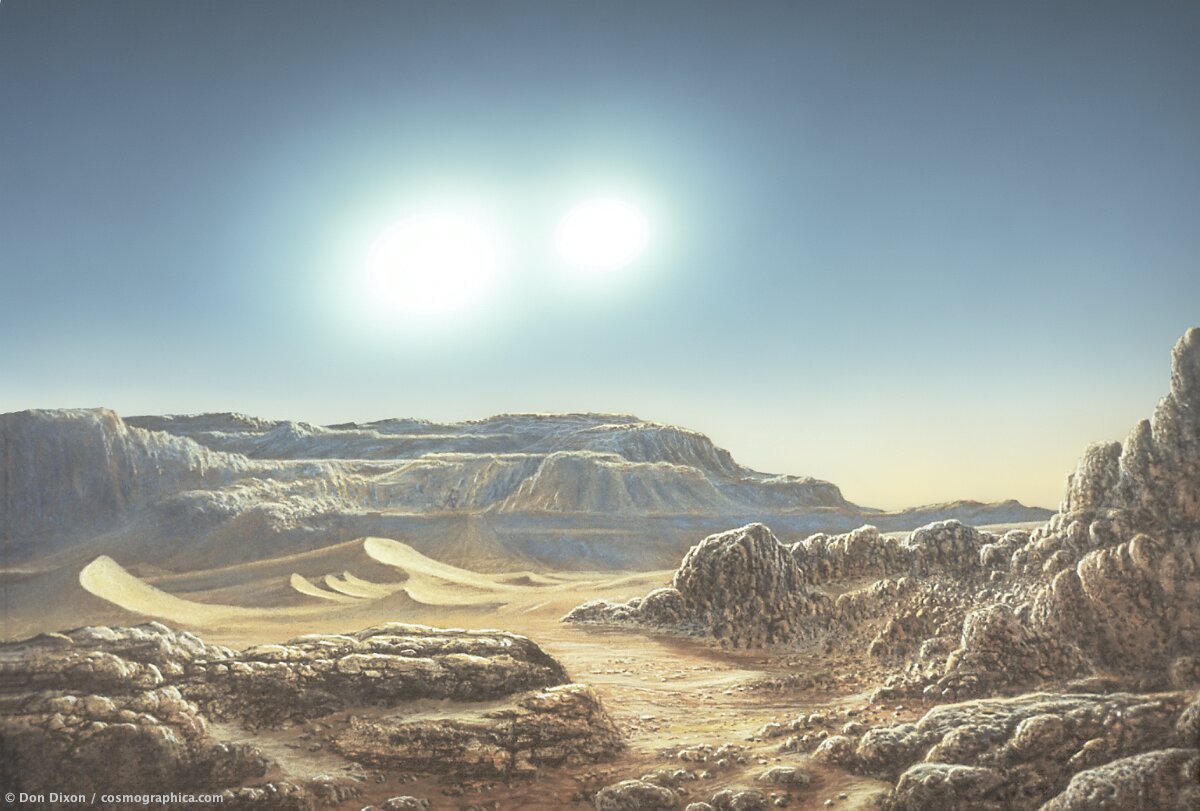
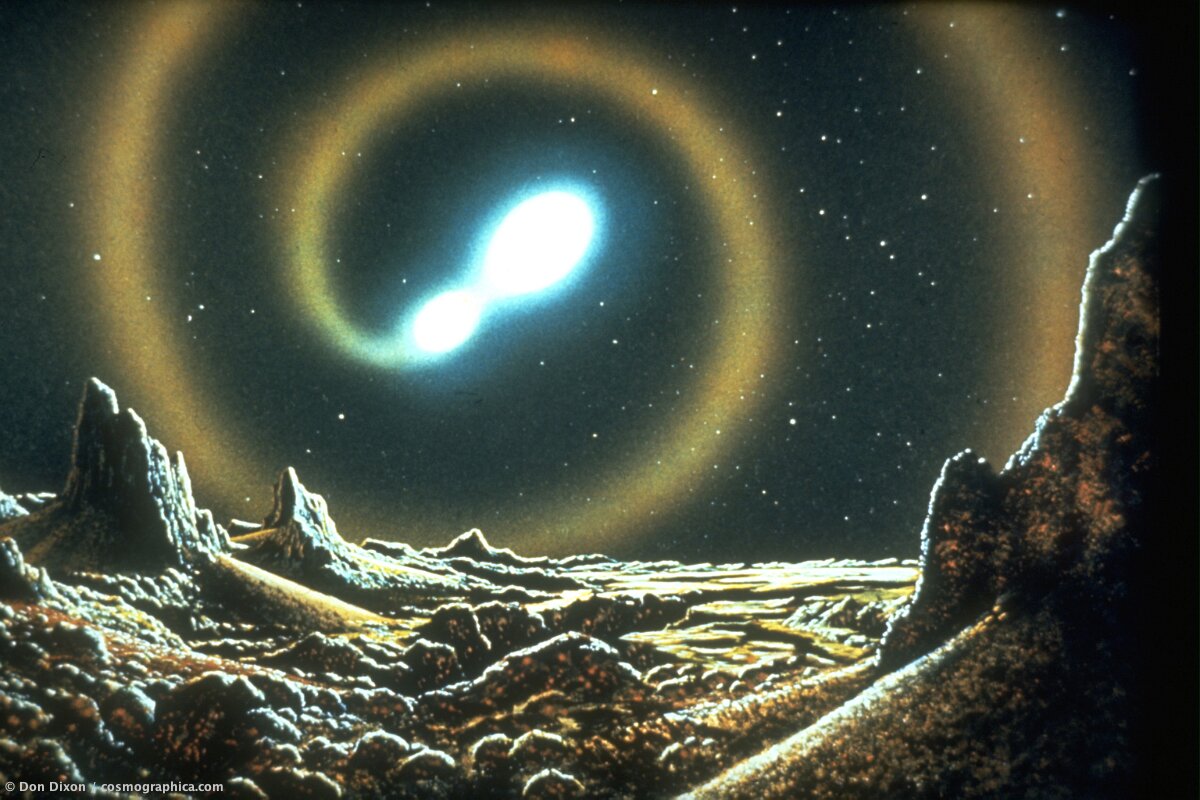
This artwork presents a vista from a circumbinary planet, featuring two closely paired sun-like stars suspended in a pale, hazy sky. The arid landscape consists of weathered, rocky outcroppings in the foreground, rolling sand dunes in the mid-ground, and distant sedimentary plateaus. The lighting conditions suggest a high-noon phase where the combined luminosity of the binary pair flattens the topography of the desert environment. Illustration by Don Dixon. gouache on illustration board, 1976 © Don Dixon
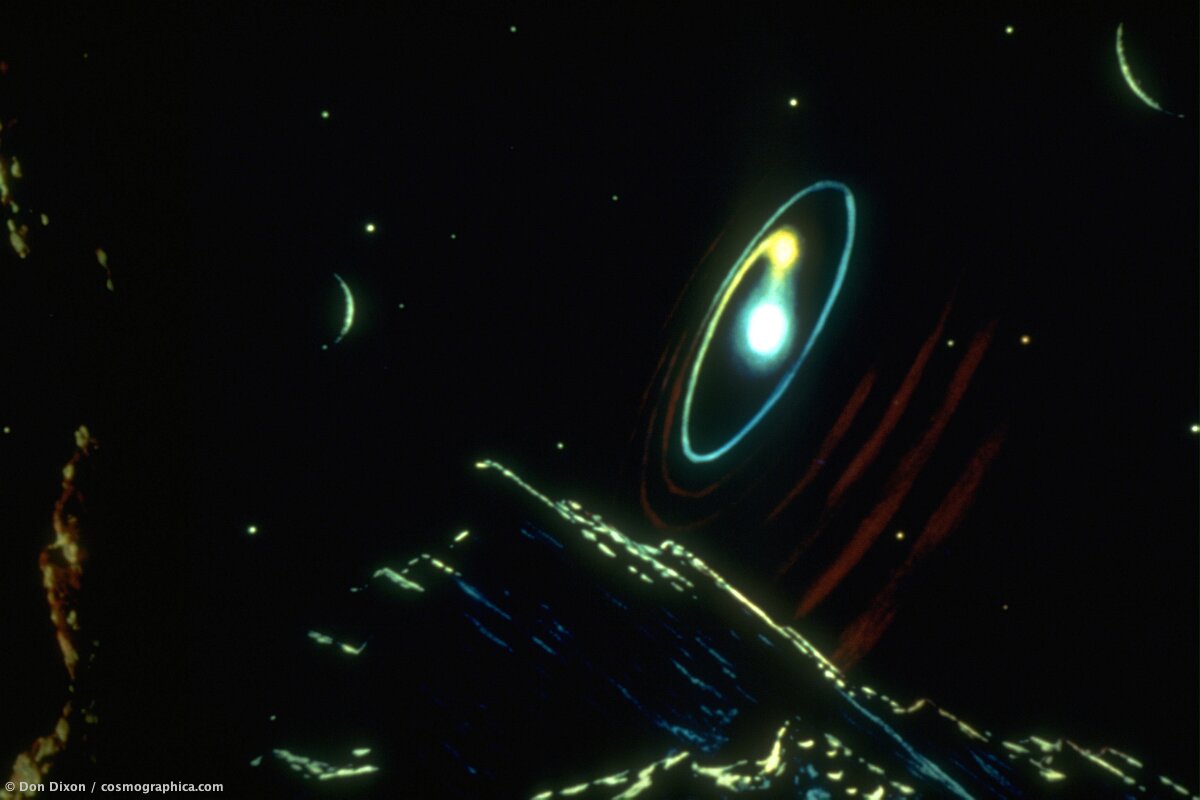
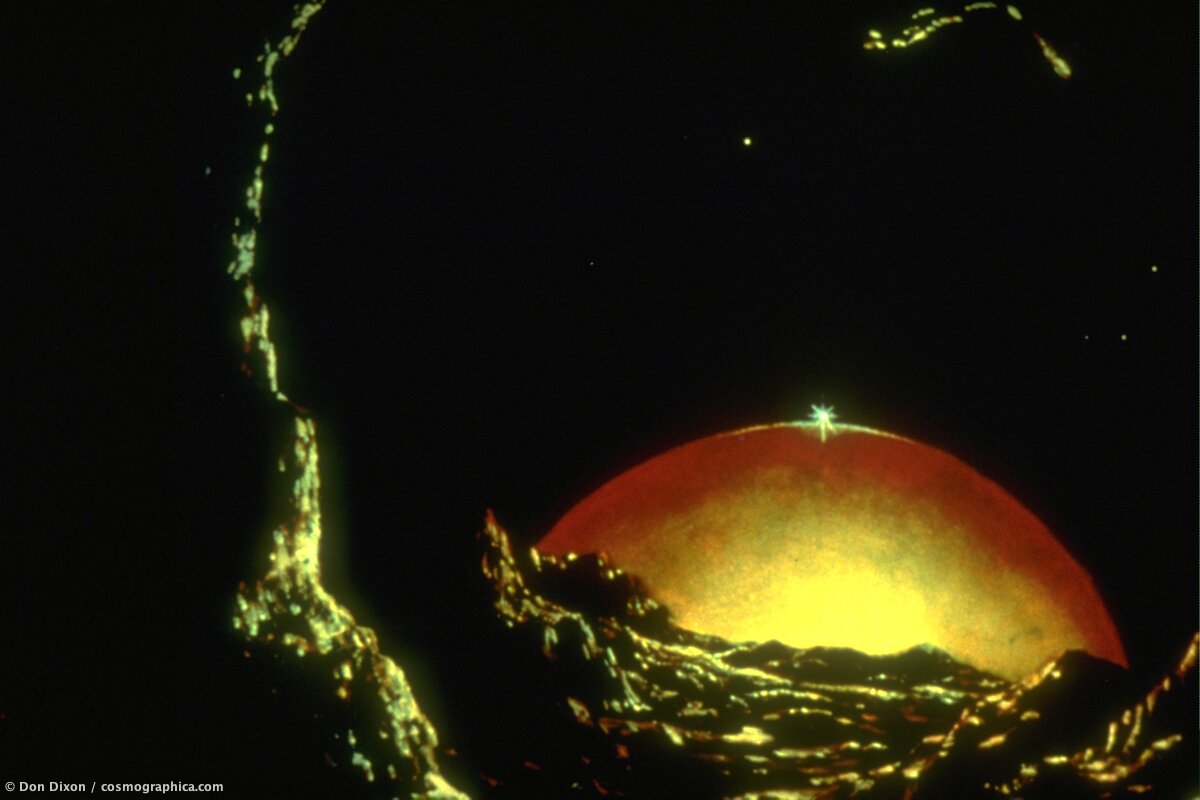
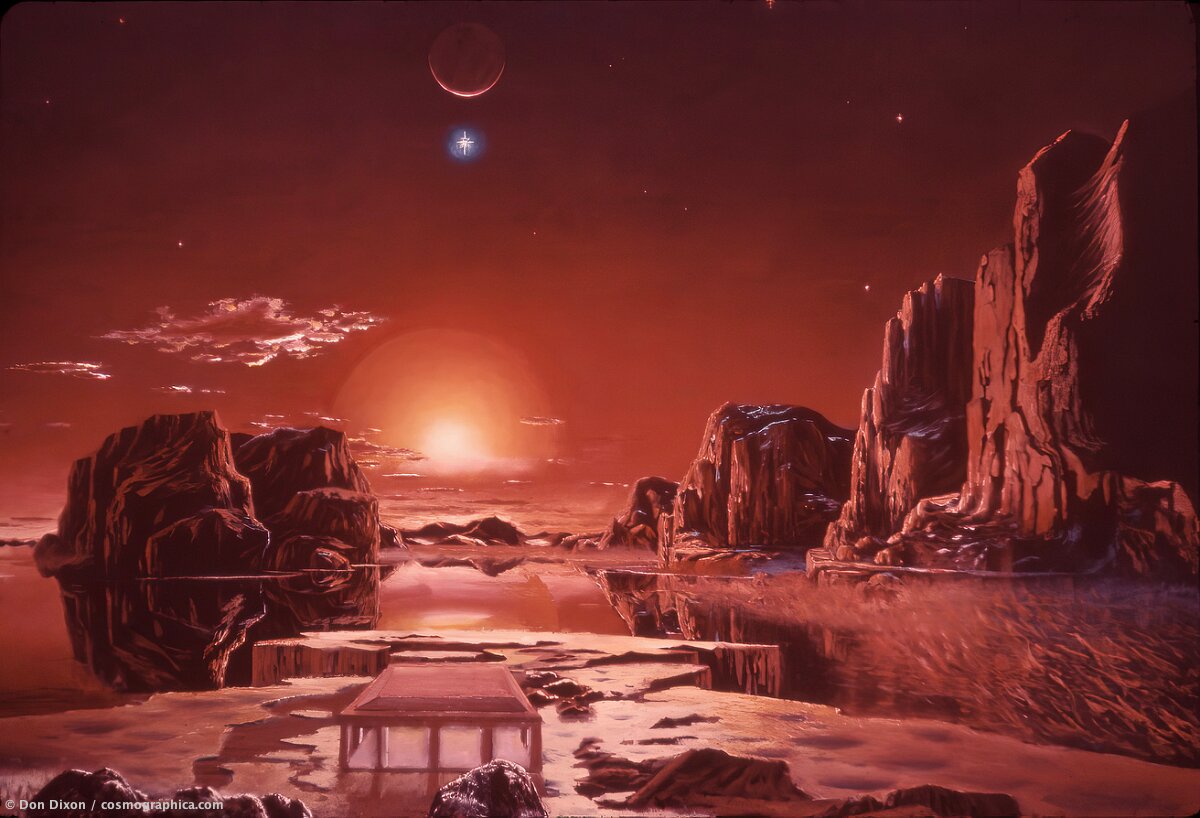
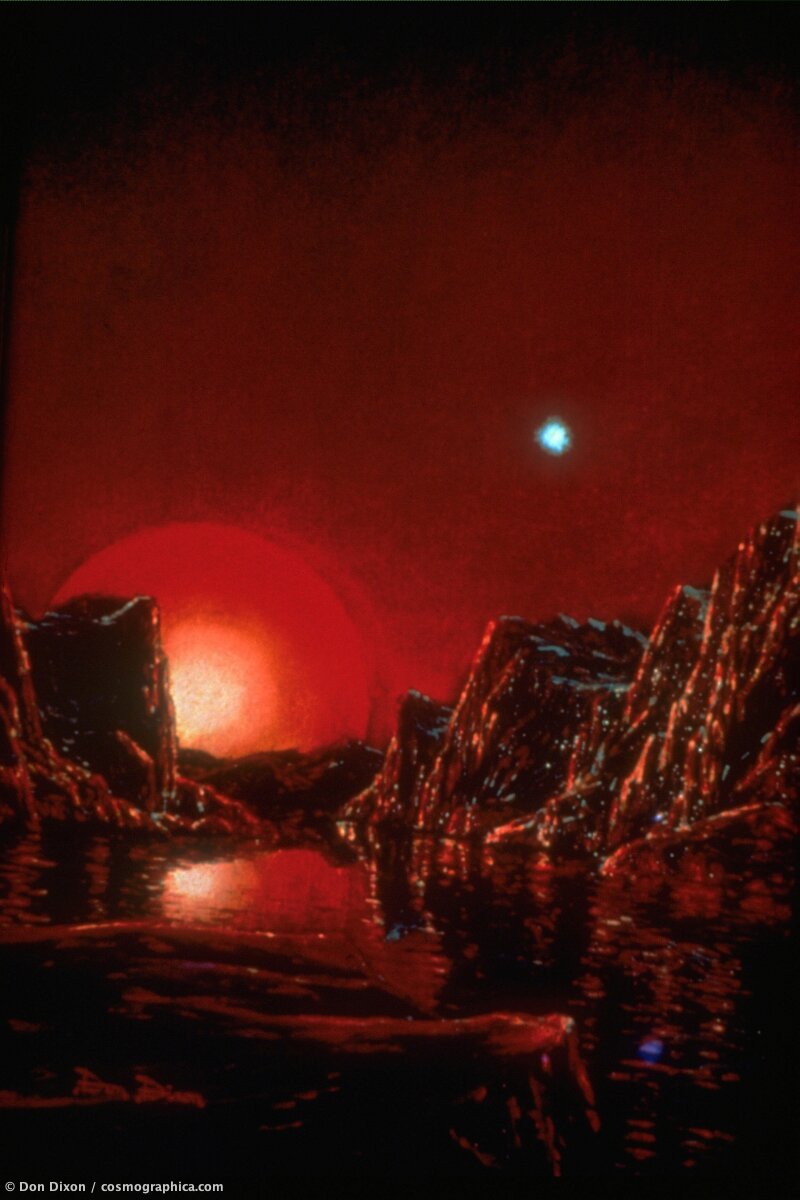
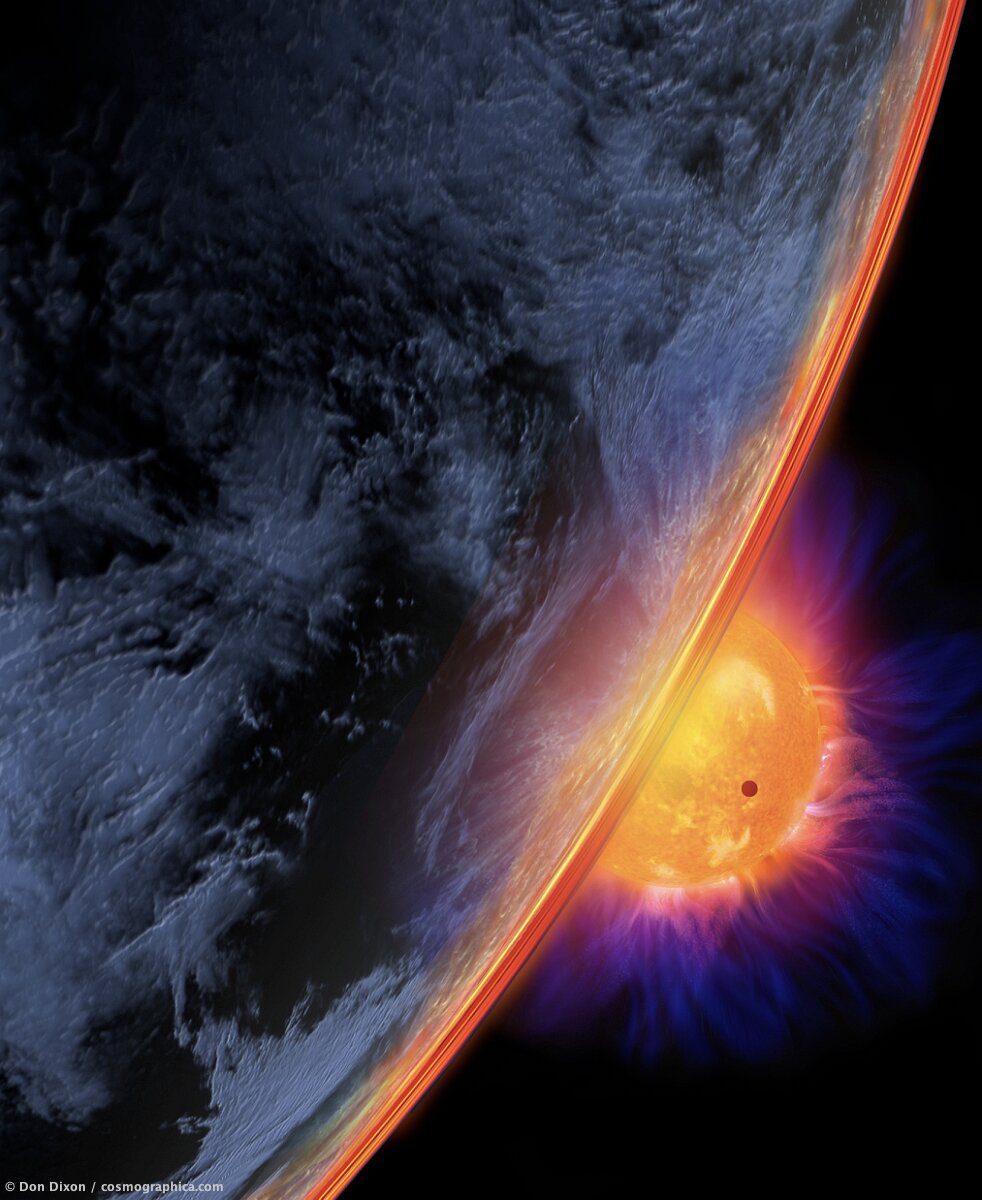
This orbital perspective features a "Super-Earth" exoplanet with a complex, cloud-filled atmosphere shown in high relief against the blackness of space. A distant star is partially eclipsed by the planetary limb, creating a vivid atmospheric ring through refraction and scattering, while a secondary, smaller planetary body is seen in transit across the stellar disk. The star exhibits significant activity, including a visible corona and surrounding nebulosity or ionization, emphasizing the high-energy environment of the system. Illustration by Don Dixon for Sky and Telescope Copyright 2011 Don Dixon cosmographica.com
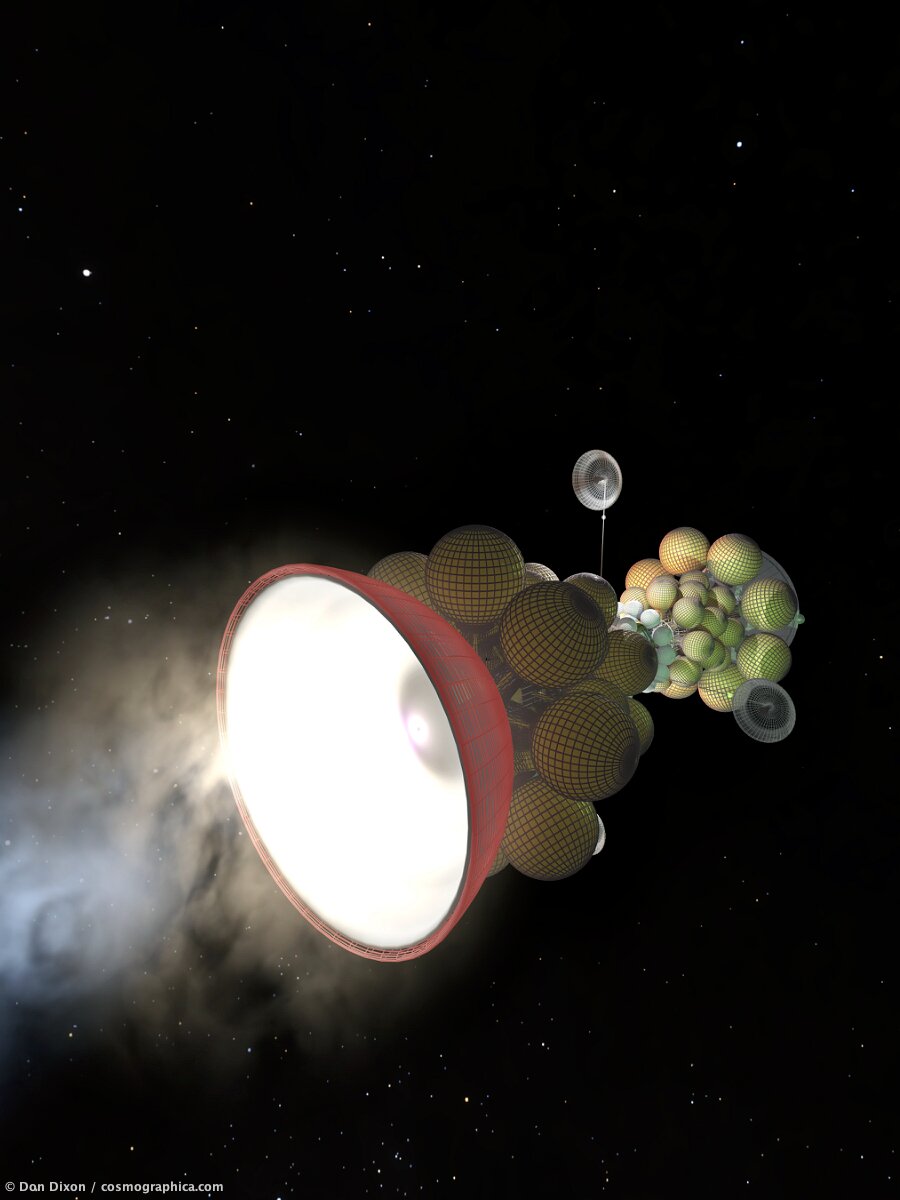
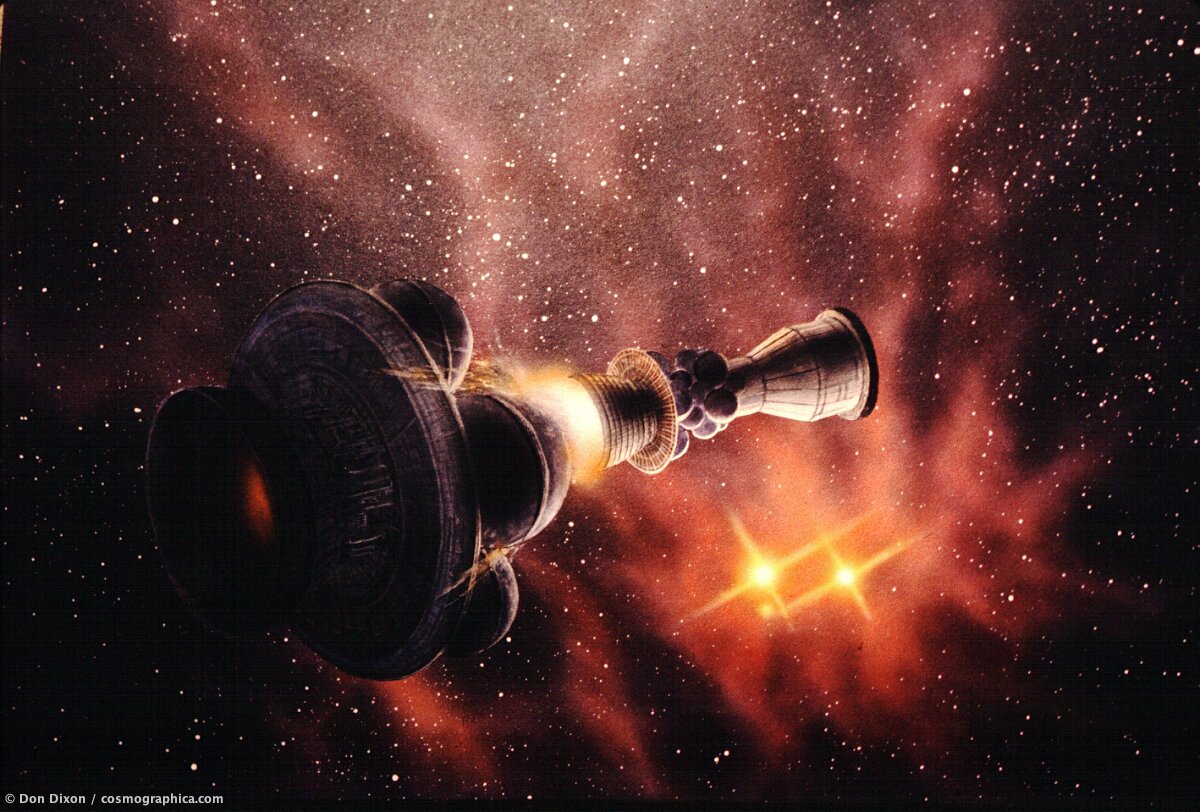
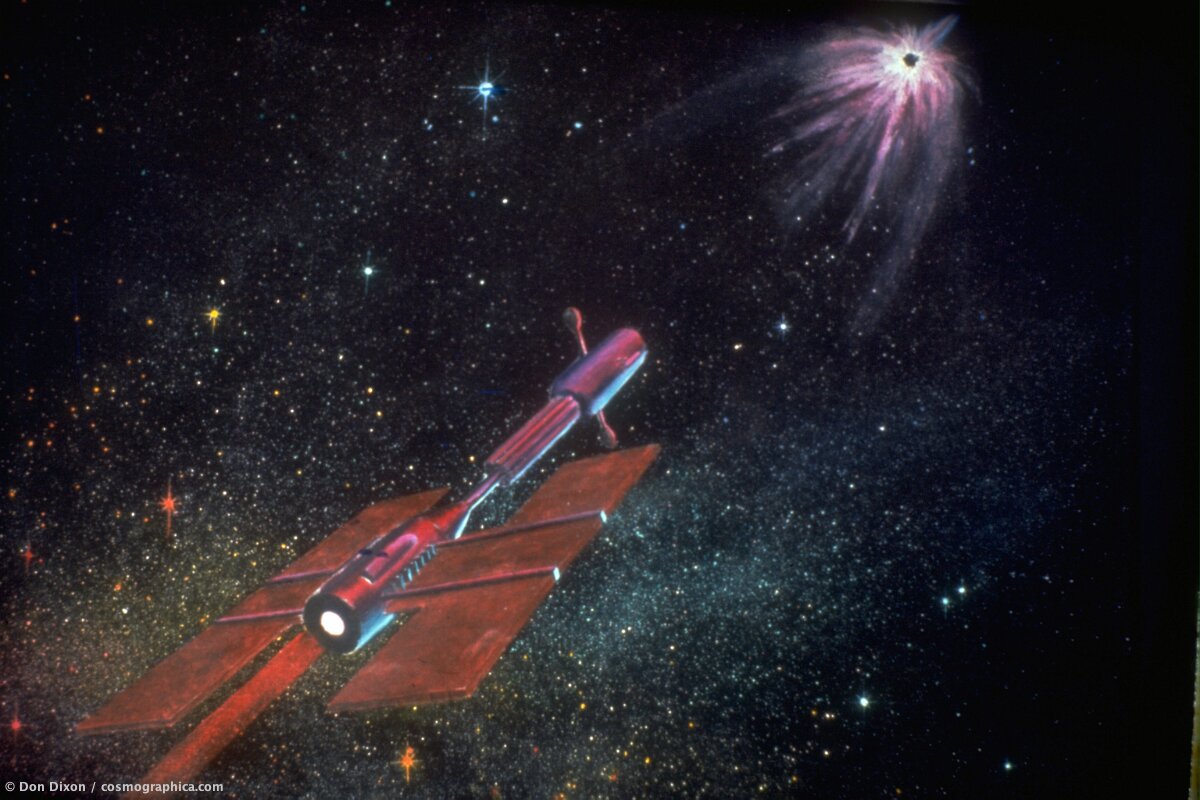
This technical rendering depicts the Project Daedalus starship, a theoretical interstellar spacecraft designed for high-velocity travel via nuclear pulse propulsion. The illustration highlights the massive primary engine bell emitting a brilliant fusion exhaust, followed by the distinctive multi-stage propellant tanks arranged in a clustered configuration. The vessel is shown in deep space, oriented for an interstellar cruise phase, with its secondary communication arrays and science instrument booms extended. Illustration by Don Dixon.. The engine, capable of producing 0.01 gravity acceleration, boosts the ship to 10 percent the speed of light after ten years of thrust. © Don Dixon
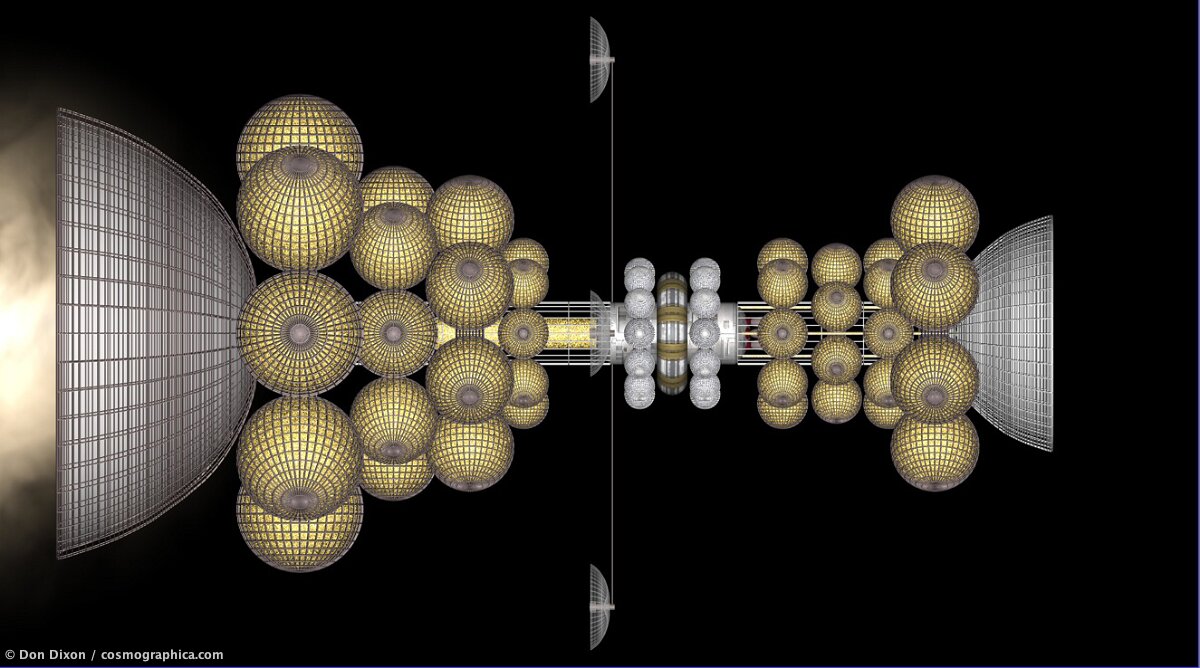
starship plan
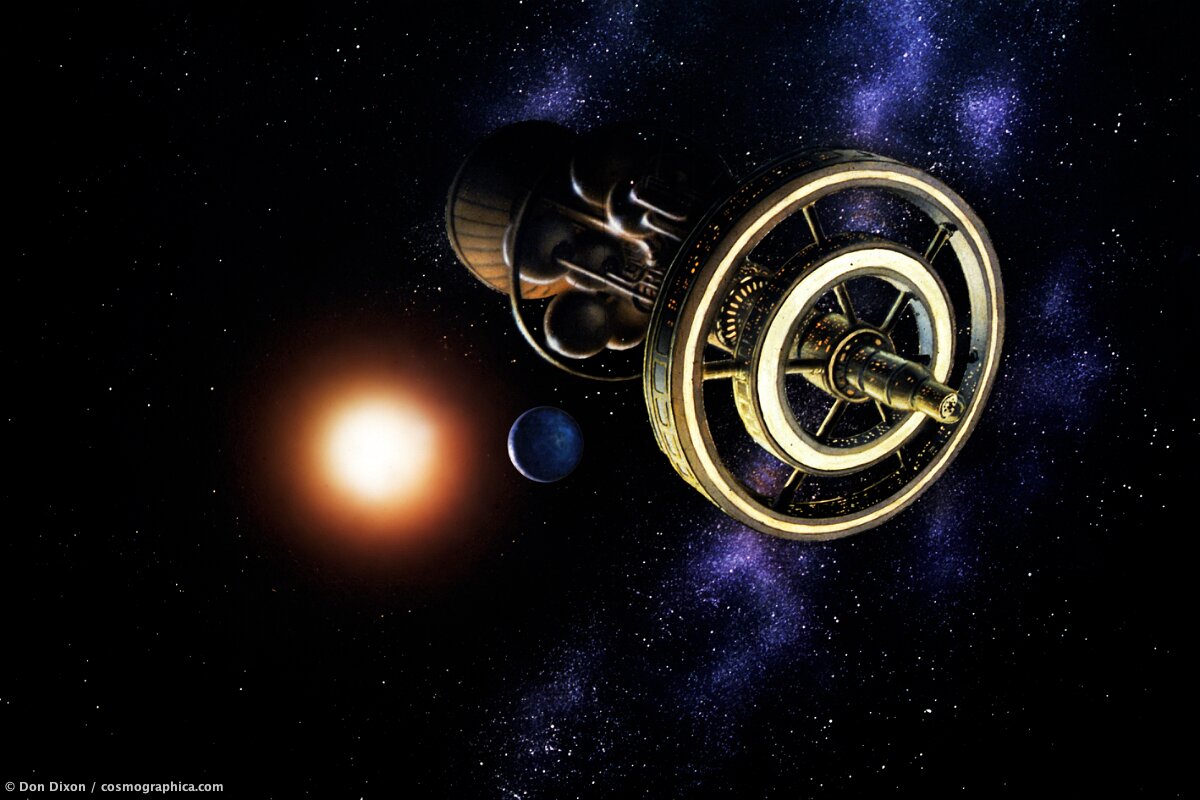
[493] Interstellar Ship Diagram –A starship 10 miles long, capable of reaching the nearest star, Alpha Centauri, is depicted in this illustration created for the July, 2012 issue of Astronomy Magazine. To eliminate the structural stress and high-velocity ablation of interstellar gas and dust during tthe deceleration phase, the ship is designed so no turnaroung maneuver is necessary. The central torus is the "seed" of this vessel, rotating at 1 revolution per minute to create centrifugal gravity for the travelers.
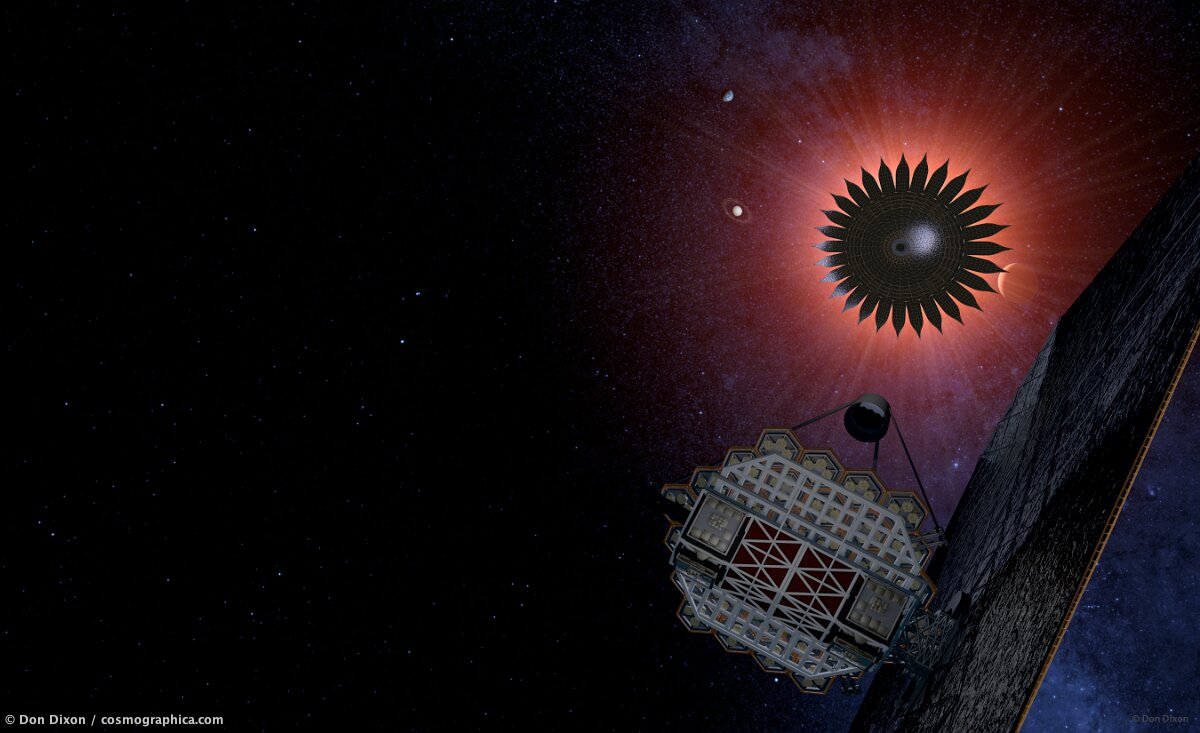
502-high-definition-space-telescope-starshade
[502] High Definition Space Telescope Starshade —
This orbital view depicts a segmented-mirror space telescope utilizing a flower-shaped external occulter (starshade) to perform direct imaging of a distant planetary system. The starshade is positioned to suppress the glare of the primary star, revealing multiple orbiting exoplanets, including a terrestrial-type world and a ringed gas giant. The composition highlights the structural detail of the telescope's secondary mirror assembly and sunshield, set against a rich background of the Milky Way's galactic plane. Illustration by Don Dixon.; digital, copyright Don Dixon 2016
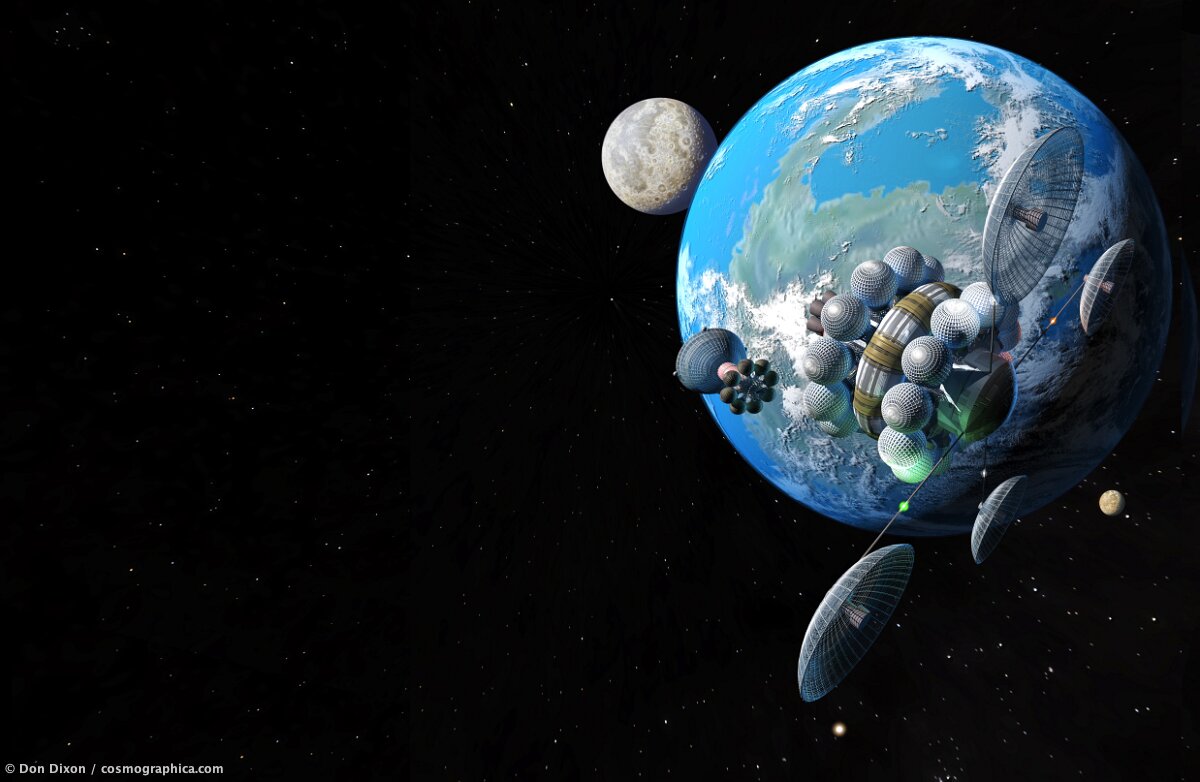
489-starship-arrives-alpha-centauri-1b
[489] Starship Arrives Alpha Centauri 1b —
This orbital composition presents a variation of the Project Daedalus arrival sequence, featuring the second-stage probe close to a terrestrial exoplanet and its large, cratered natural satellite. The spacecraft is depicted with its hexagonal payload modules and high-gain mesh antennas deployed for data transmission as it executes a flyby of the habitable-zone world. The presence of multiple moons and a richly detailed planetary atmosphere emphasizes the complex celestial mechanics of this extrasolar system. . Interior illustration for Astronomy Magazine, July 2012. © Don Dixon
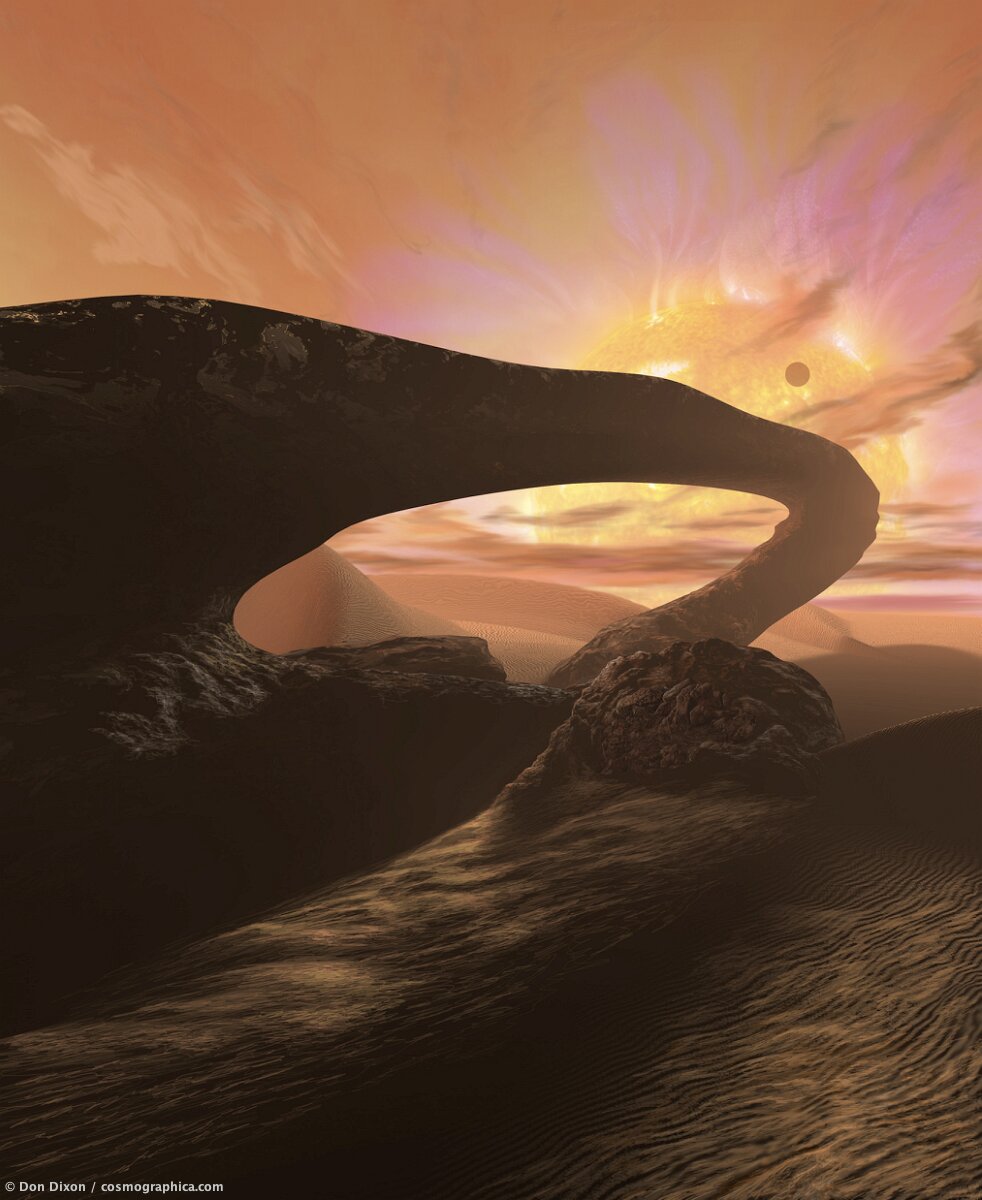
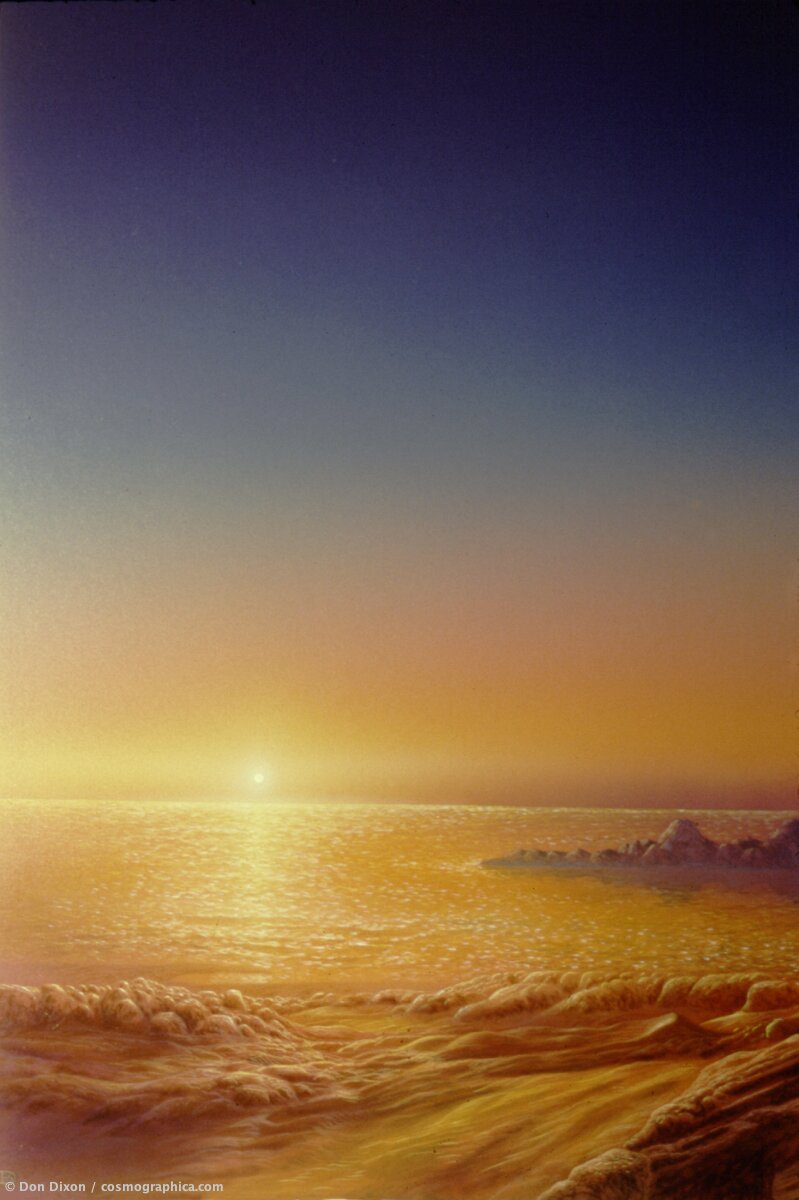
This artwork illustrates a sunset on an extrasolar planetary surface, featuring a distant sun-like star descending toward a vast liquid horizon. The foreground depicts a textured, rocky coastline with evidence of wave action or sedimentation, while the atmosphere exhibits a smooth vertical gradient from deep indigo to warm orange, suggesting Rayleigh scattering within a thick atmosphere. The star's reflection creates a distinct glitter path across the surface of the planetary ocean. Illustration by Don Dixon. detail from cover art for "Fire Sanctuary"
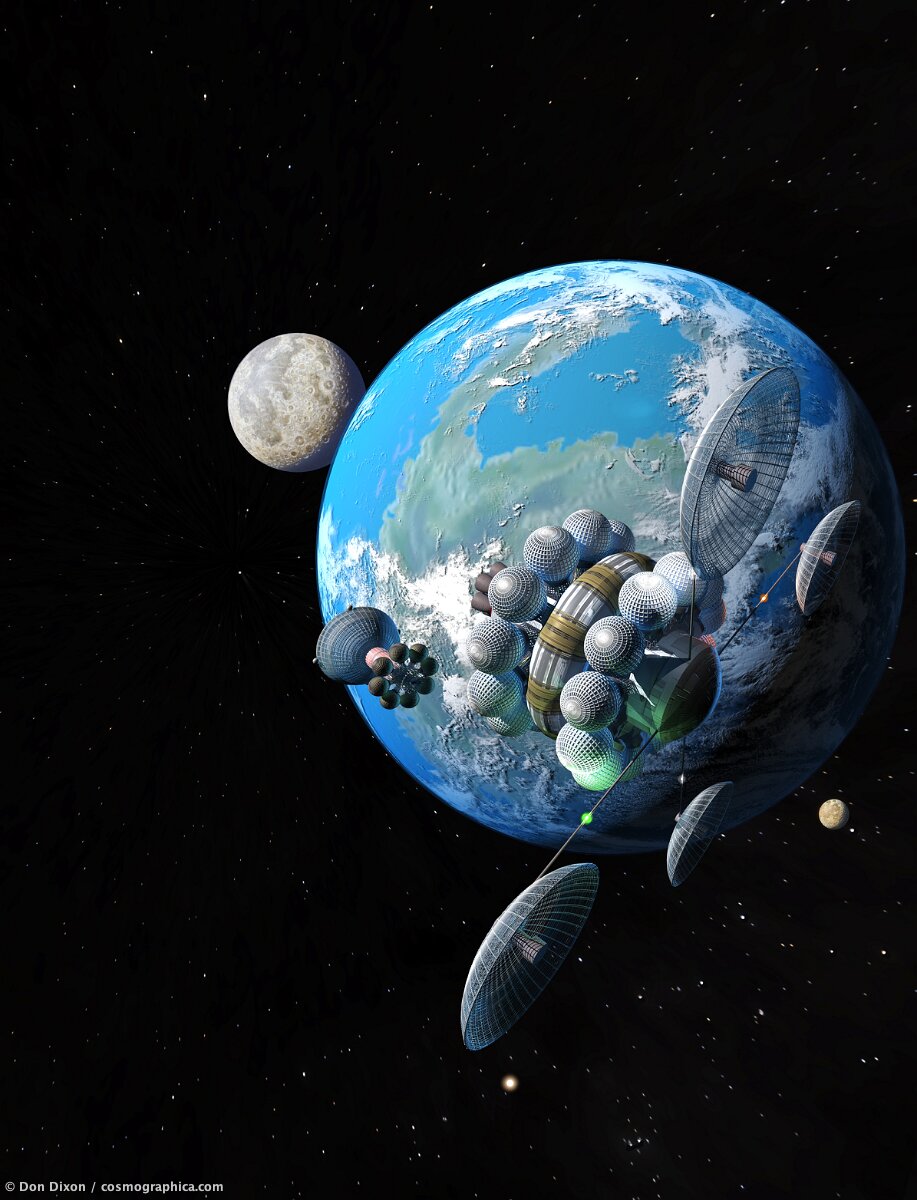
489-starship-arrives-alpha-centauri-1
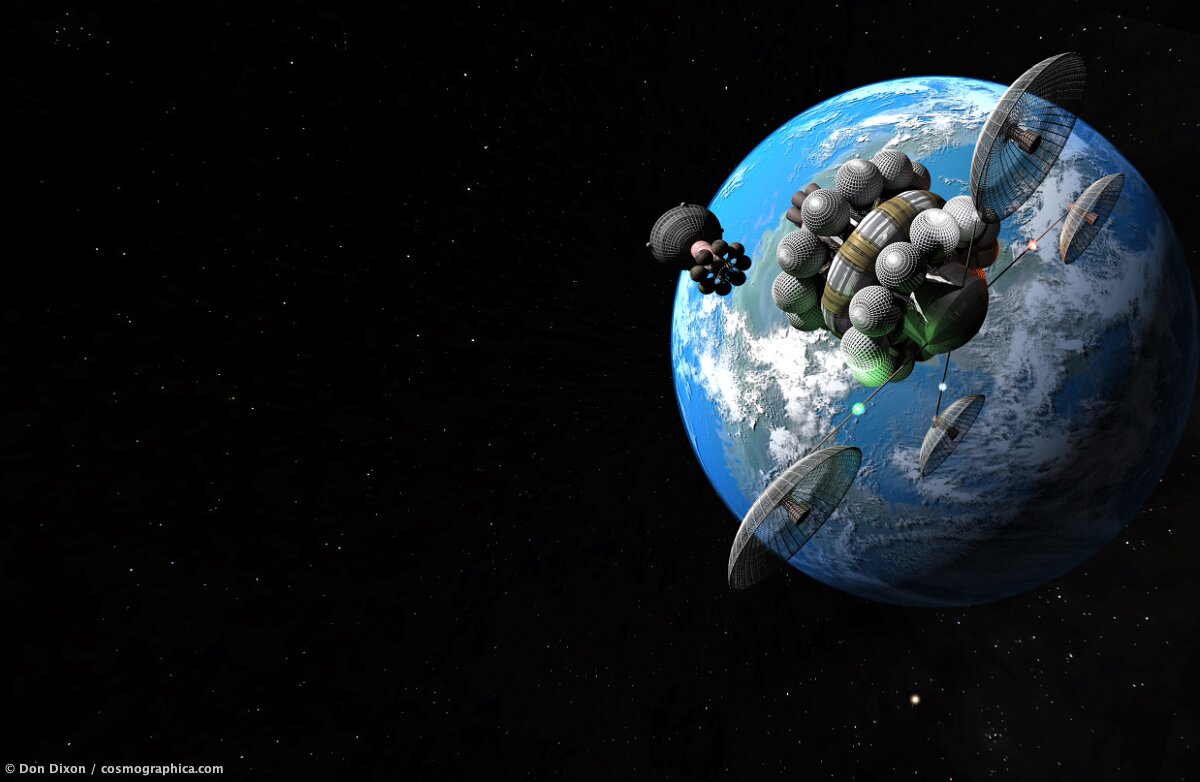
[491] Starship Arrives at Alpha Centauri v.1 – A habitat two miles across arrives to orbit a hypothetical earthlike planet orbiting the star Alpha Centauri after a 50-year voyage. The discarded braking stage of the giant starship drifts in the far background. The bright star below the planet is our sun, 4.3 light years away. Interior illustration for Astronomy Magazine, July 2012.
501-starshade-exoplanet-telescope-dixon
[501] Exoplanet Finder Telescope Starshade —
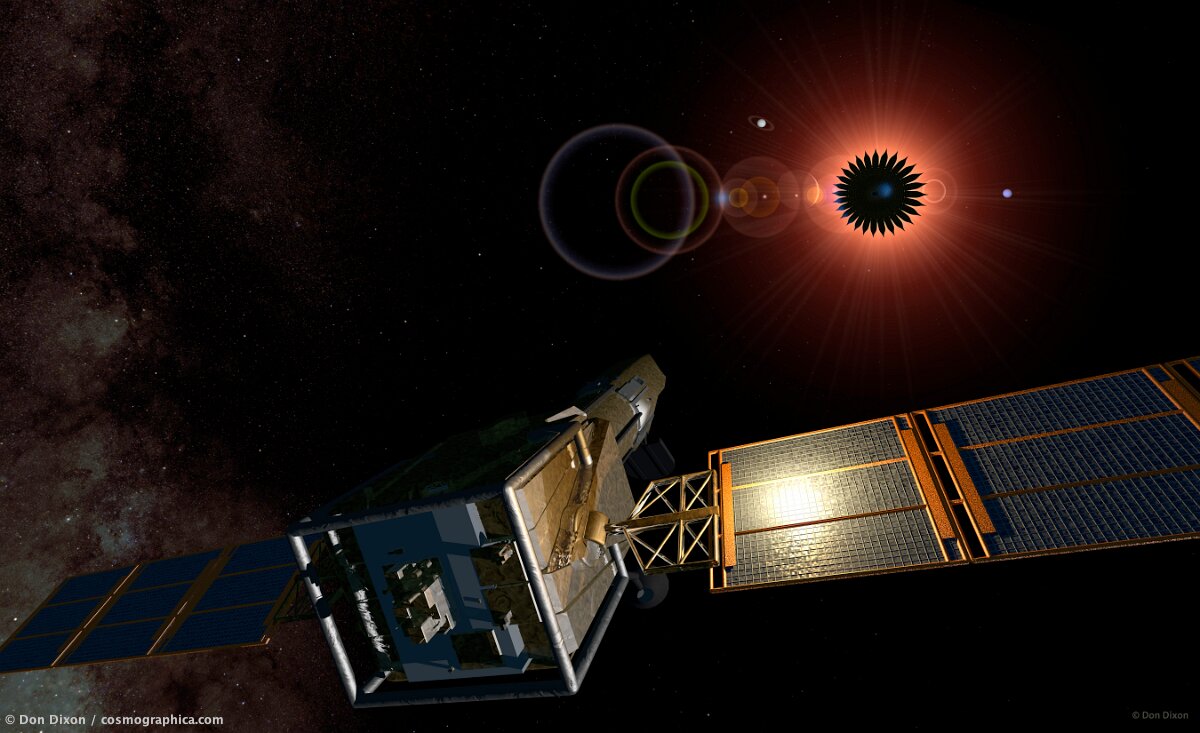
This illustration demonstrates the operation of an external occulter, or starshade, used in conjunction with a space-based observatory to image exoplanets. The flower-shaped starshade is positioned at a significant distance from the telescope, precisely aligned to block the intense light of a target star while allowing the much dimmer light of orbiting planets to reach the observatory's sensors. The scene captures the high-contrast environment of deep space, showing the eclipsed central star surrounded by several revealed planetary bodies. Illustration by Don Dixon.