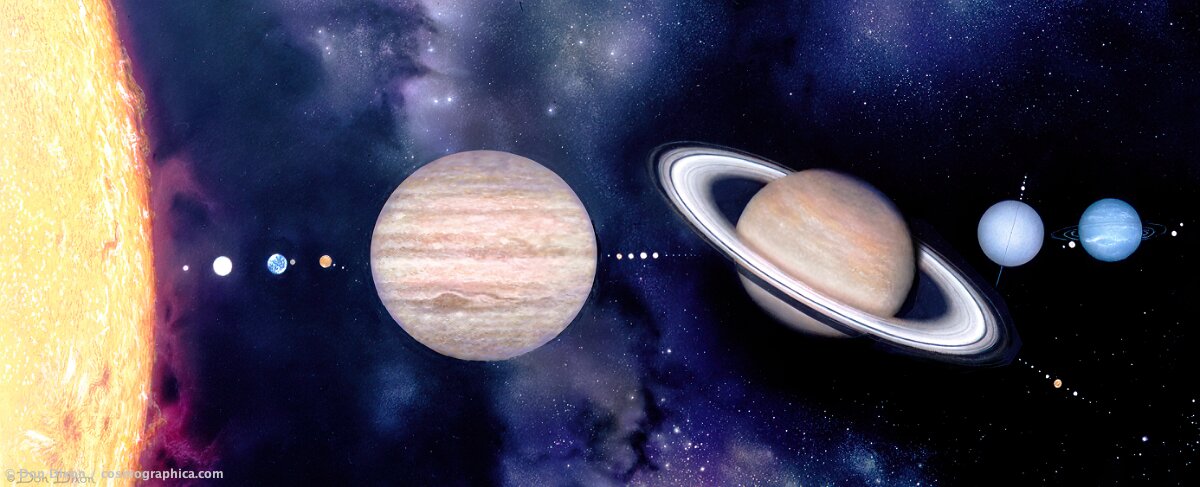
313-Solar-System-to-scale-2
313-solar-system-to-scale-2-dixon – This panoramic astronomical painting presents a scale comparison of the solar system, displaying the eight major planets and several prominent moons arranged horizontally from left to right next to the blazing edge of the Sun. Moving outward from the fiery solar limb, the terrestrial planets—Mercury, Venus, Earth with its Moon, and Mars—precede the immense spheres of Jupiter and Saturn. On the far right, the ice giants Uranus and Neptune complete the sequence, all set against a rich cosmic background filled with deep purple nebulae and distant stars. relative sizes are correct, but not the distances between the planets; acrylic and gouache, © Don Dixon
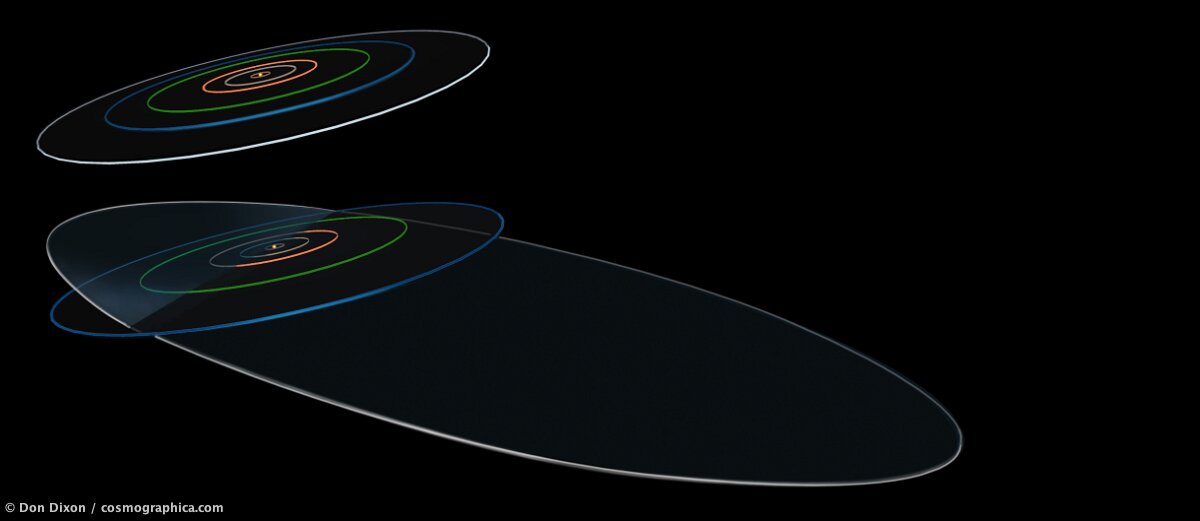
366-Evolving-Orbits
366-evolving-orbits-dixon – This two-part technical diagram illustrates the dynamic evolution of planetary and planetesimal orbits within a stellar system, contrasting an early configuration with a later, rearranged state. The upper panel shows an initial stage where thin, concentric, color-coded rings (orange, green, light blue, and white) encircle a central star on a single, relatively flat plane. The lower panel depicts a post-migration phase where the orbits have destabilized and evolved, showcasing an expanded, highly elongated, and eccentric outer white orbit that stretches far into the foreground, while the inner planetary tracks remain relatively contained. Gravitational perturbations may have caused the orbit of Pluto to become more elliptical. digital, 2004, copyright Don Dixon
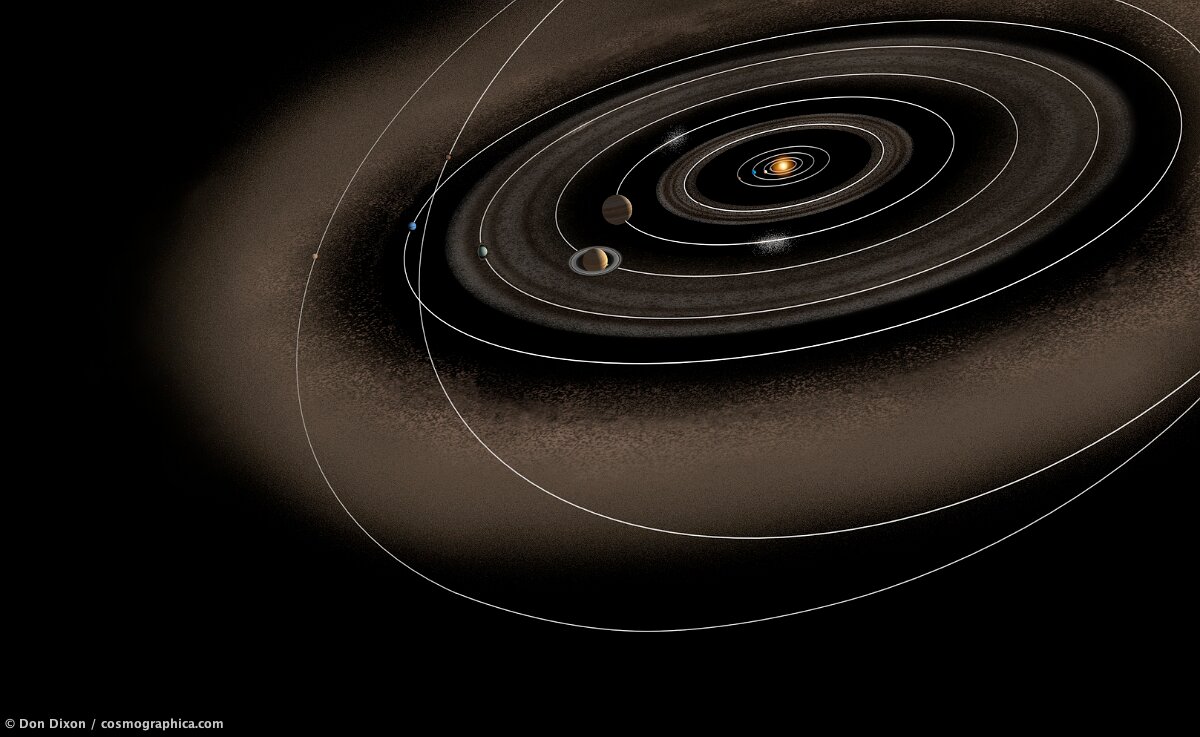
451 Solar System with Kuiper Objects
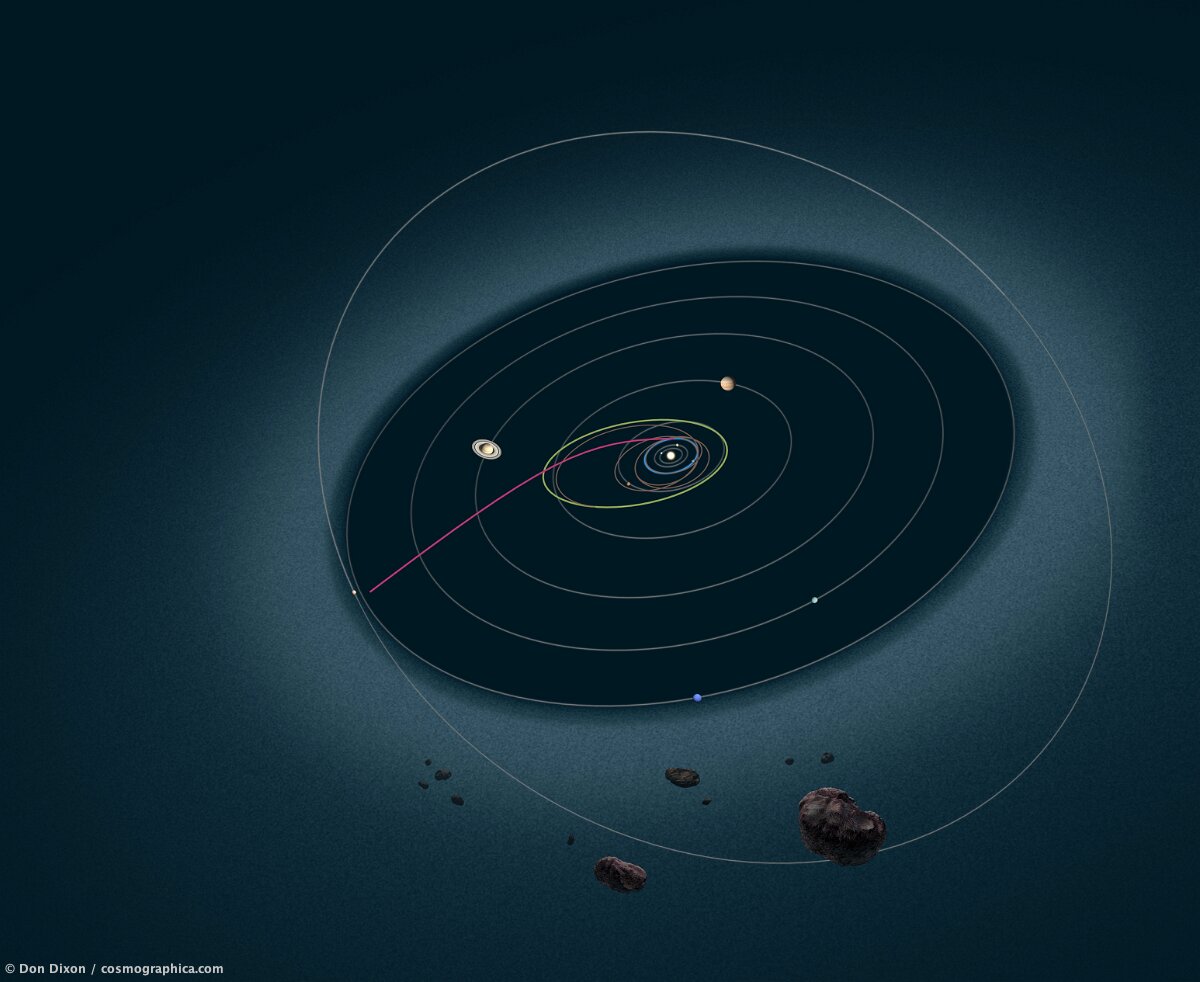
451-pluto-solar-system-diagram-dixon – This technical astronomical diagram illustrates the structural layout of the solar system from an oblique perspective, emphasizing the relationship between the planets, the asteroid belt, and the expansive Kuiper Belt. The inner planets orbit closely around the bright central Sun, bordered by a dense, white-flecked main asteroid belt and two Trojan asteroid clouds. The major gas giants trace clean white paths across a vast, dark disc, while a highly eccentric, inclined orbital path cuts steeply through the outer system, demonstrating the orbital mechanics characteristic of Pluto and other resonant trans-Neptunian objects navigating the hazy, brown-tinted debris field of the Kuiper Belt. Digital, for Scientific American; Artwork © 2007 Don Dixon / cosmographica.com
485-solar-system-diagram
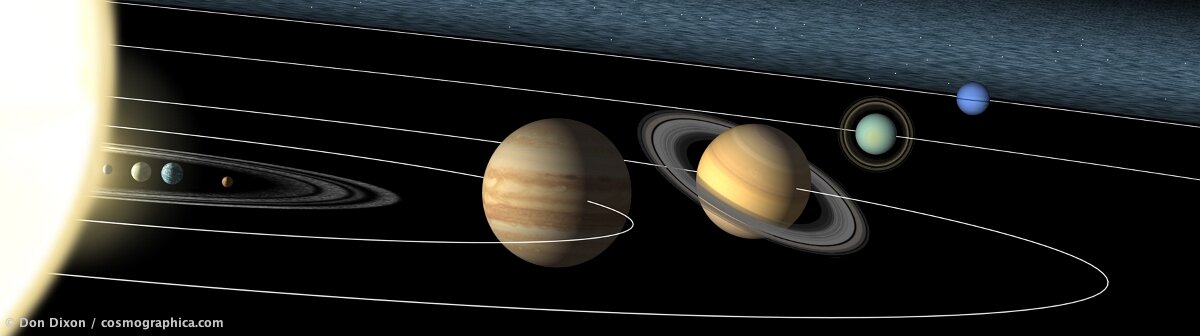
485-solar-system-diagram-dixon – This wide aspect ratio digital infographic illustrates the layout of the solar system, showcasing the planets along their respective white orbital paths relative to the Sun on the far left. The four inner terrestrial planets are clustered closely to the star, followed by the main asteroid belt rendered as concentric gray dust rings. The outer gas giants—Jupiter, Saturn, Uranus, and Neptune—stretch across the right half of the canvas, bounded by a textured blue expanse at the top representing the Kuiper Belt.The relative distances of the planets are NOT to scale. Diagram created for Scientific American in 2006.
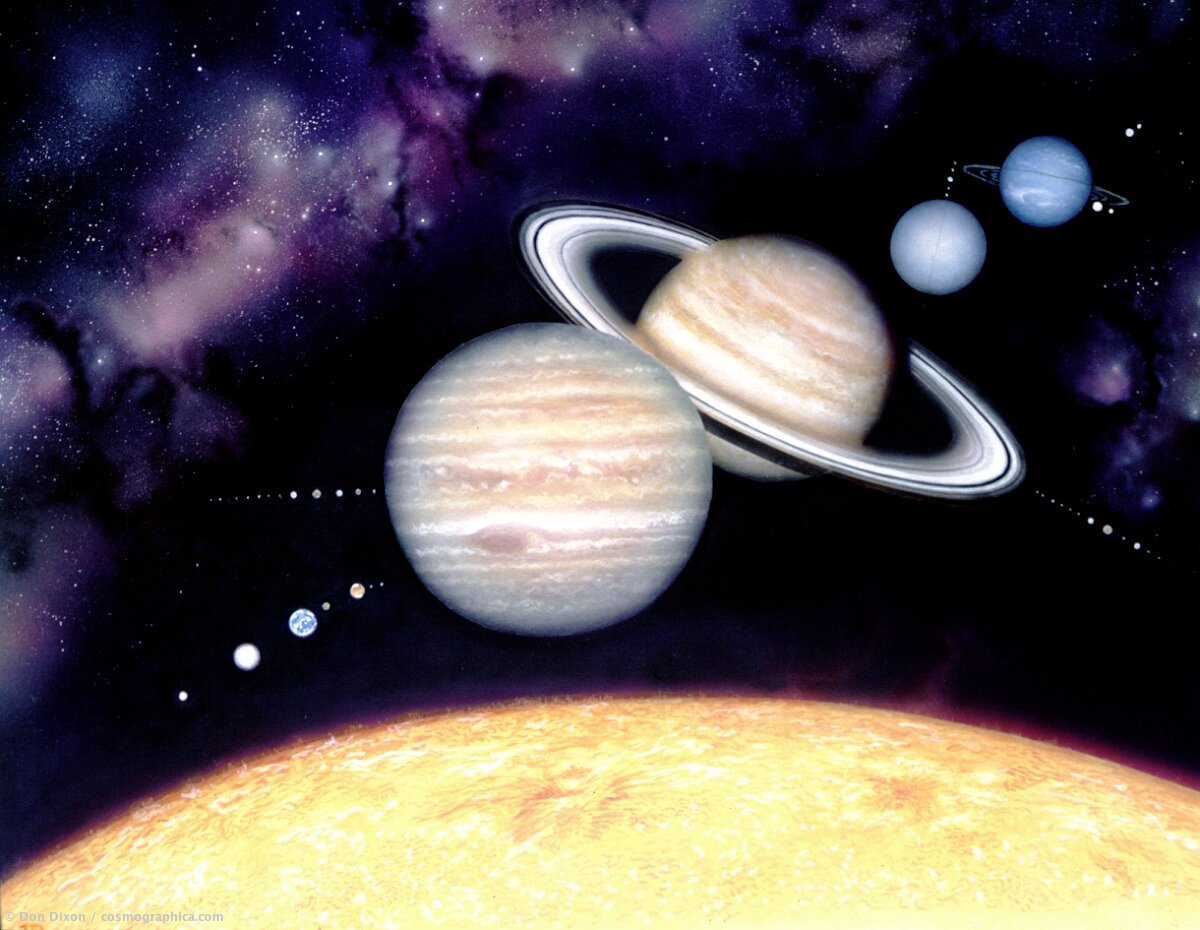
505-solar-system-planets-to-scale
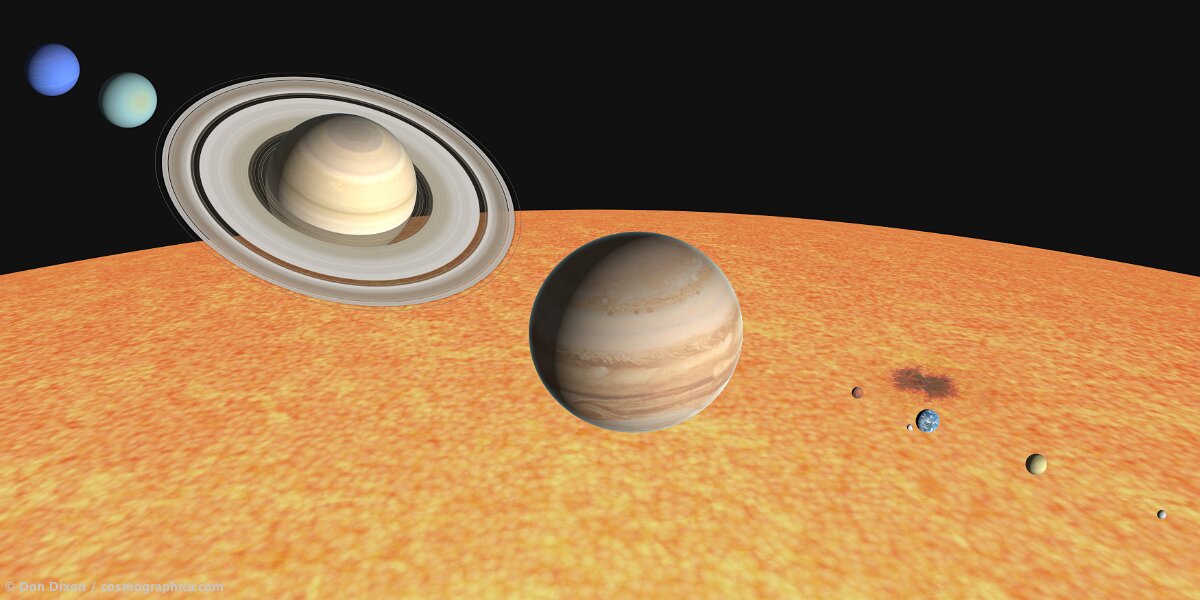
505-solar-system-planets-to-scale-dixon – This technical digital diagram illustrates the relative sizes of the eight major planets of the solar system, arranged in order of distance from left to right against the vast curve of the Sun's limb. The gas giants Neptune, Uranus, Saturn, and Jupiter dominate the left side of the frame with realistic atmospheric band detailing, while the smaller rocky planets Mars, Earth, Venus, and Mercury are clustered on the right near a dark solar sunspot group. The composition emphasizes the stark scale disparity between the terrestrial planets, the Jovian giants, and the immense solar diameter. Relative sizes are correct. Distances have been compressed. digital, 2016; © Don Dixon / cosmographica.com