Uranus

Uranus from Miranda
Uranus from Miranda
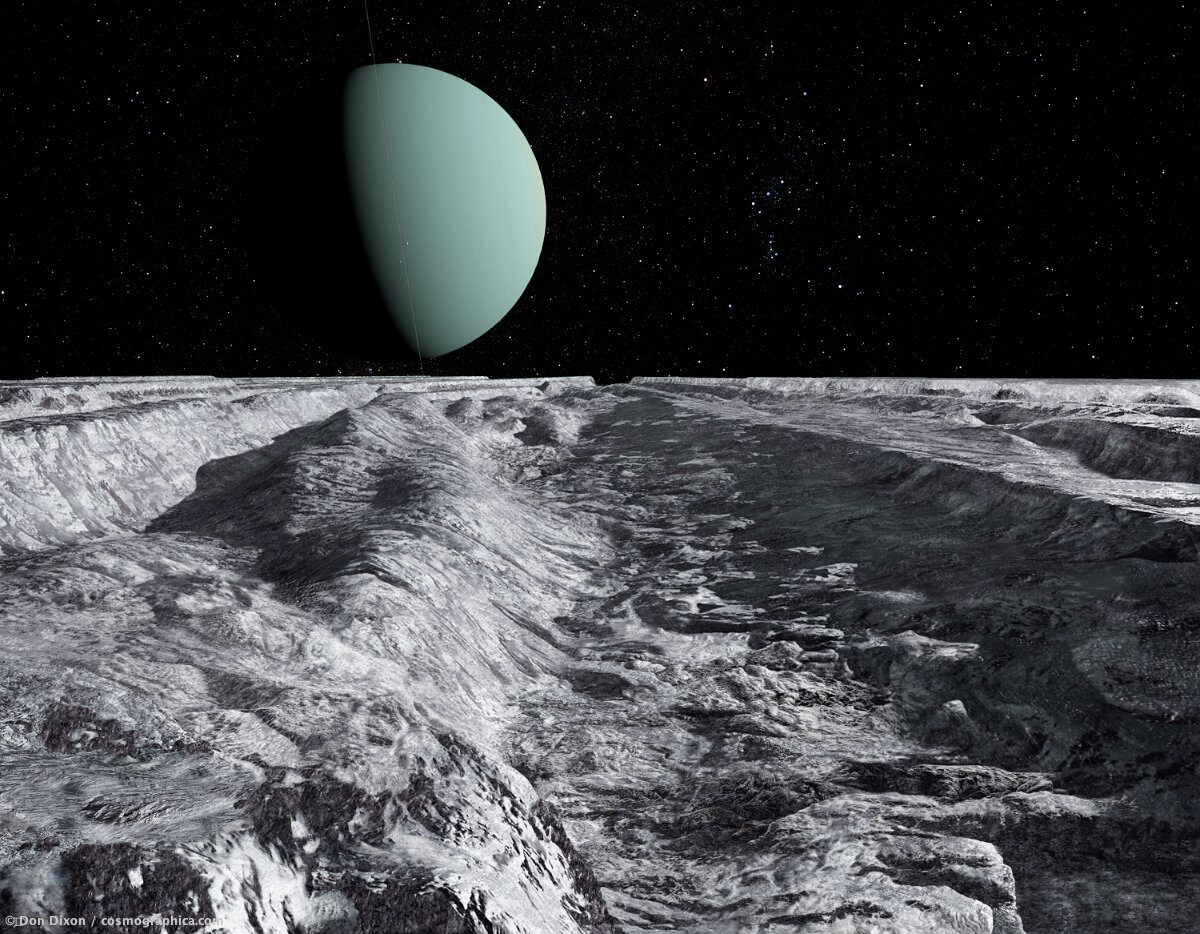
447-uranus-from-miranda-dixon – Deep rift valleys mark the surface of this strange moon that has apparently been repeatedly disrupted and reassembled. This astronomical illustration depicts the gas giant Uranus as viewed from the fractured icy surface of its moon, Miranda. The planet looms in the airless sky with its thin, vertical ring system faintly visible cutting across its disc. The rugged canyon in the foreground is filled with fractured ice, ridges, and complex graben topography, characteristic of Miranda's extreme geological formations like Verona Rupes.; digital, 2006, for Griffith Observatory, © Don Dixon
Uranus Rings Diagram

Uranus Rings Diagram

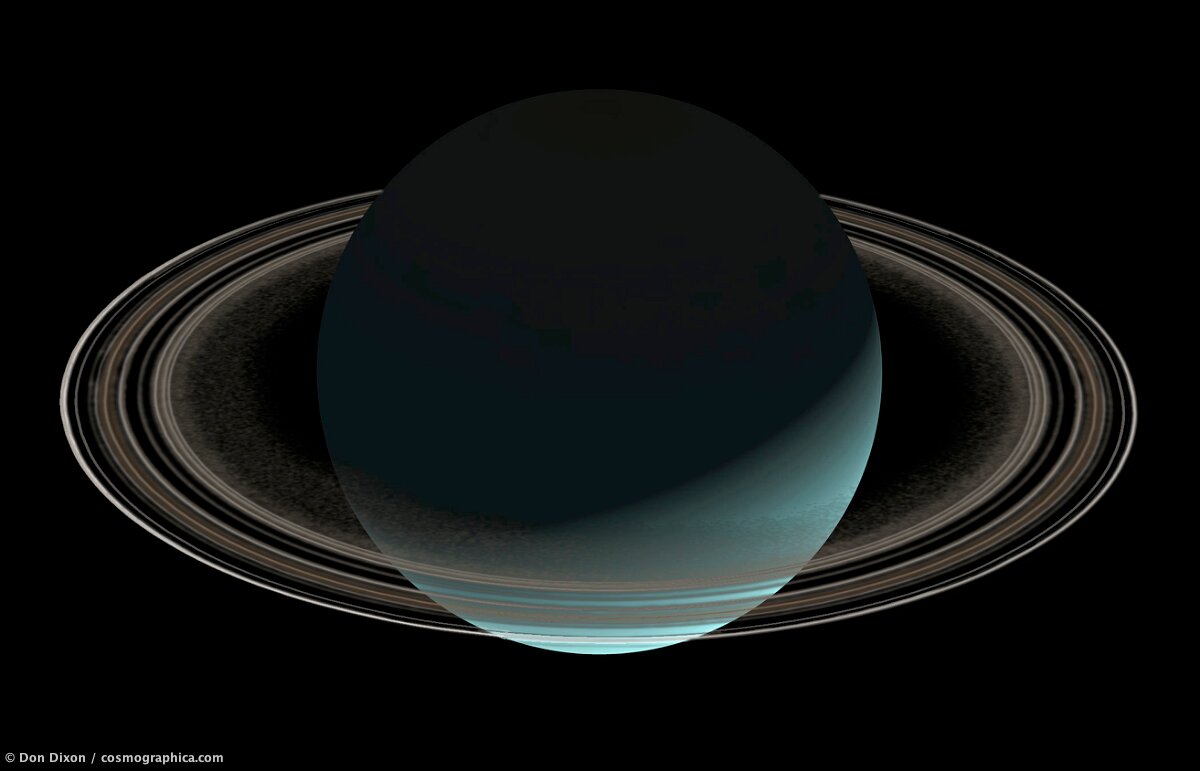
393-uranus-rings-diagram-dixon – This scientific illustration presents a close-up view of Uranus and its complex, narrow planetary ring system against a solid black background. The planet is oriented with its northern hemisphere mostly in shadow, showing only a faint, soft blue-cyan crescent illumination along its lower edge. The concentric rings encircle the planet's equator horizontally in this perspective, rendered in fine detail with varying bands of dark gray, charcoal, and bright dust lanes. painting by Don Dixon for Scientific American
Uranus seen from Miranda

Uranus seen from Miranda

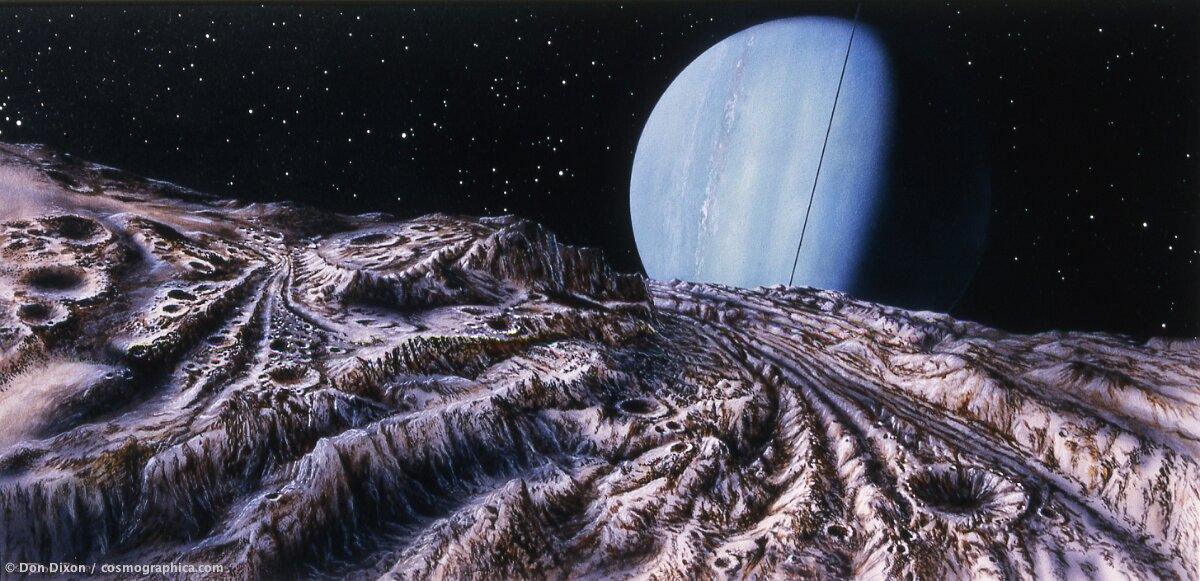
260-uranus-from-miranda-dixon – This panoramic astronomical painting showcases the pale blue globe of Uranus rising above the heavily cratered, fractured terrain of its moon Miranda. The planet's surface features subtle atmospheric banding and wispy clouds, with a single, razor-thin vertical ring cutting directly across its disc. The foreground highlights a classic hand-painted texture depicting Miranda’s chaotic geology. - acrylic painting by Don Dixon for the Orange County Register
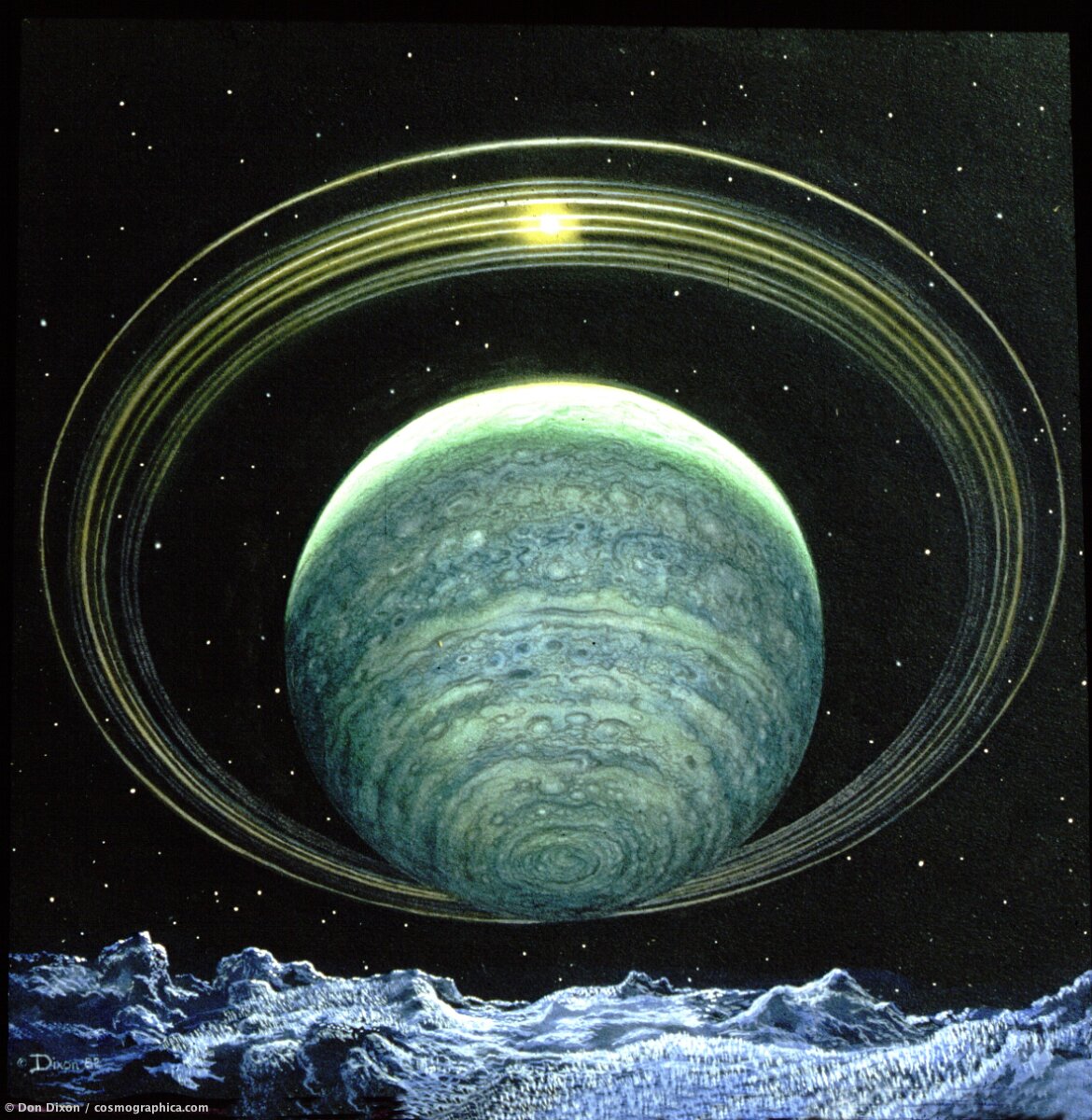
184-uranus-rings-full-dixon
184-uranus-rings-full-dixon –This square-format astronomical painting depicts an early speculative view of Uranus and its ring system as seen from a rugged, icy moon. The gas giant is rendered with intricate convective storm cells and cloud bands of pale green and blue swirling toward its rotational pole. A wide system of concentric, golden-hued rings encircles the planet, with the distant Sun positioned directly behind the upper ring plane to create a striking back-lit illumination across the scene. acrylic, 1980
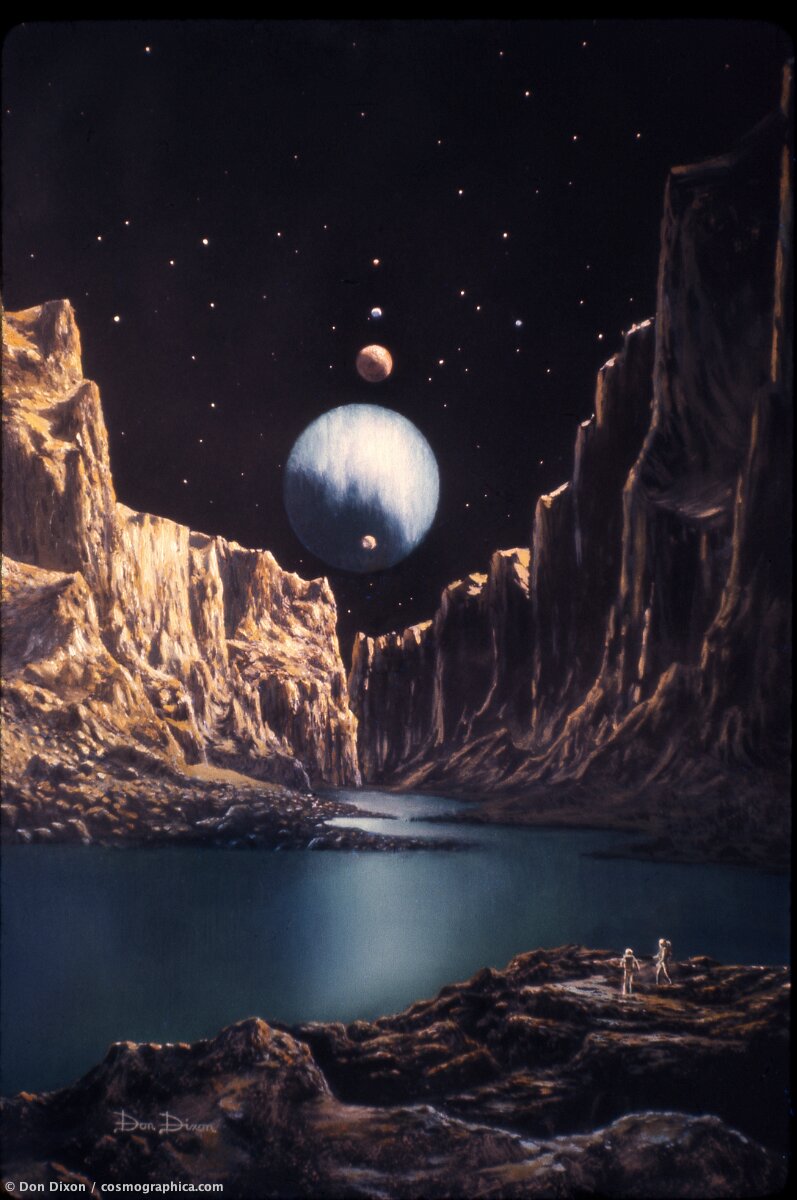
017-uranus-from-oberon-dixon
017-uranus-from-oberon-dixon – This classic astronomical painting presents a speculative view of Uranus and its satellite system from a deep, sunlit canyon on the moon Oberon. The gas giant appears centered in the sky with distinctive, dark vertical atmospheric formations crossing its disc, while several smaller moons are aligned vertically above and across it against a dense starfield. In the foreground, a smooth, frozen valley floor catches the light below towering rock cliffs, with two small astronaut figures standing on a rocky ledge in the lower right for scale. Oil on canvas, 1973.
Uranus from Oberon

Uranus from Oberon

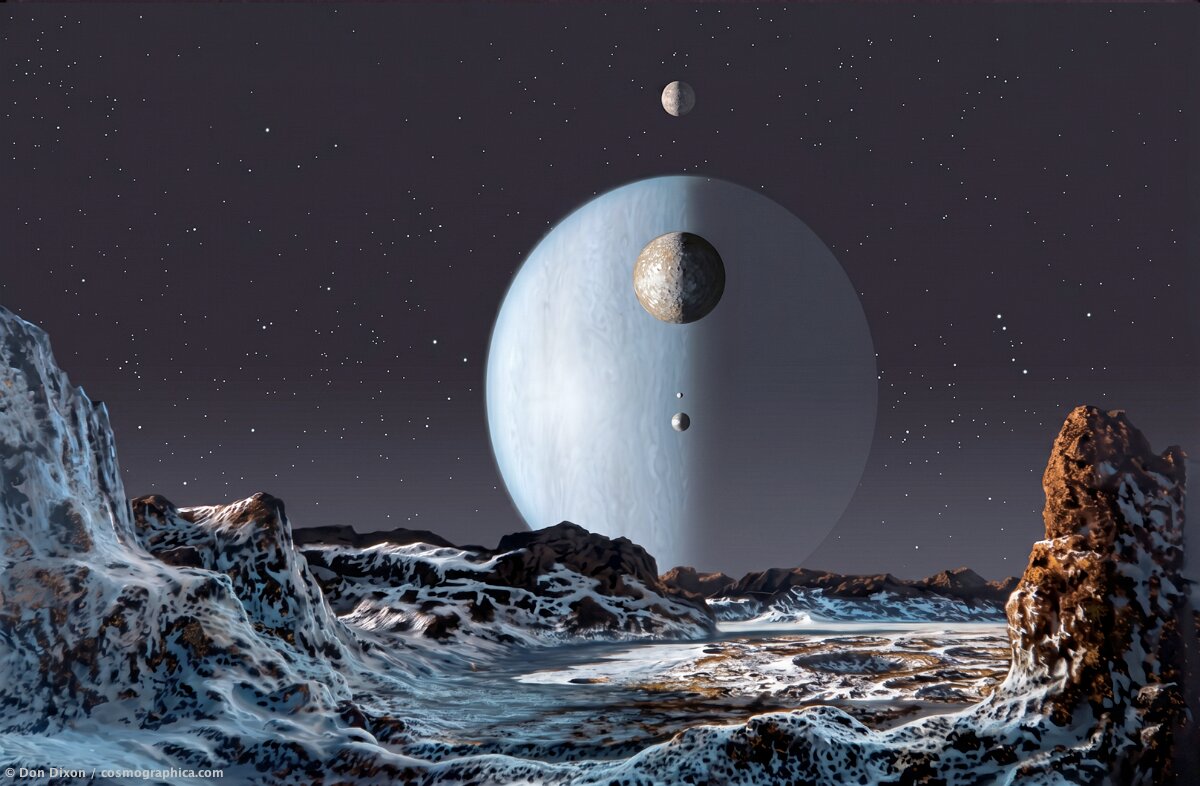
051-uranus-dixon – Uranus on the horizon of its moon Oberon. This historical astronomical painting presents a speculative view of Uranus and its major satellites aligned vertically against the planet's disc, as viewed from a cratered, icy moon's surface. The gas giant exhibits subtle vertical atmospheric bands, consistent with its unique, highly tilted rotational axis. Three smaller spherical moons are positioned in a straight vertical line over the planet's face, transiting across the terminator line between the day and night sides, while a rugged foreground of rocky spires and frozen plains shapes the low-angle perspective. acrylic and gouache on illustration board, 1974. © Don Dixon