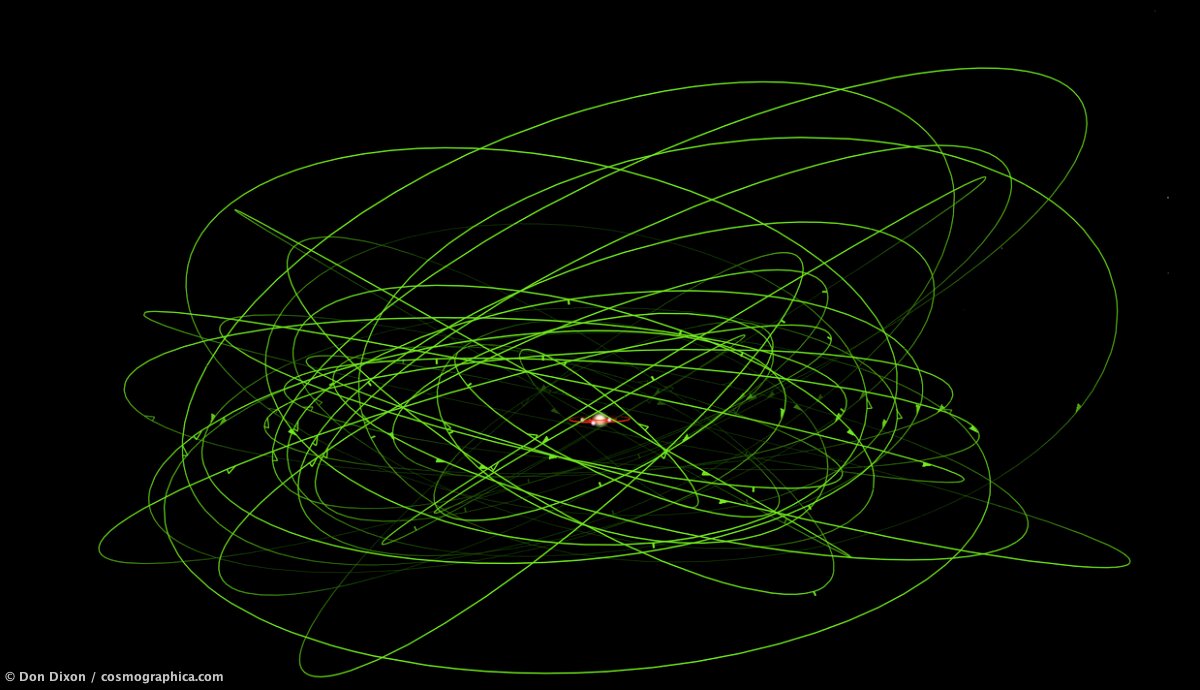
Diagram of Jupiter's Satellites' Orbits
455-jupiter-moon-orbit-diagram-dixon – This orbital schematic illustrates the complex, tangled web of irregular satellite trajectories surrounding Jupiter. The highly eccentric, inclined, and overlapping paths are highlighted in luminous green vector lines against a stark black void, with small arrows indicating orbital direction. The central planet is depicted at the focal point as a small, banded globe encircled by its regular, inner prograde satellite orbits. digital, for Scientific American, around 2006
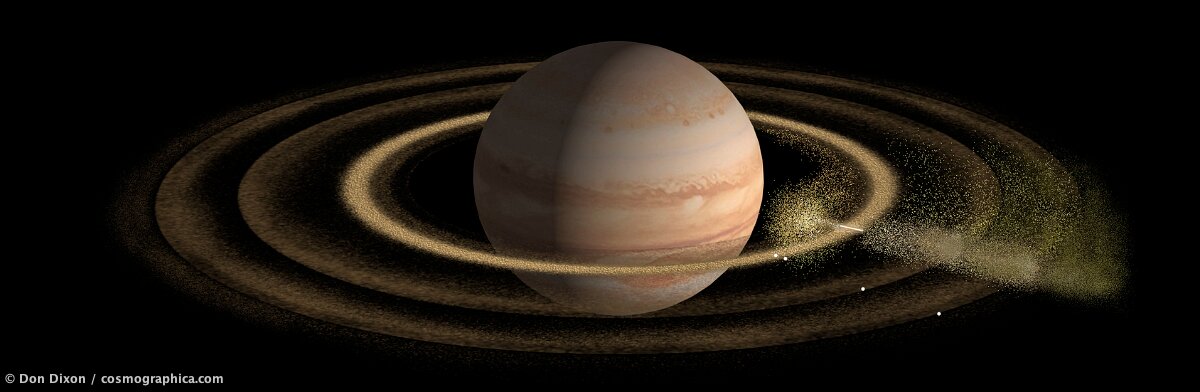
391-jupiter-rings-diagram-dixon –A technical three-dimensional diagram illustrating the structure and origin of Jupiter's ring system. The graphic models the faint main ring, the inner halo, and the expansive, faint outer gossamer rings. On the right, a callout demonstrates micrometeoroid impacts on small inner moons (such as Metis, Adrastea, Amalthea, or Thebe), showing how the resulting dust ejecta feeds and maintains the distinct concentric ring structures. Brightness and density of the rings are exagerrated. digital painting by Don Dixon for Scientific American
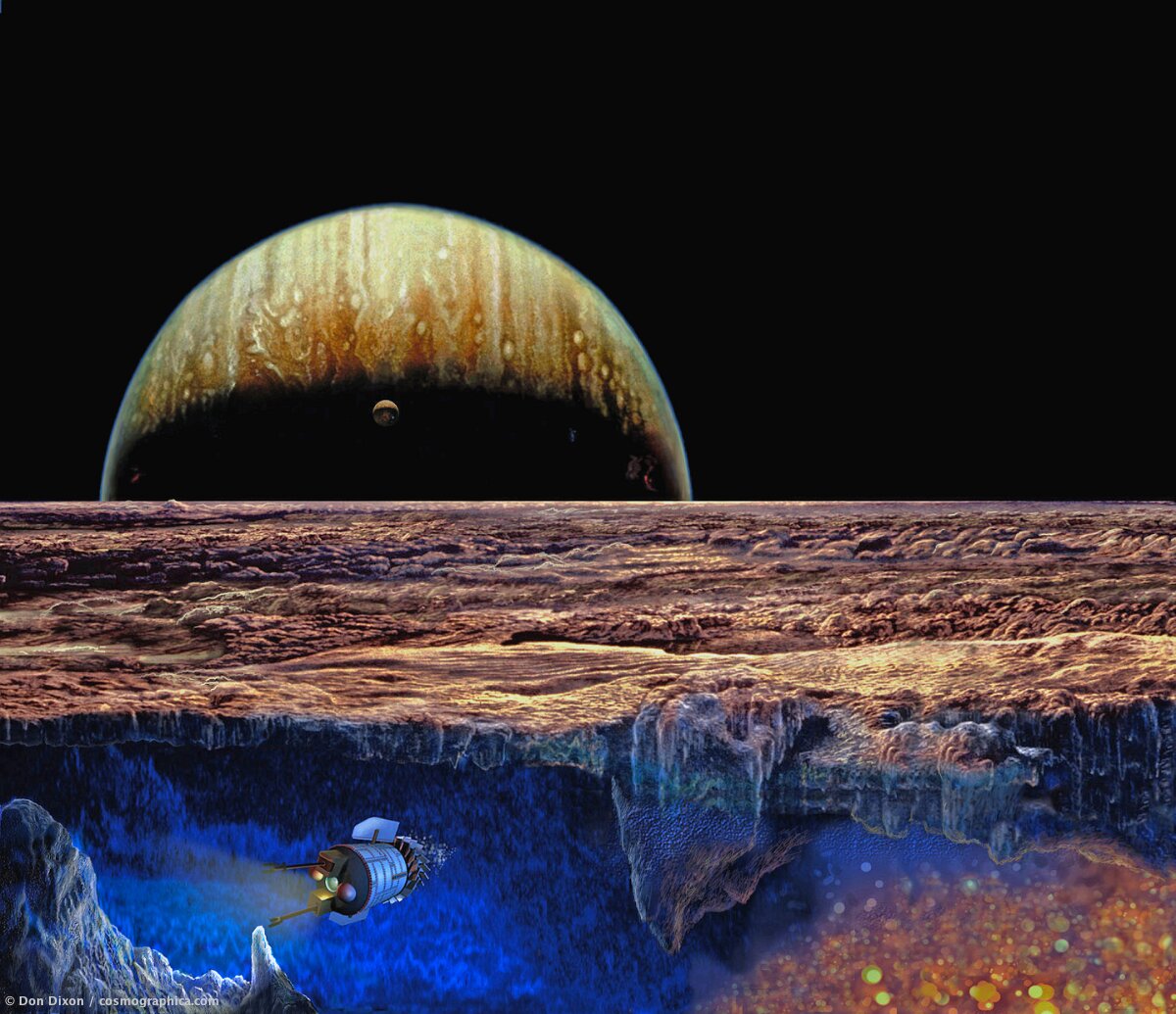
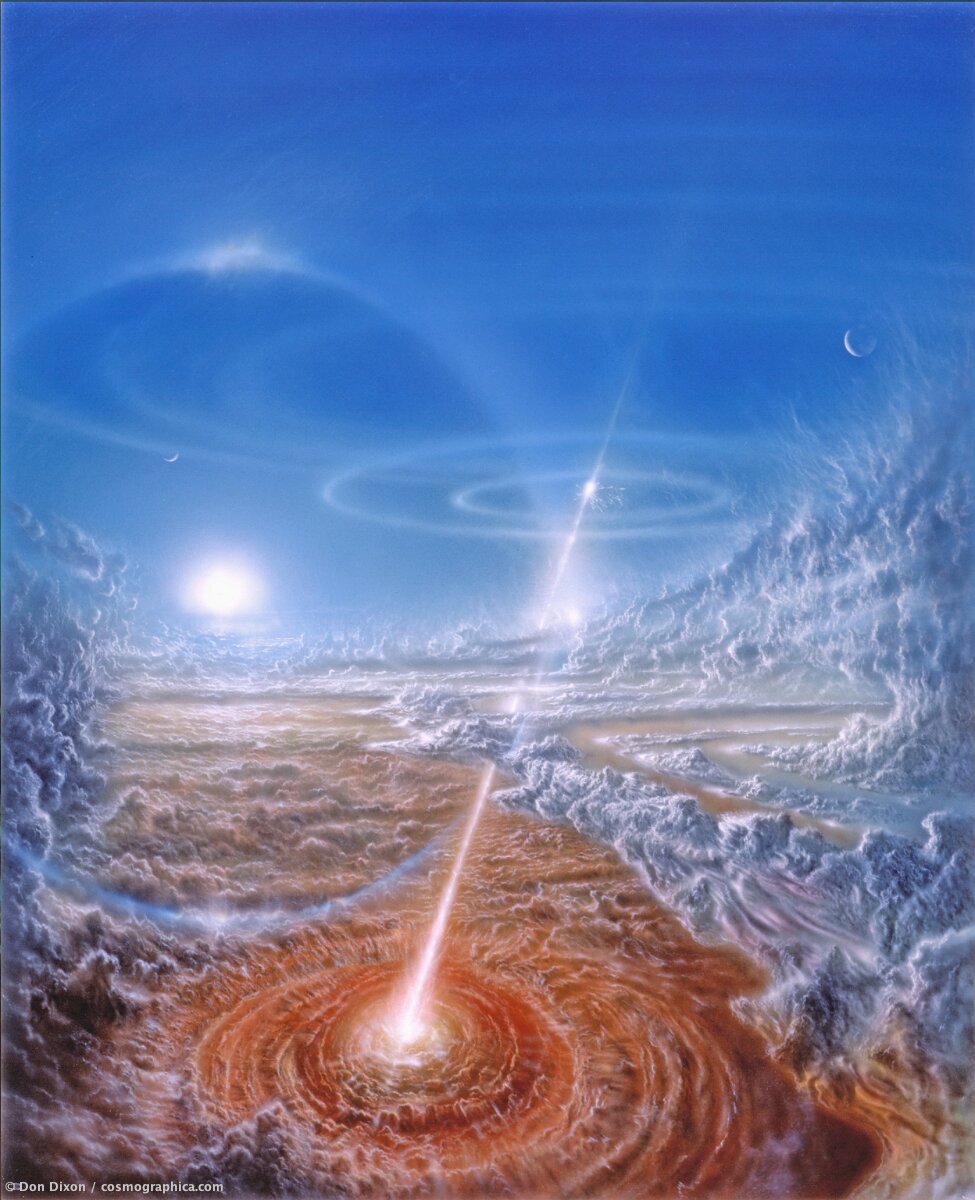
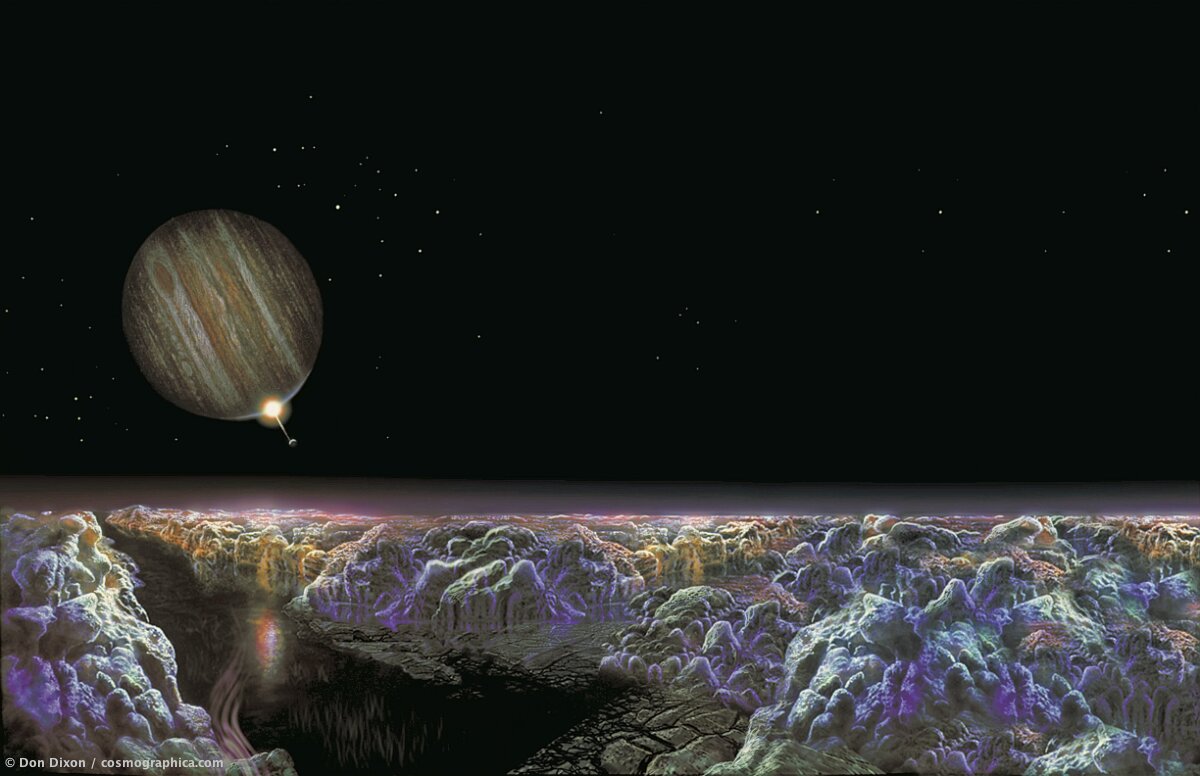
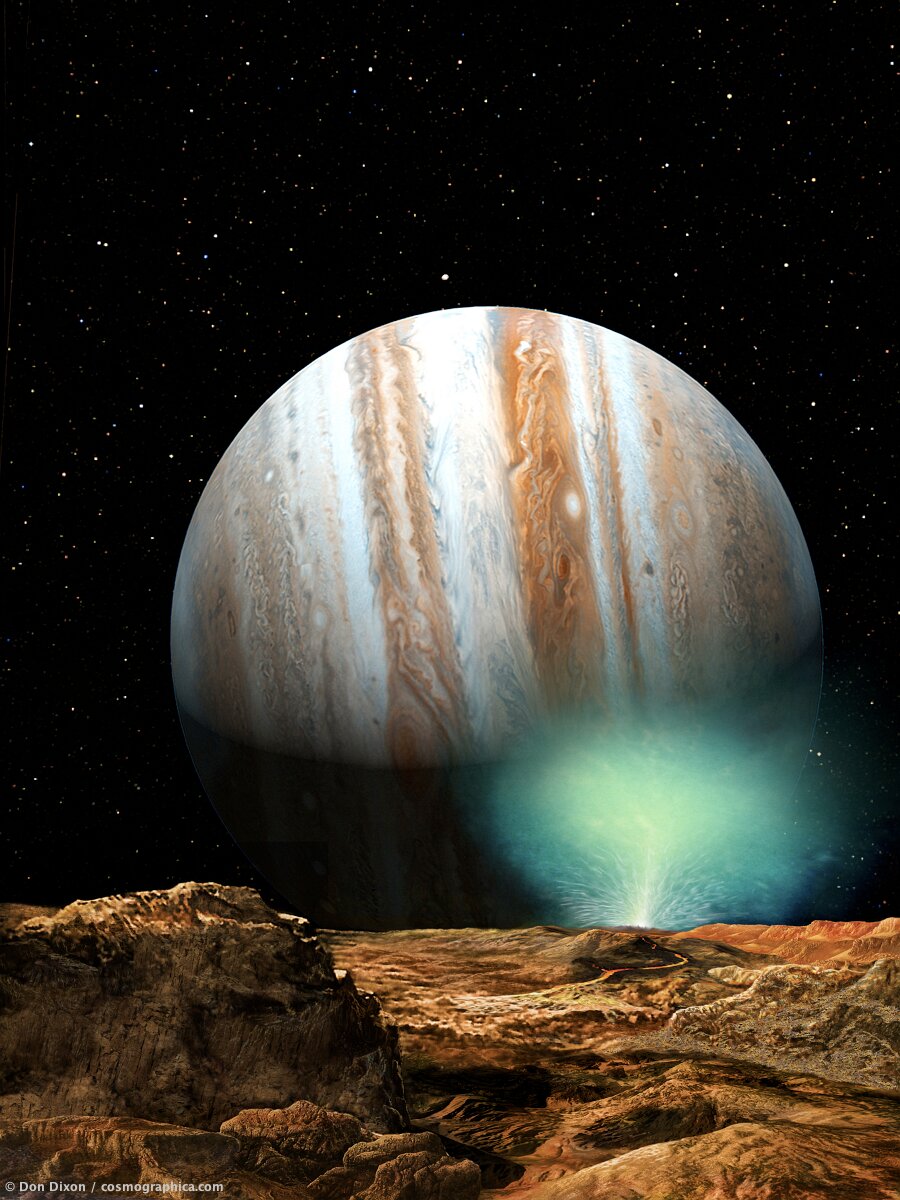
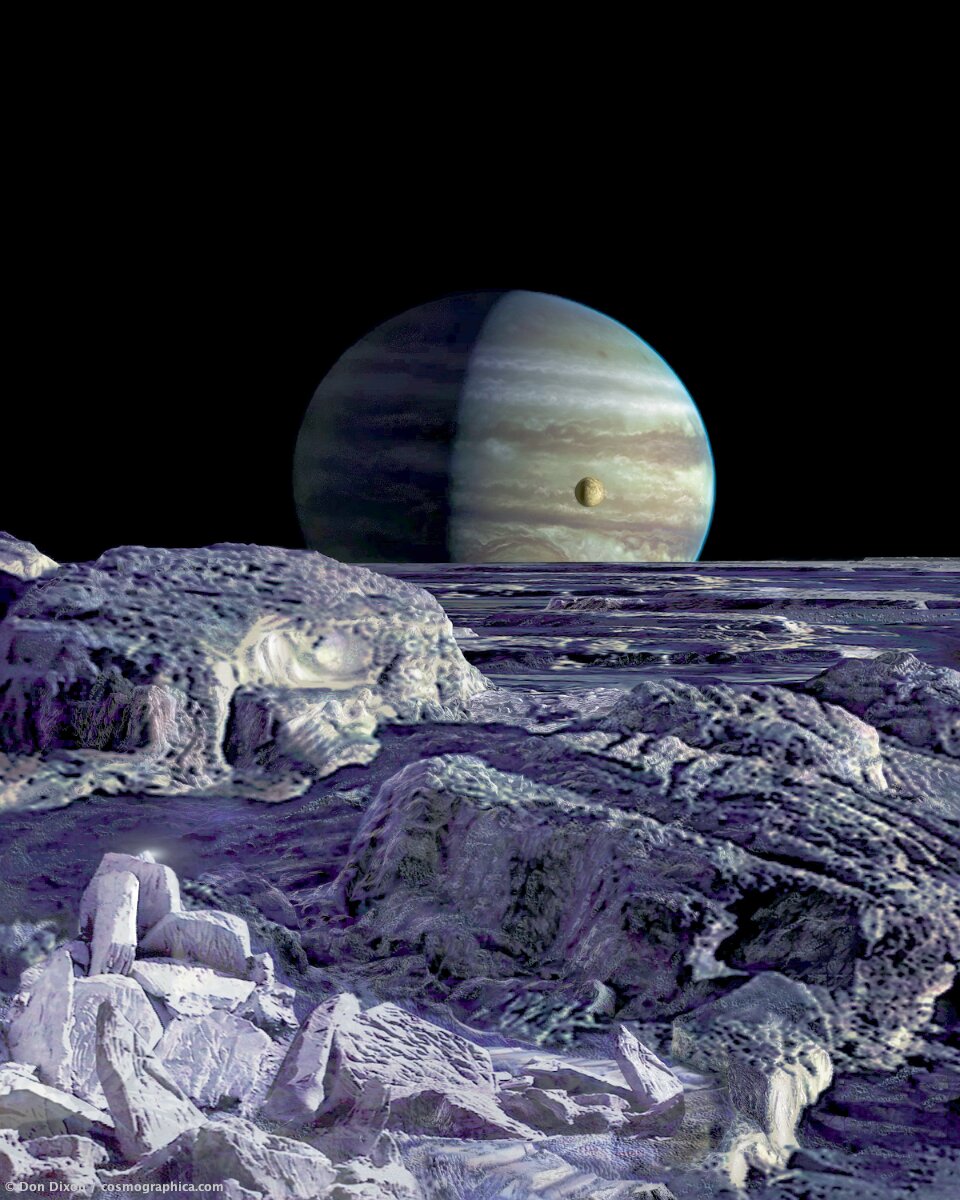
332-ice-lead-on-europa-2-dixon – a brief opening in the icy crust of Europa reveals its usually hidden ocean, frontispiece for Scientific American Cosmos. A dramatic night view across a fractured ice lead on the surface of Europa, showing a dark lane of slushy or newly frozen water cutting through jagged, hummocky ice blocks. High in the black sky, a large Jupiter hangs over the flat horizon, its banding subtly illuminated by moonlight as glare from the eclipsed sun peaks out from its lower edge, which casts a faint specular reflection onto the dark ice below. painting by Don Dixon
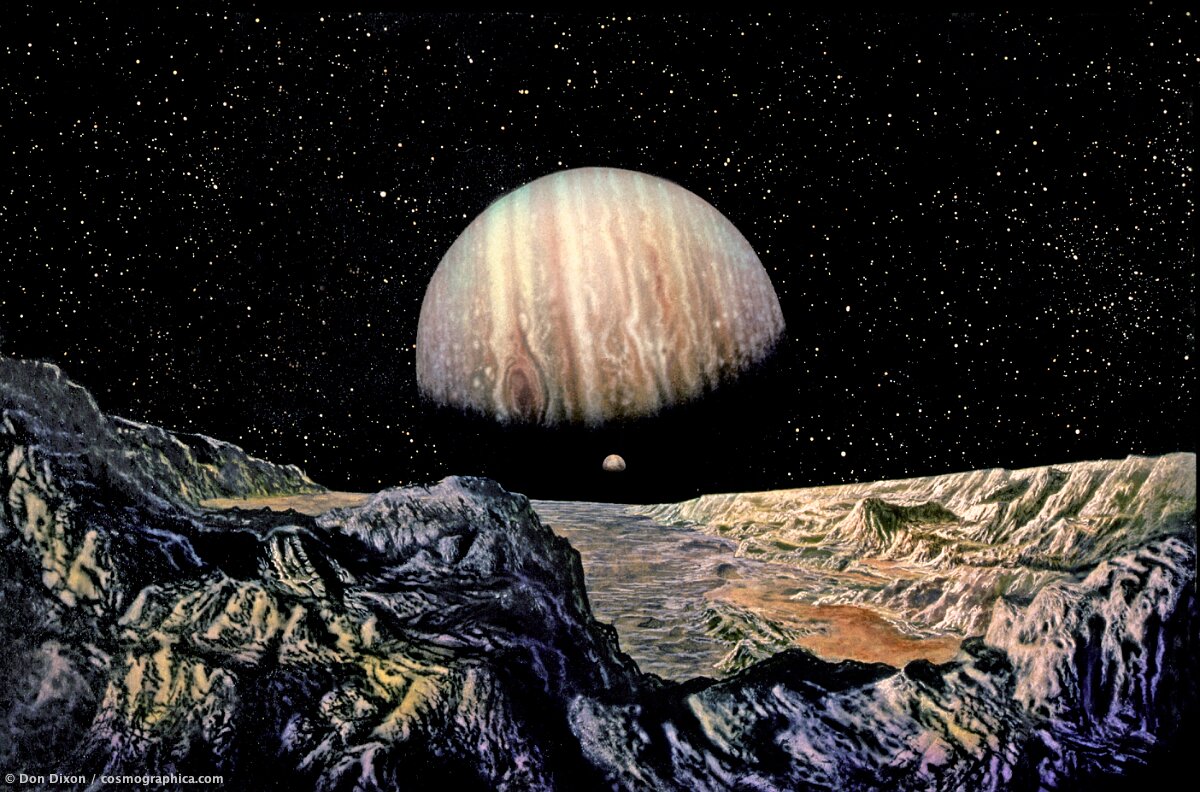
281-europan-valley-dixon – A wide view from inside a deep, fractured ice canyon or graben on the surface of Europa, looking across a smooth, refrozen valley floor toward the distant horizon. The sheer, rugged canyon walls show complex vertical faulting textures characteristic of a tidally stressed ice crust. In the pitch-black sky above, a huge, banded Jupiter dominates the upper frame, displaying prominent atmospheric storms and the Great Red Spot near its limb, while a small inner moon hangs directly beneath it in a star-filled vacuum. acrylic and goauche on board
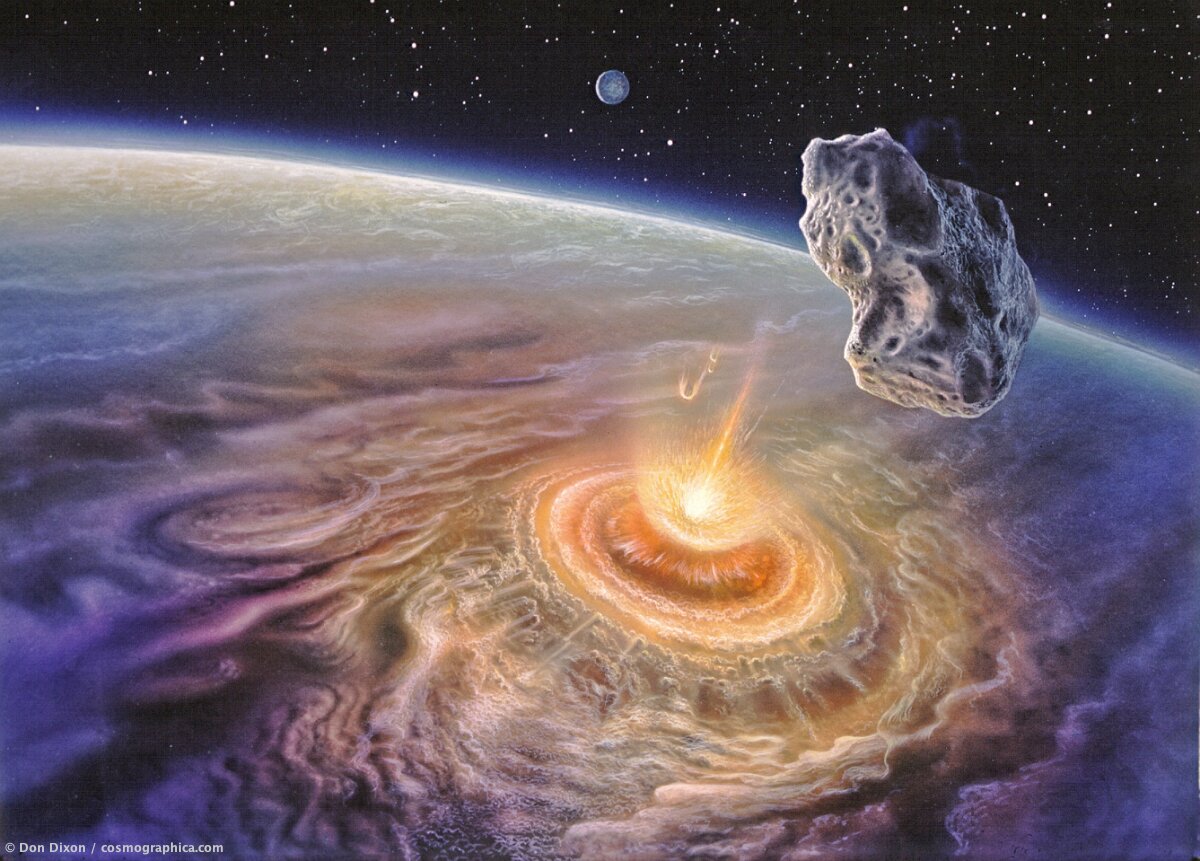
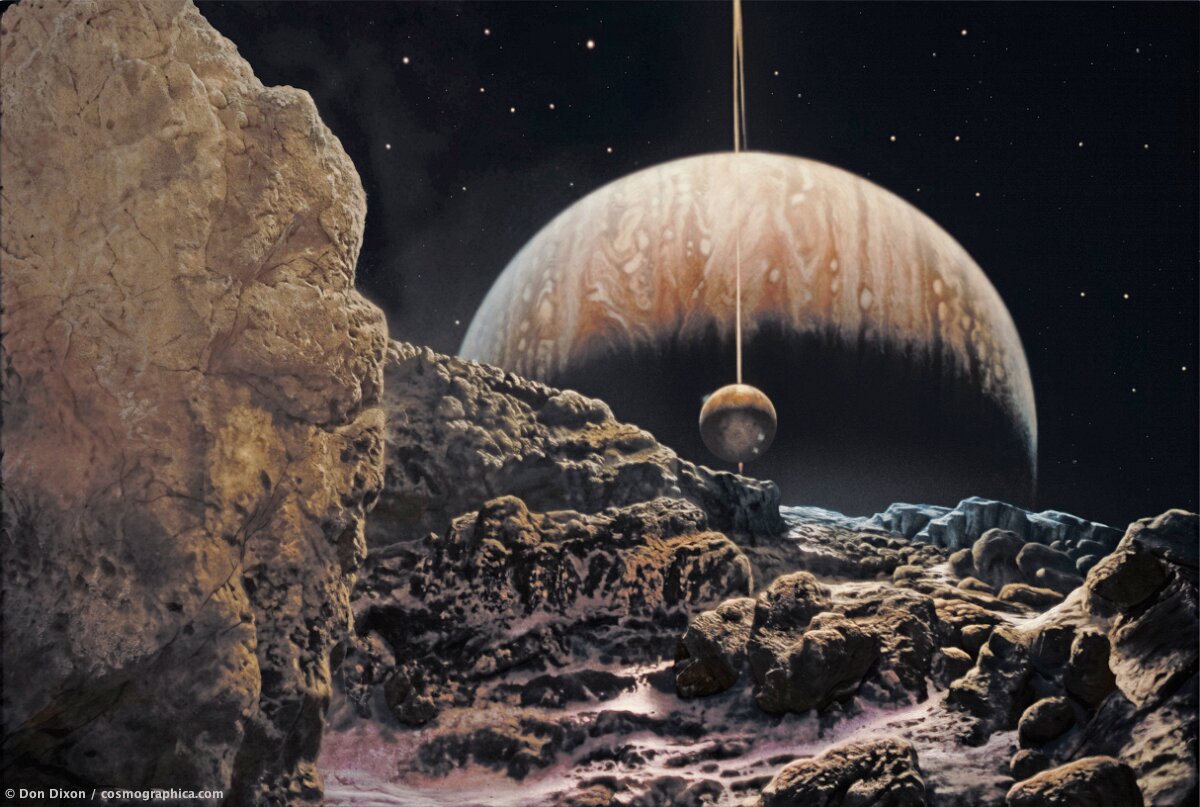
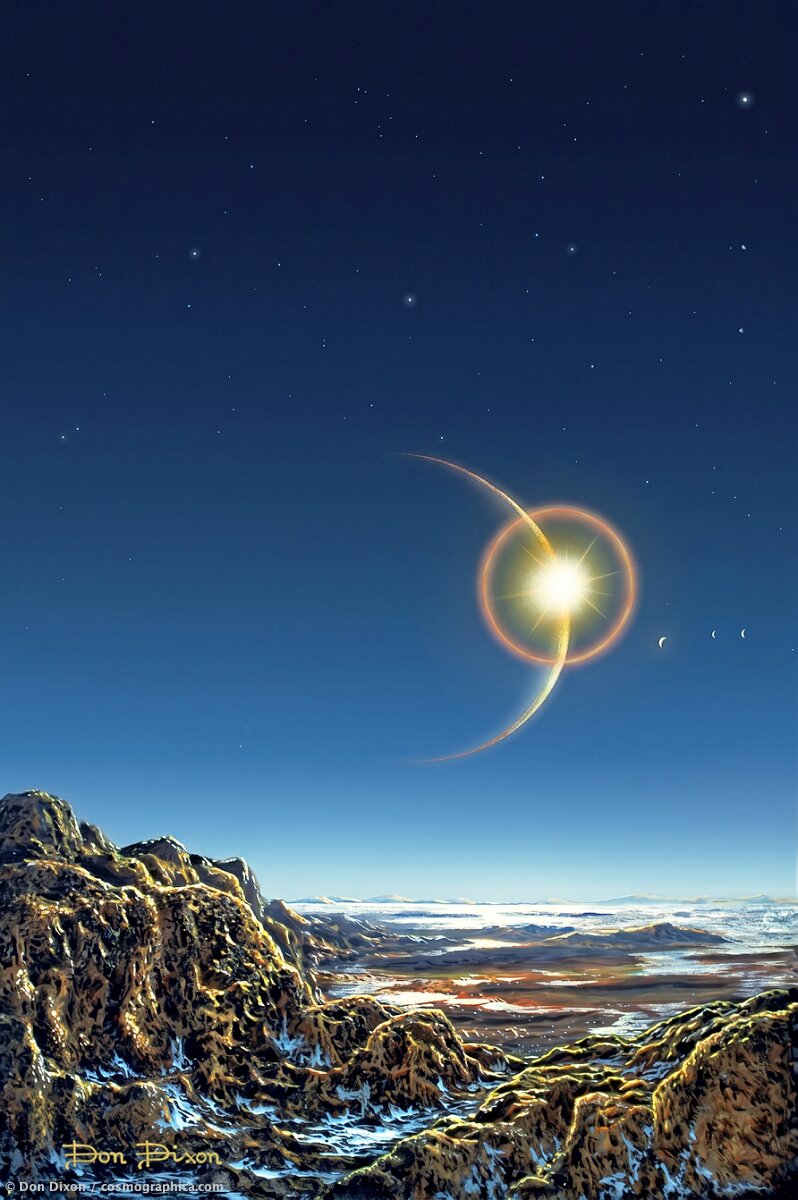
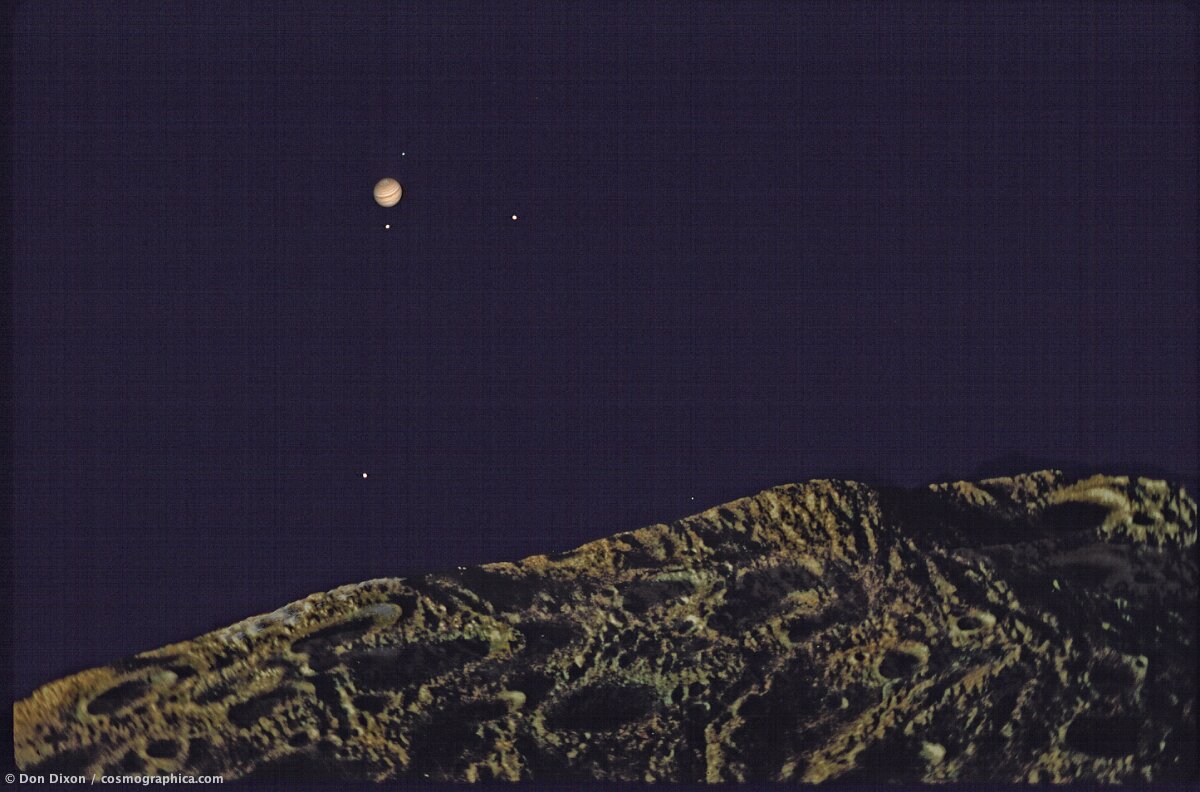
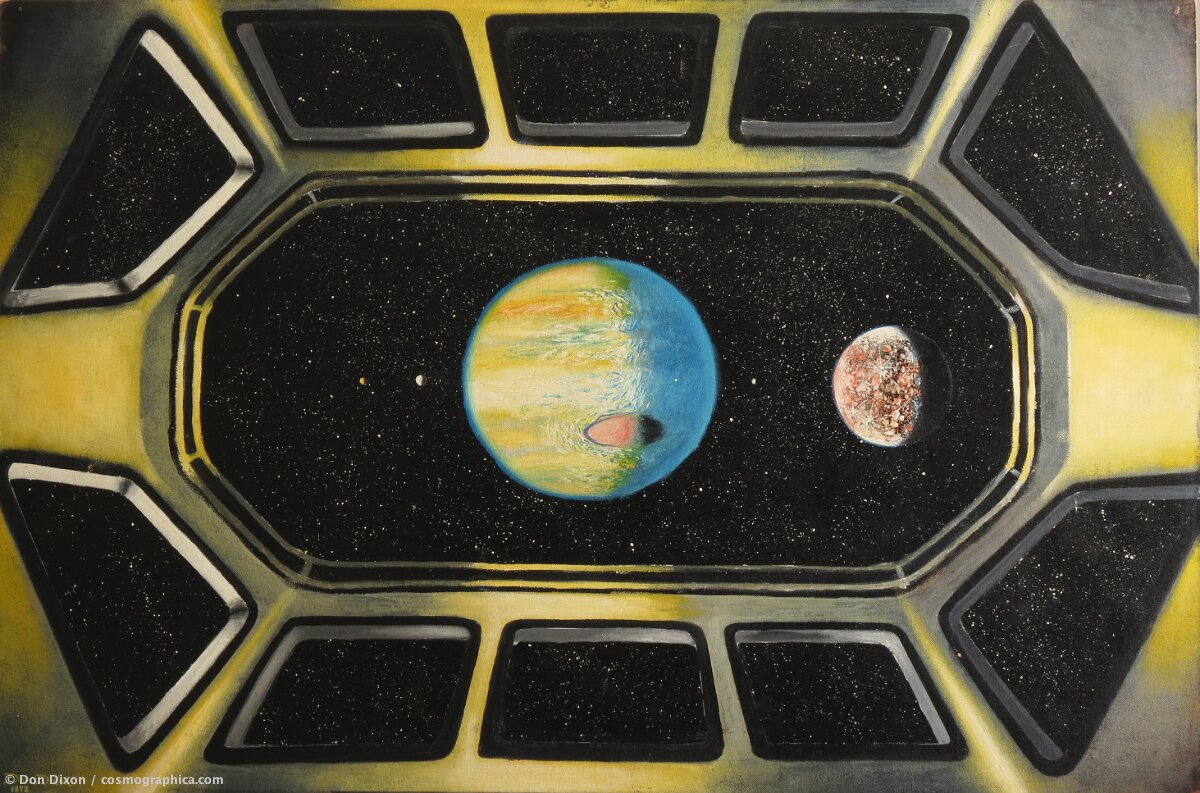
144-jupiter-10-dixon - probably a captured asteroid, this tiny moon affords a distant, high-inclination view of the giant planet. The small, distinct sphere of Jupiter reveals faint atmospheric banding, surrounded by its four prominent Galilean moons scattered as pinpricks of light at varying orbital distances.
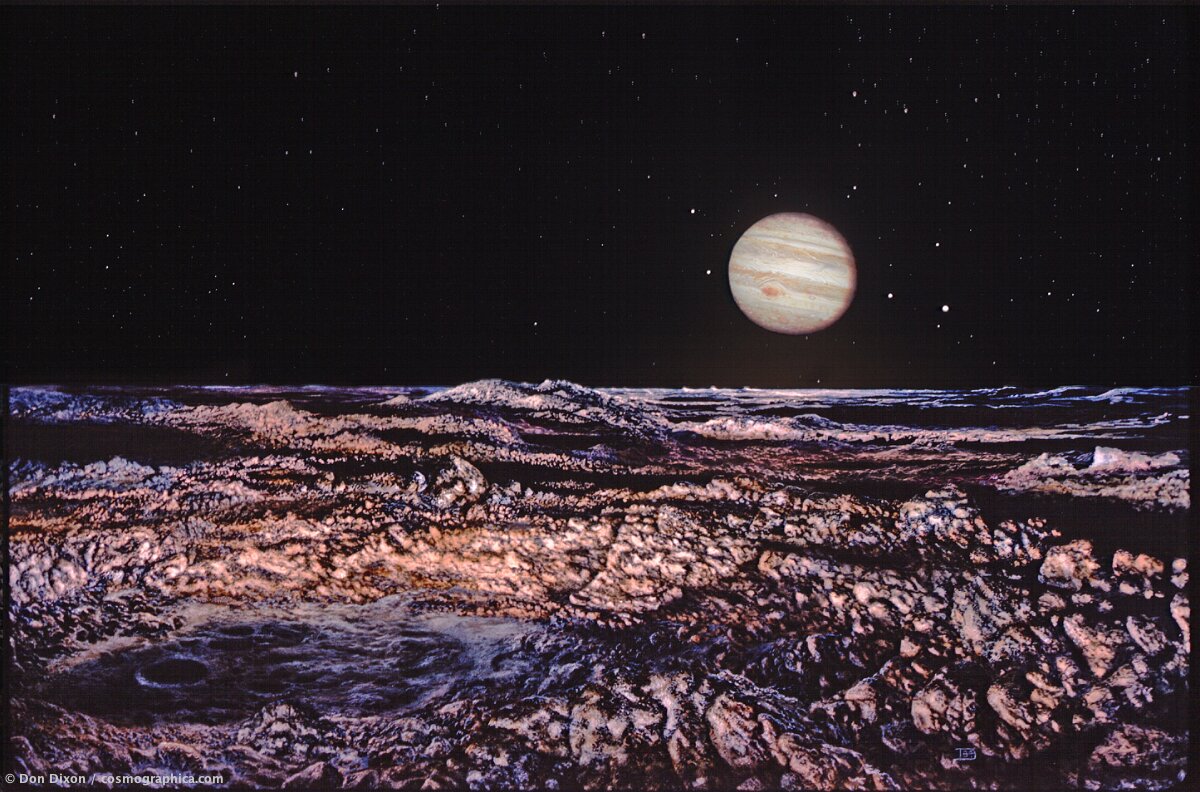
143-callisto-dixon - A wide, desolate look across the ancient, heavily cratered terrain of the Jovian moon Callisto, emphasizing a surface dominated by frost-rimmed ridges and icy impact structures. Hanging prominently in the dark, starry vacuum above the horizon is the detailed disk of Jupiter, showing its characteristic atmospheric bands and a hint of the Great Red Spot. Several small, pinpoint moons are scattered near the gas giant, tracing their orbital paths against the deep space background.
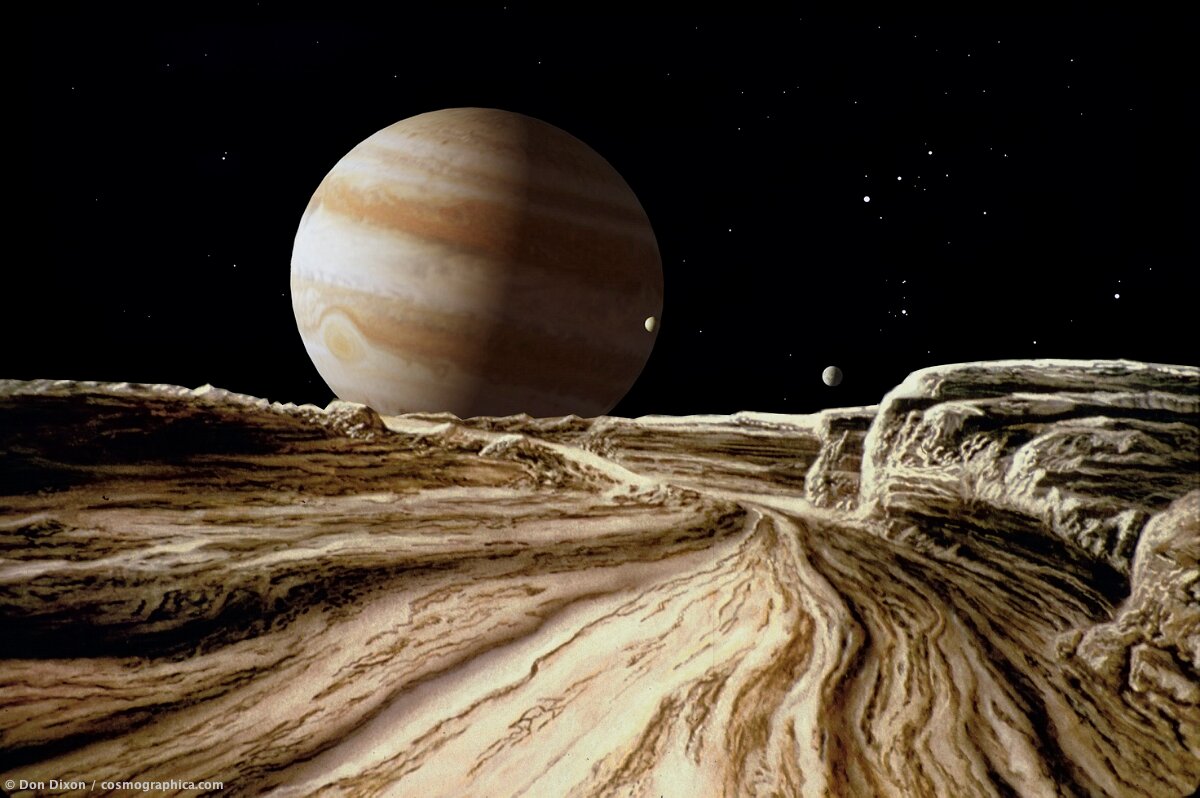
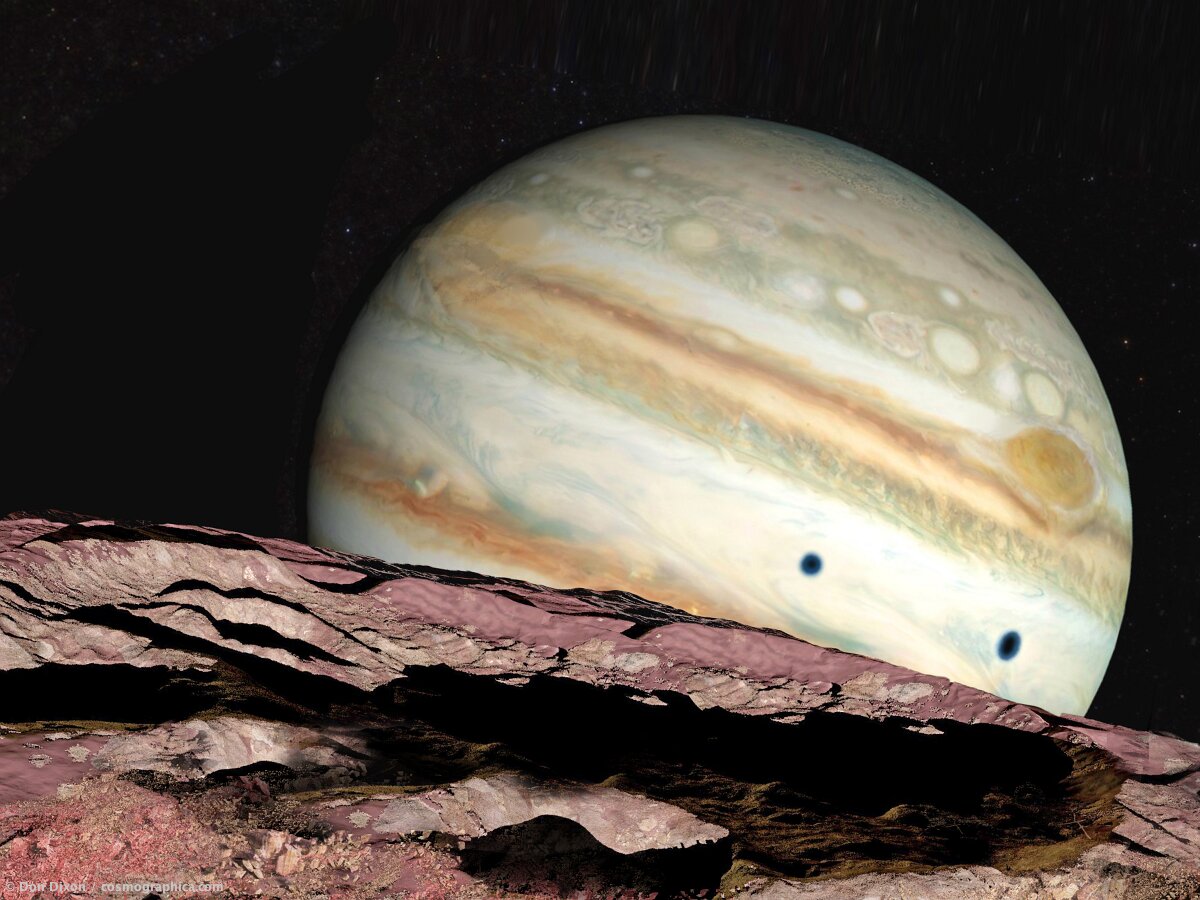
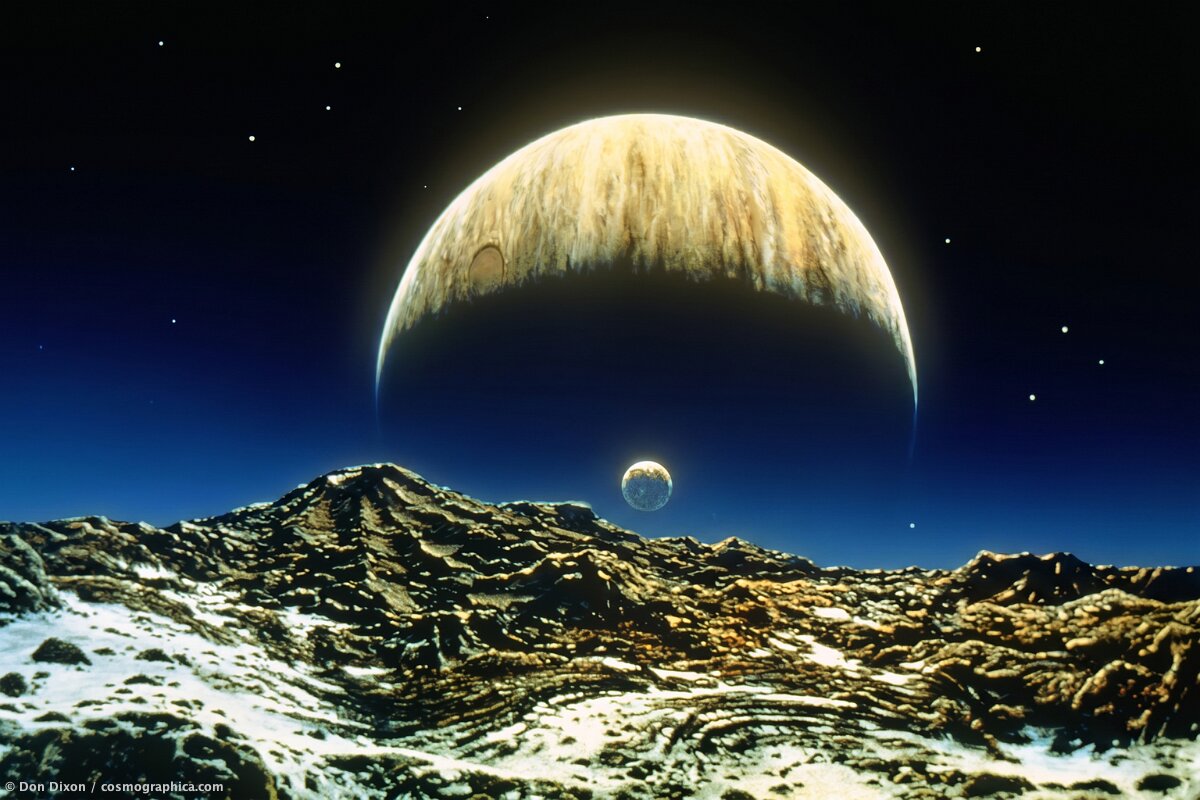
142-ganymede-dixon – A wide-angle perspective from the deeply grooved and stratified surface of the Jovian moon Ganymede, looking down an icy, undulating tectonic valley framed by weathered ridges. In the deep black sky above the flat horizon, a large, detailed Jupiter displays subtle atmospheric bands and swirling weather patterns. Two smaller moons hang nearby in the star-flecked vacuum, with one positioned close to Jupiter's edge and the other suspended further to the right.
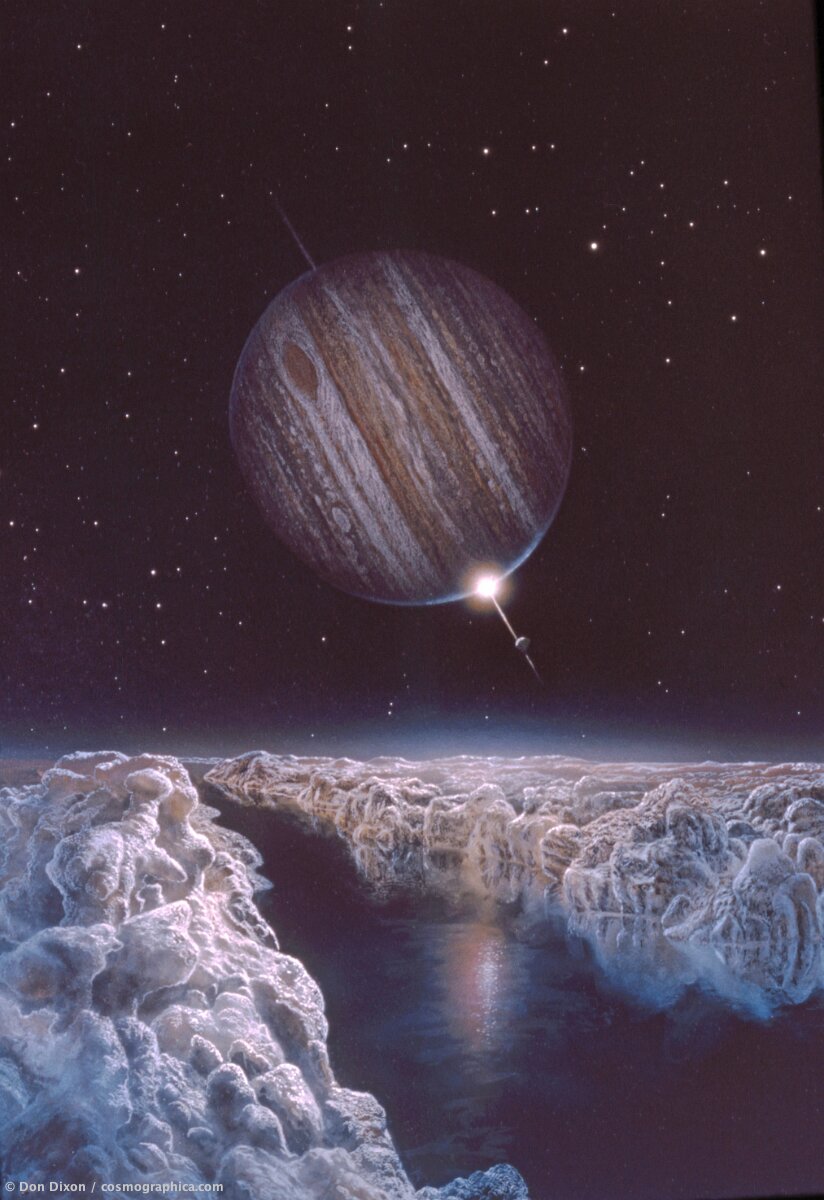
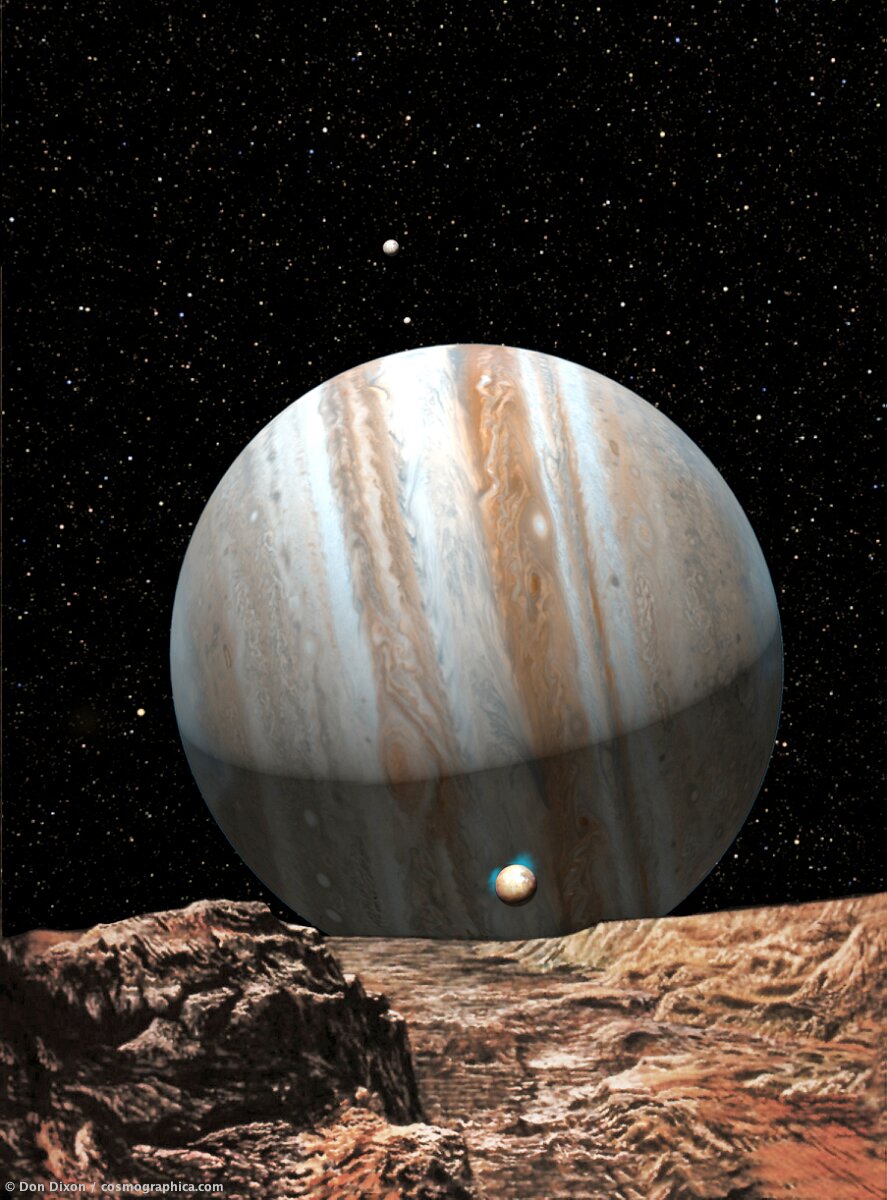
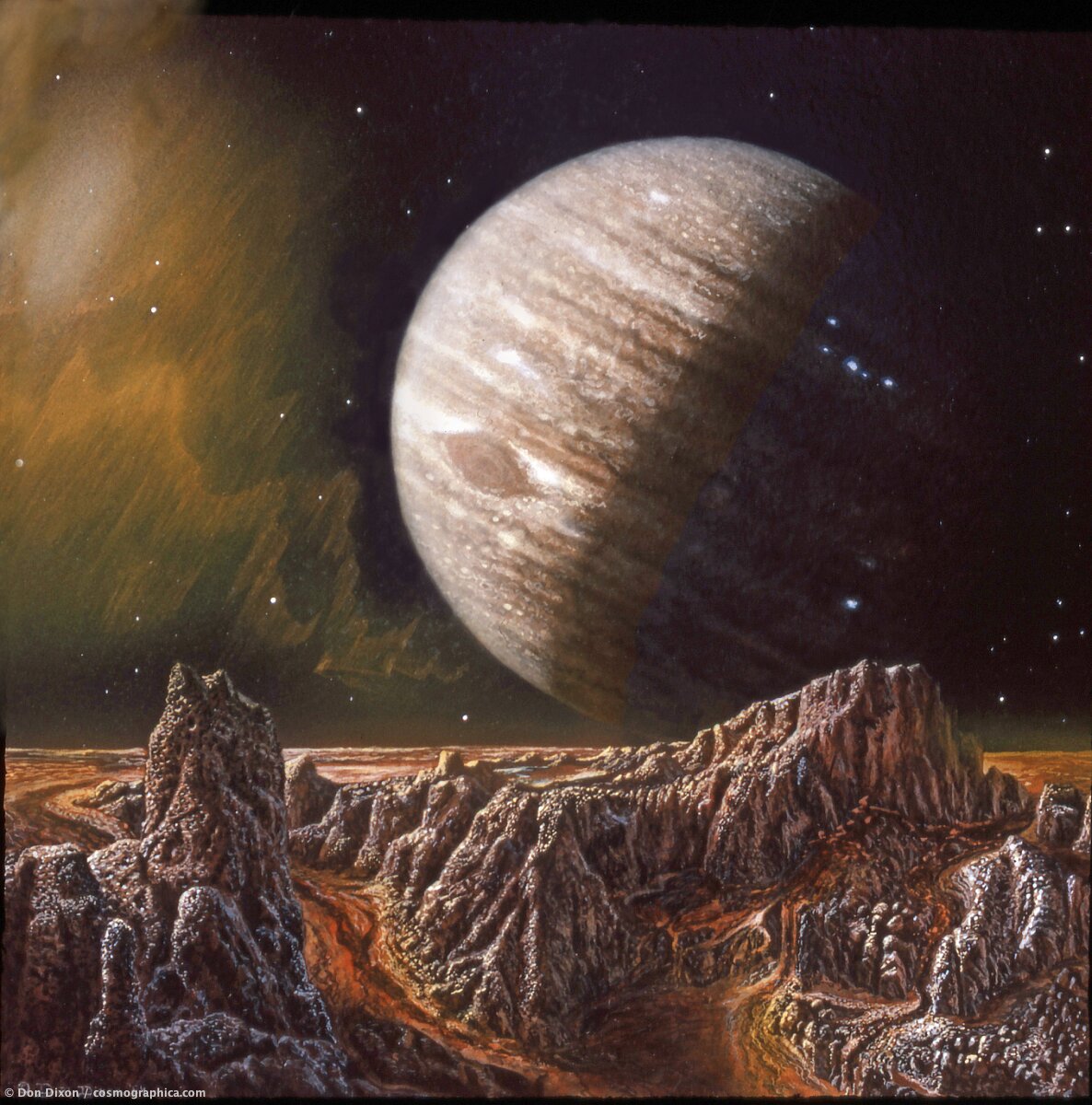
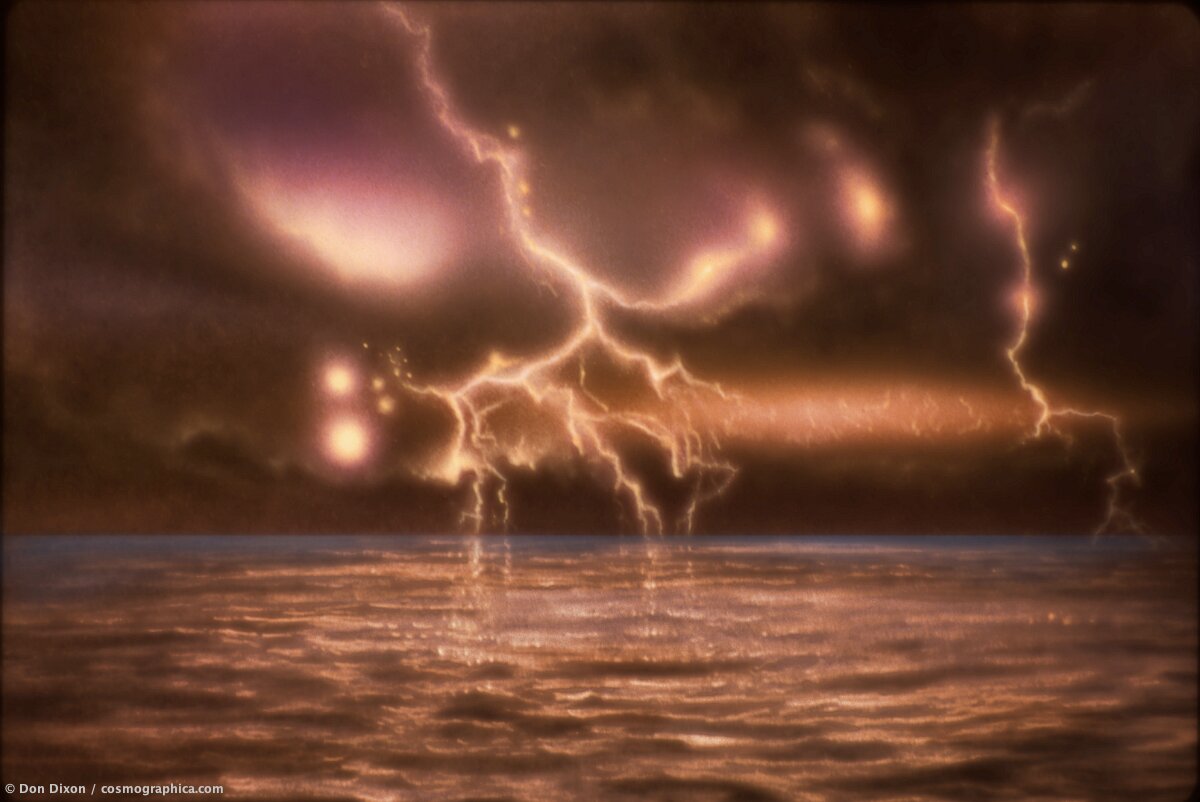
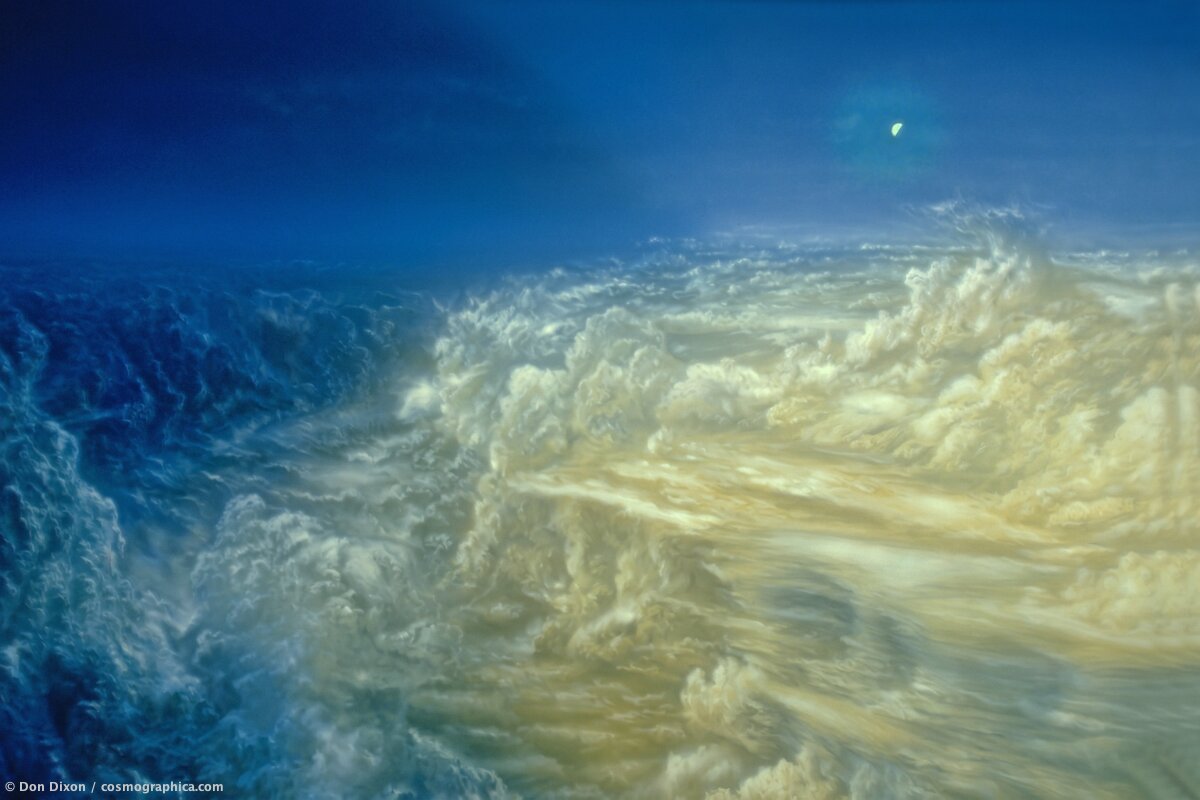
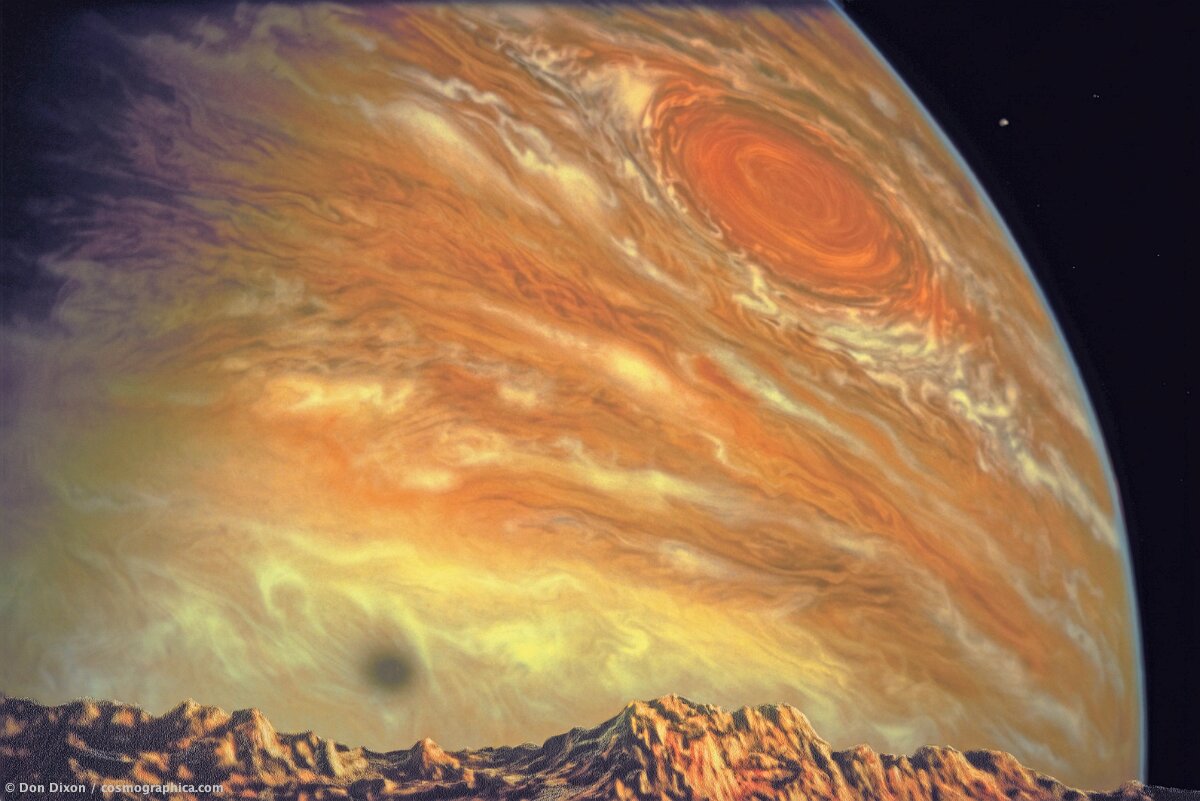
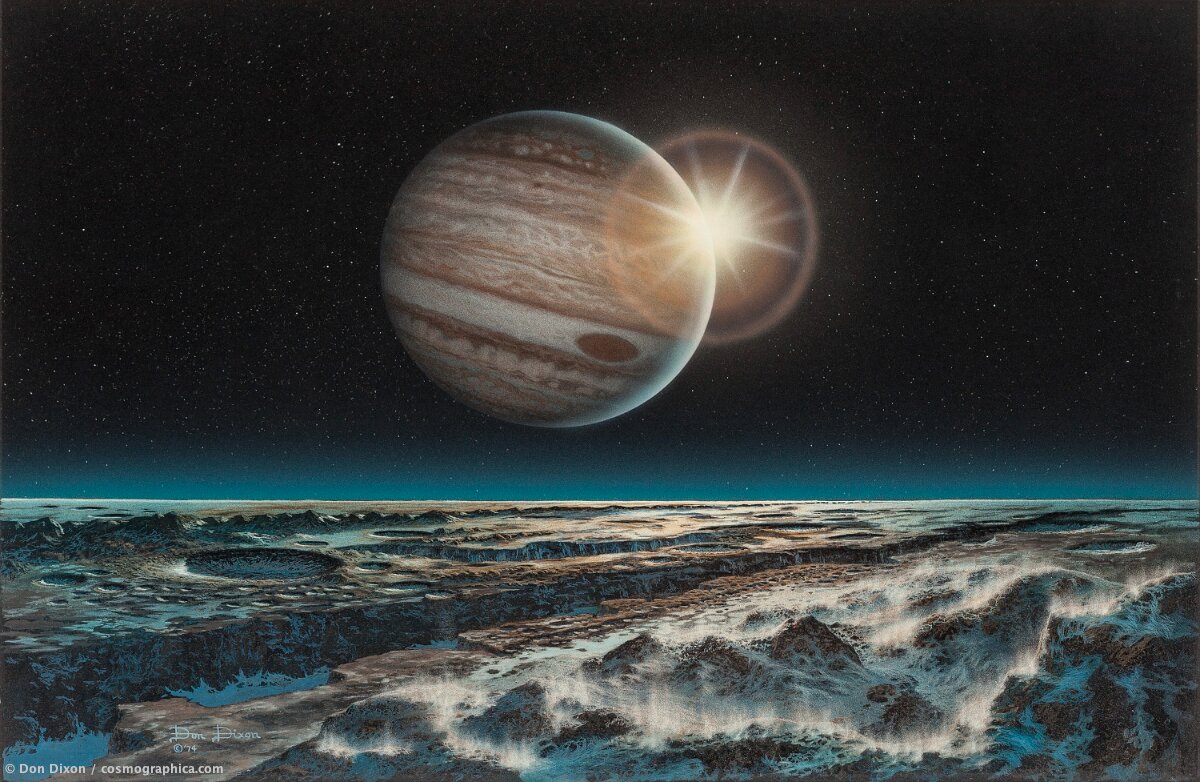
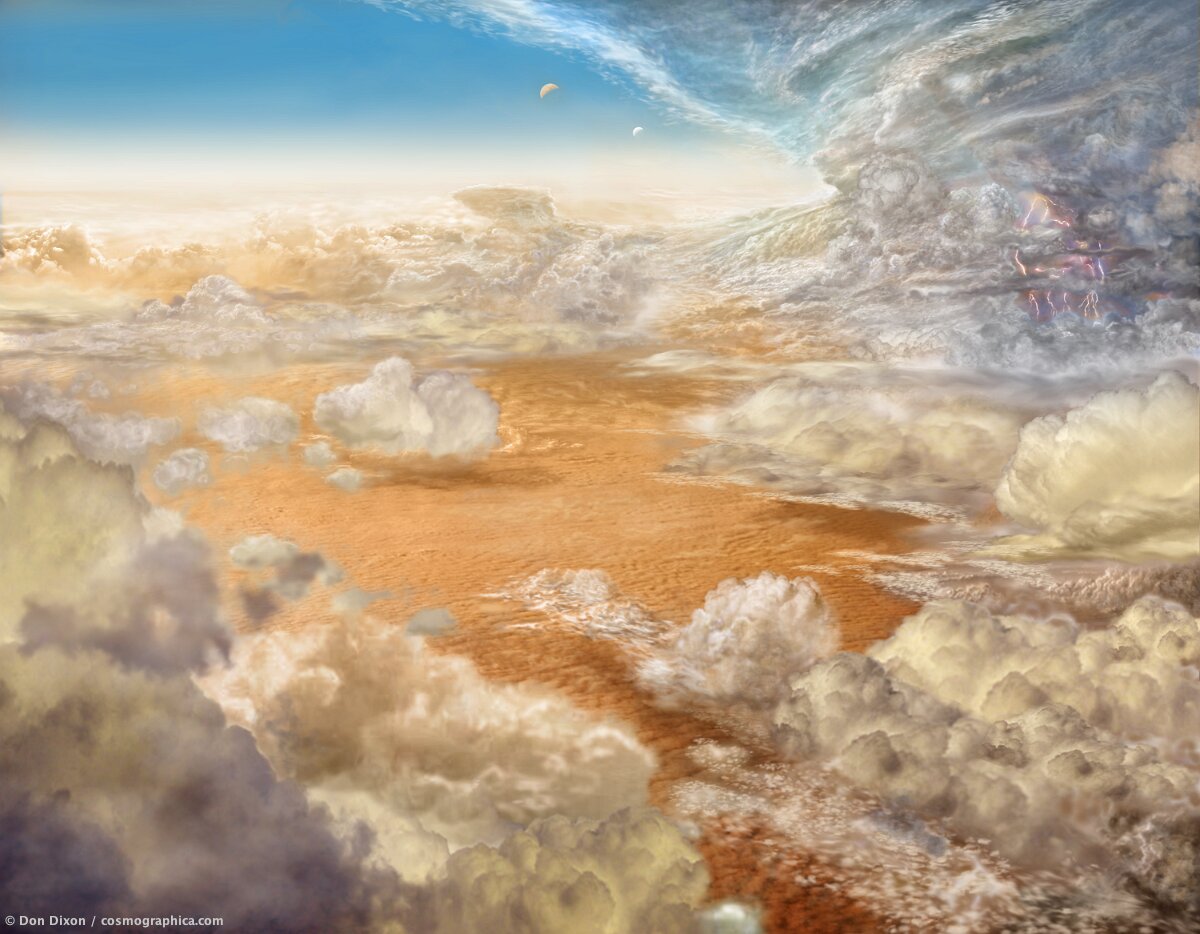
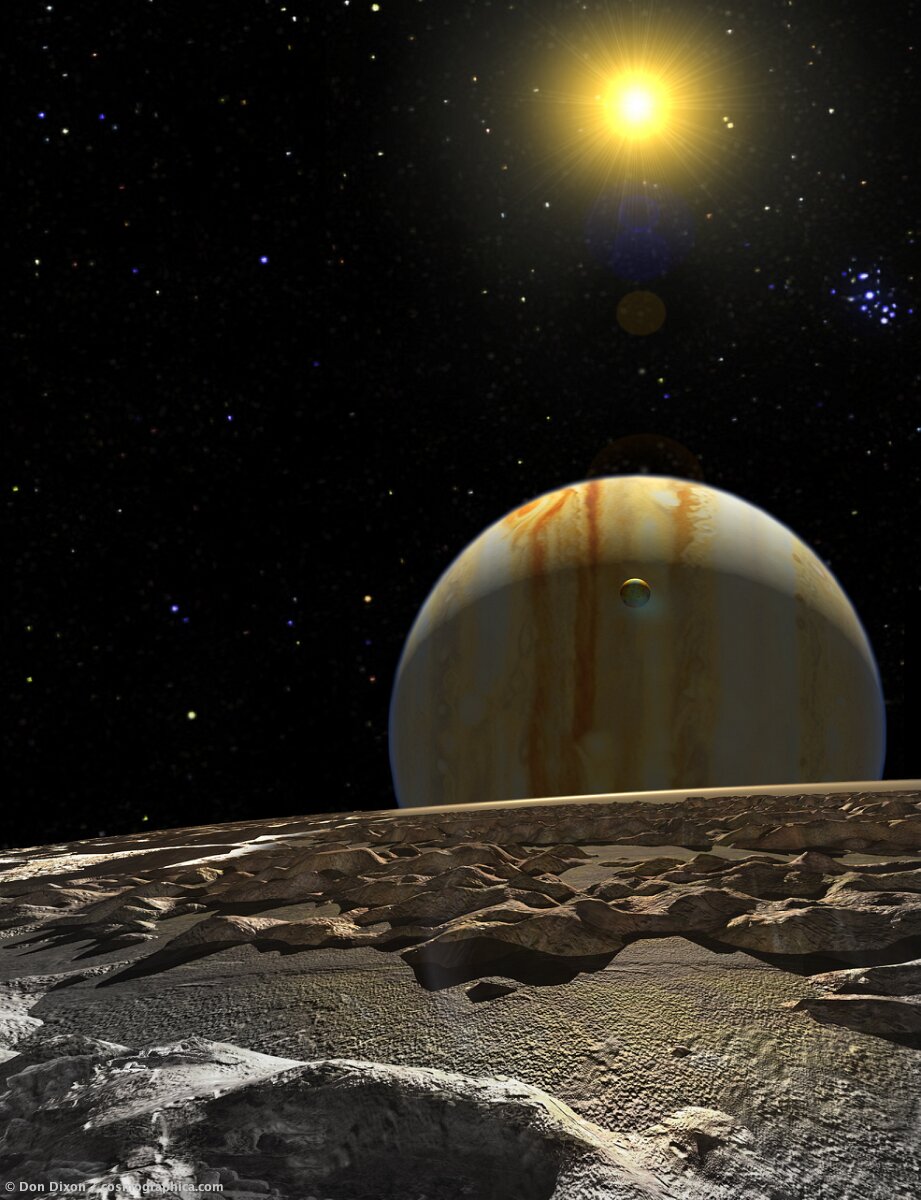
047-eclipse-from-io-1 – The Sun begins to slip from behind the massive disk of Jupiter as viewed from the fractured surface of its moon Io, creating a brilliant lens flare along the planet's limb. The gas giant dominates the starry sky, showcasing its iconic Great Red Spot and highly detailed atmospheric bands in ochre and cream tones. Below, the craggy landscape features dramatic scarps, a prominent impact crater on the left, and plumes of sublimating frost venting into the thin atmosphere across the right foreground. acrylic and goache painting on illustration board; © Don Dixon, 1974
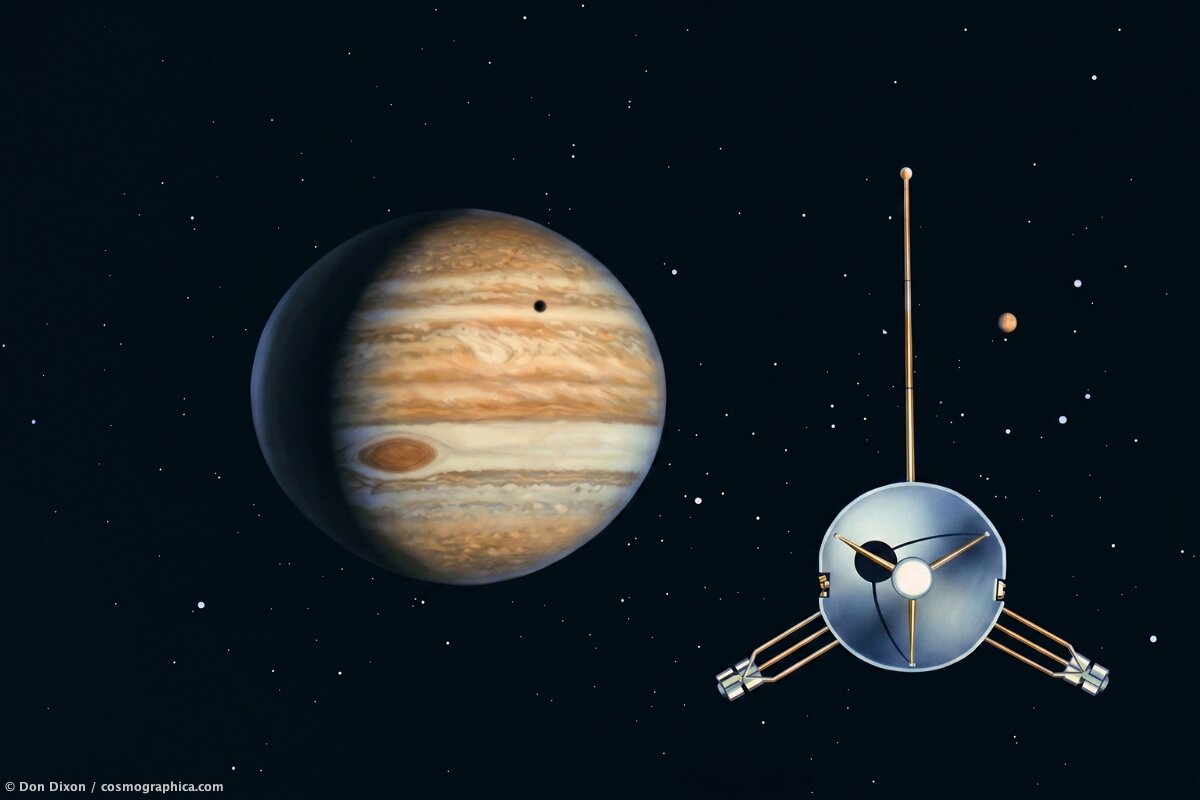
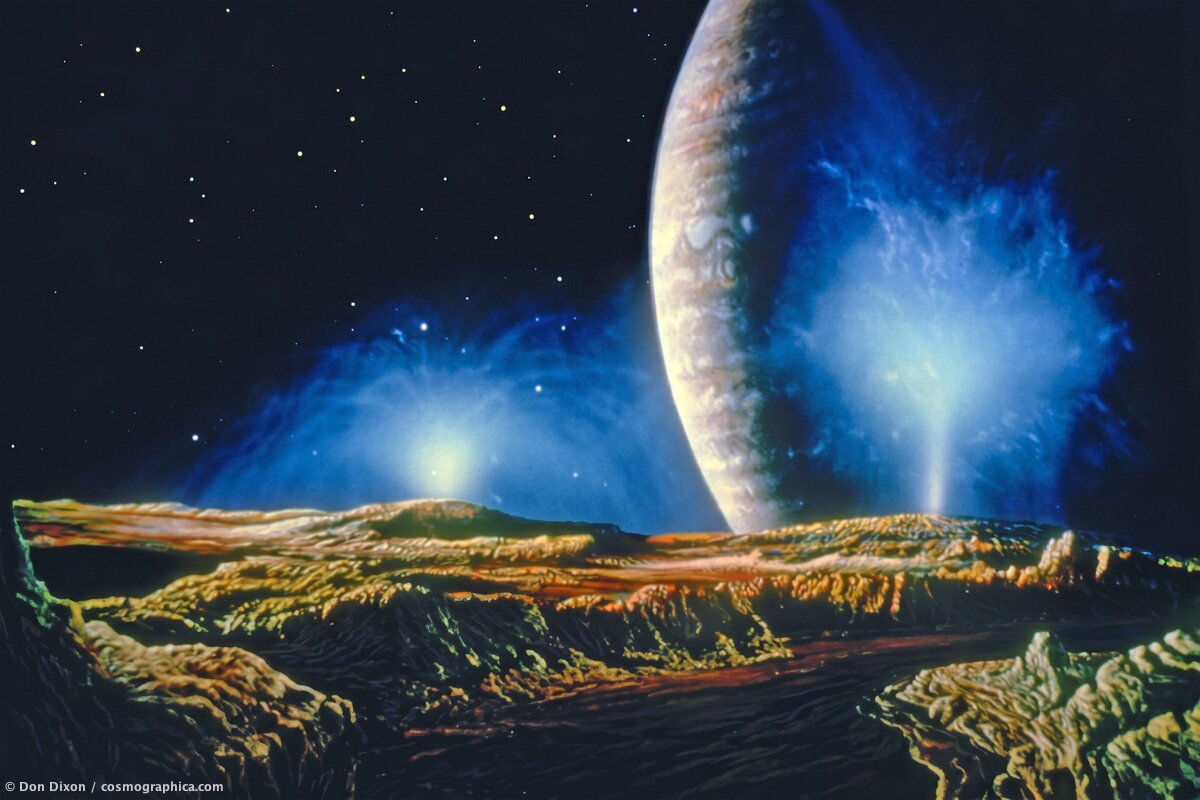
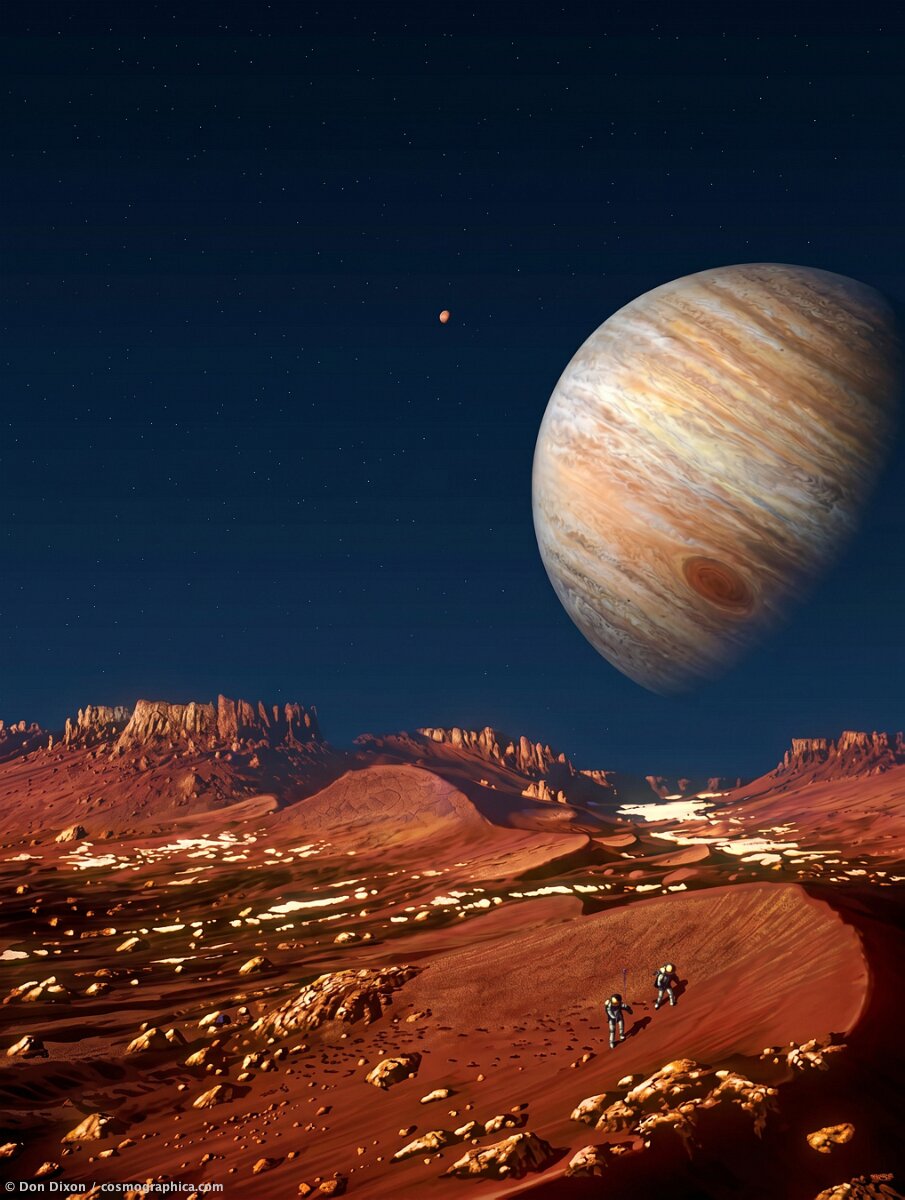
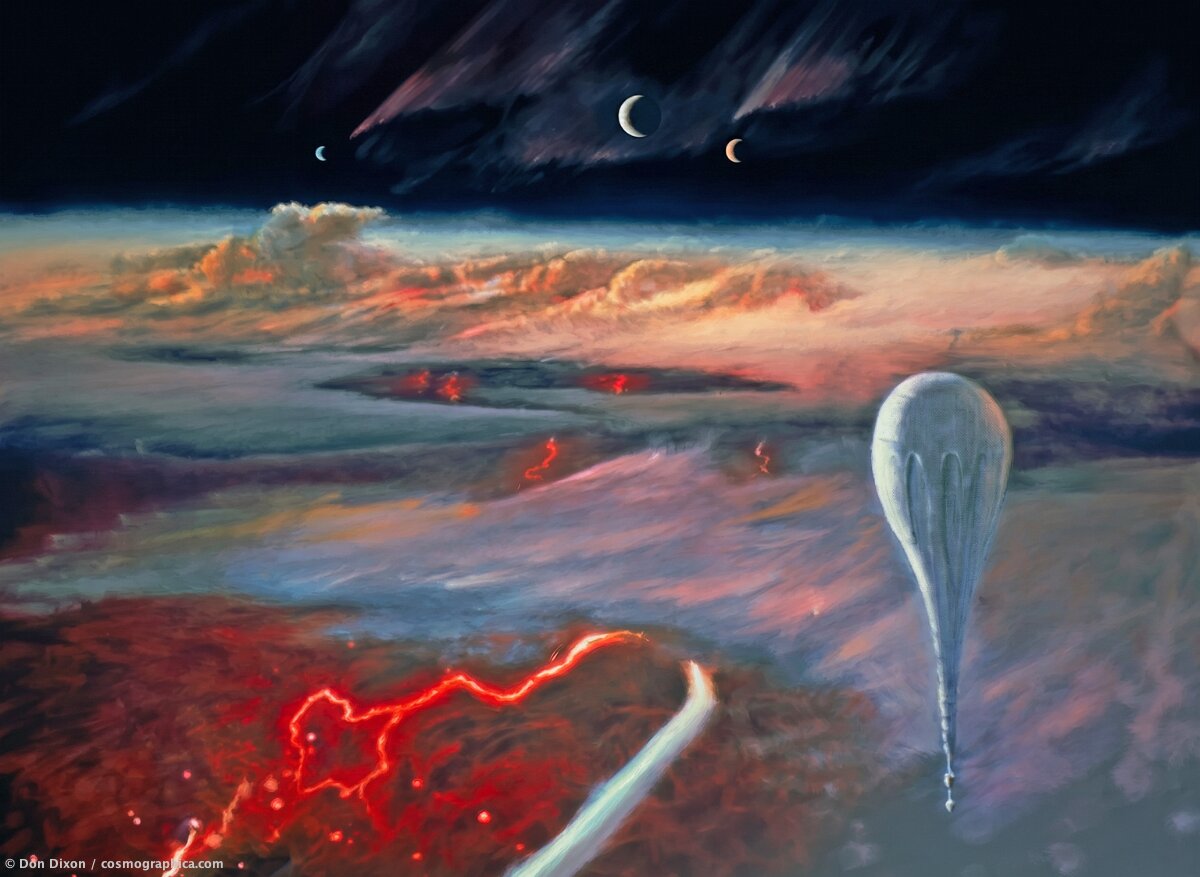
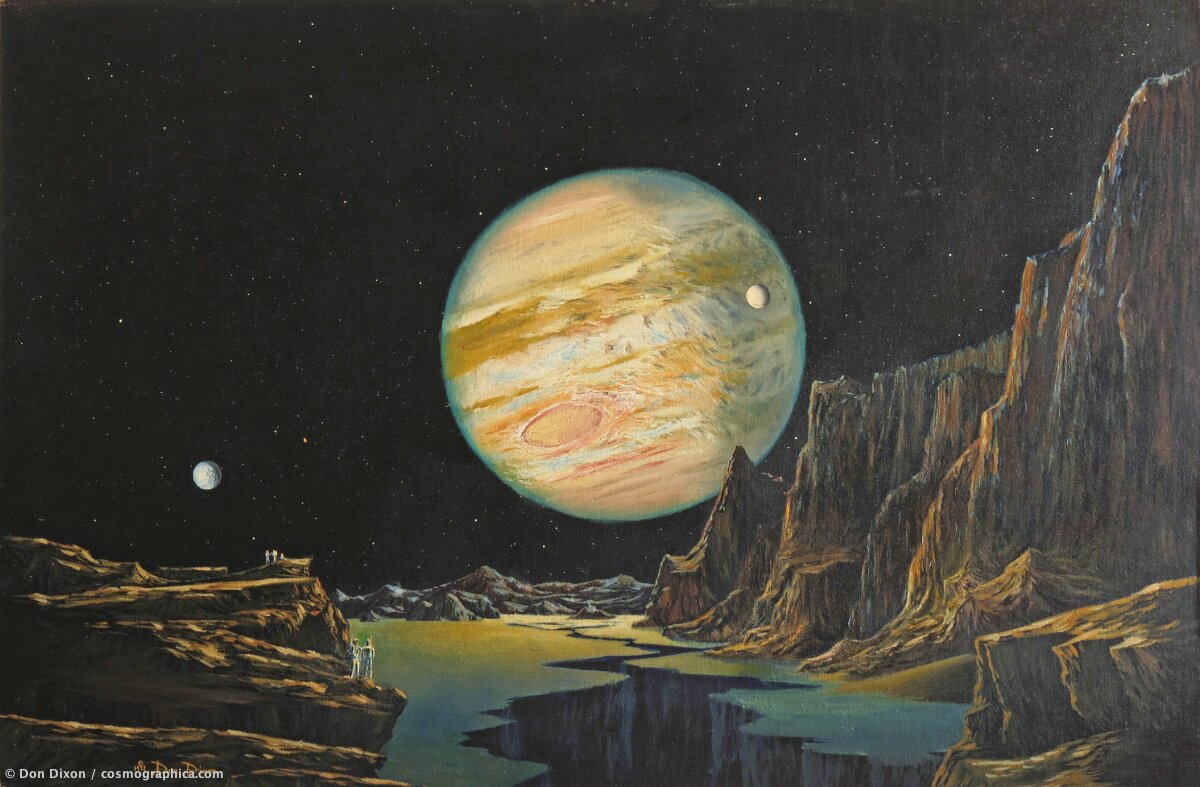
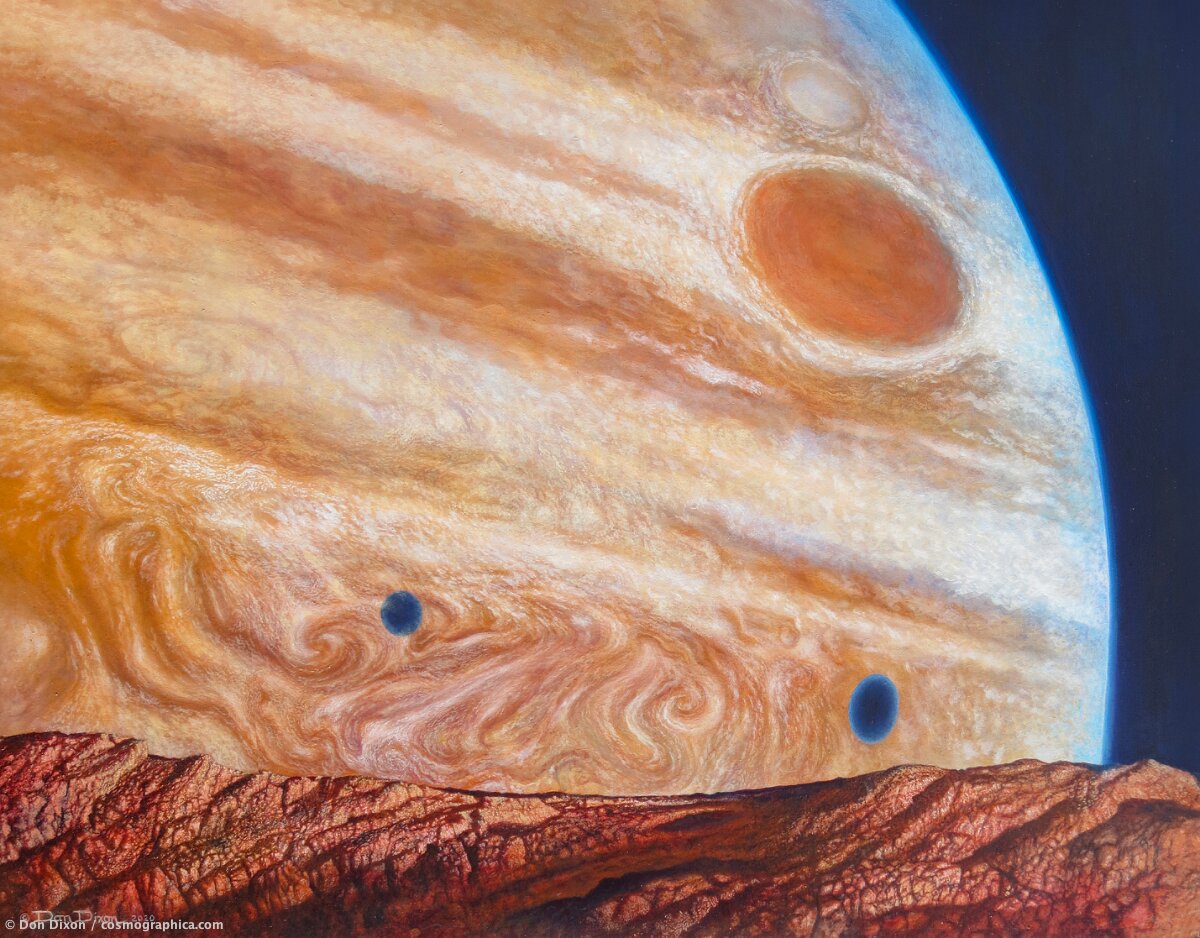
014-ganymede-dixon – Exploring Ganymede ; an early Don Dixon painting showing astronauts exploring one of Jupiter's moons; A large, near-full Jupiter dominating the star-filled sky displays pronounced, swirling atmospheric bands and a prominent, pale Great Red Spot near its southern limb. A small moon transits across the upper right quadrant of the gas giant, while another icy, textured moon hangs further out in deep space to the left. The scene is viewed from a deep canyon on Ganymede, where several tiny astronauts in white spacesuits explore flat-topped mesas and a smooth valley floor bordered by massive, fractured stone cliffs on the right. 24 x 36 inches, oil on canvas, 1972; copyright Don Dixon