Mars

440-Exploring-Mars

440-Exploring-Mars

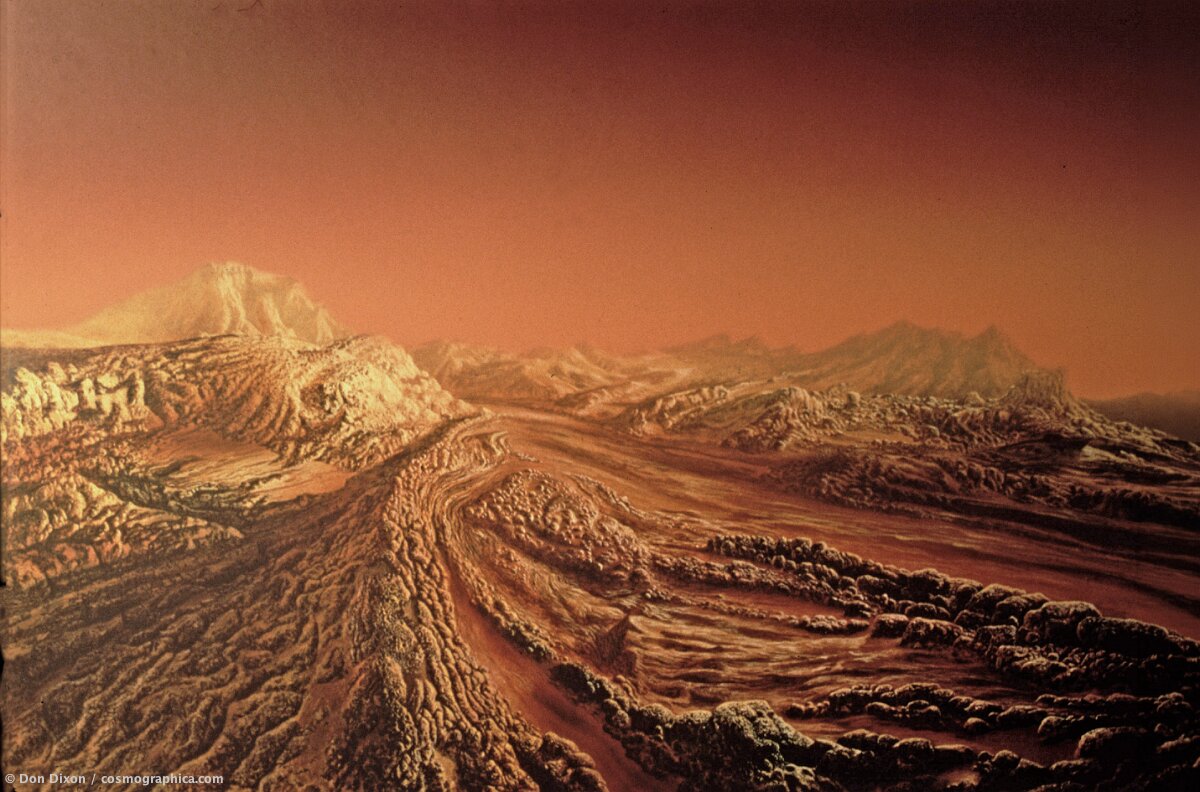
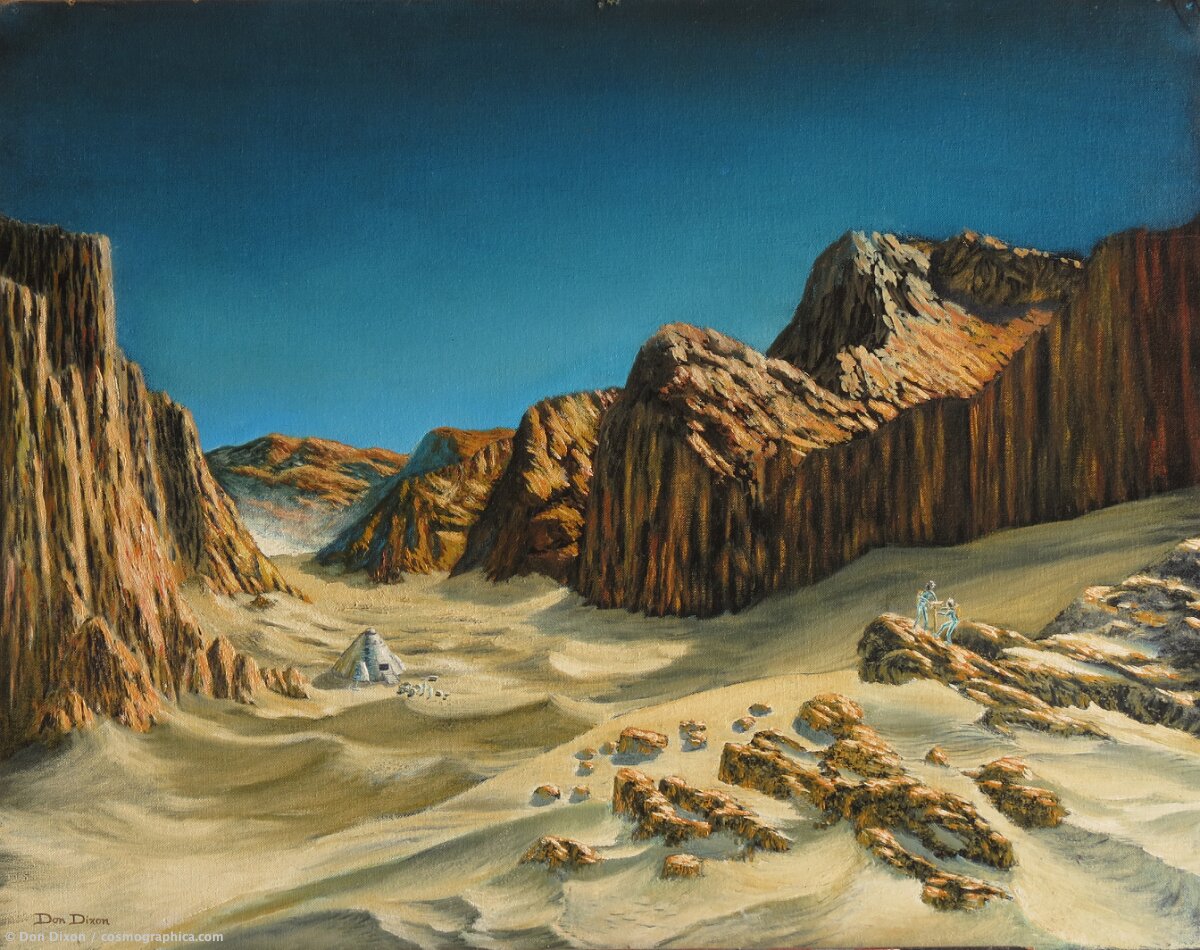
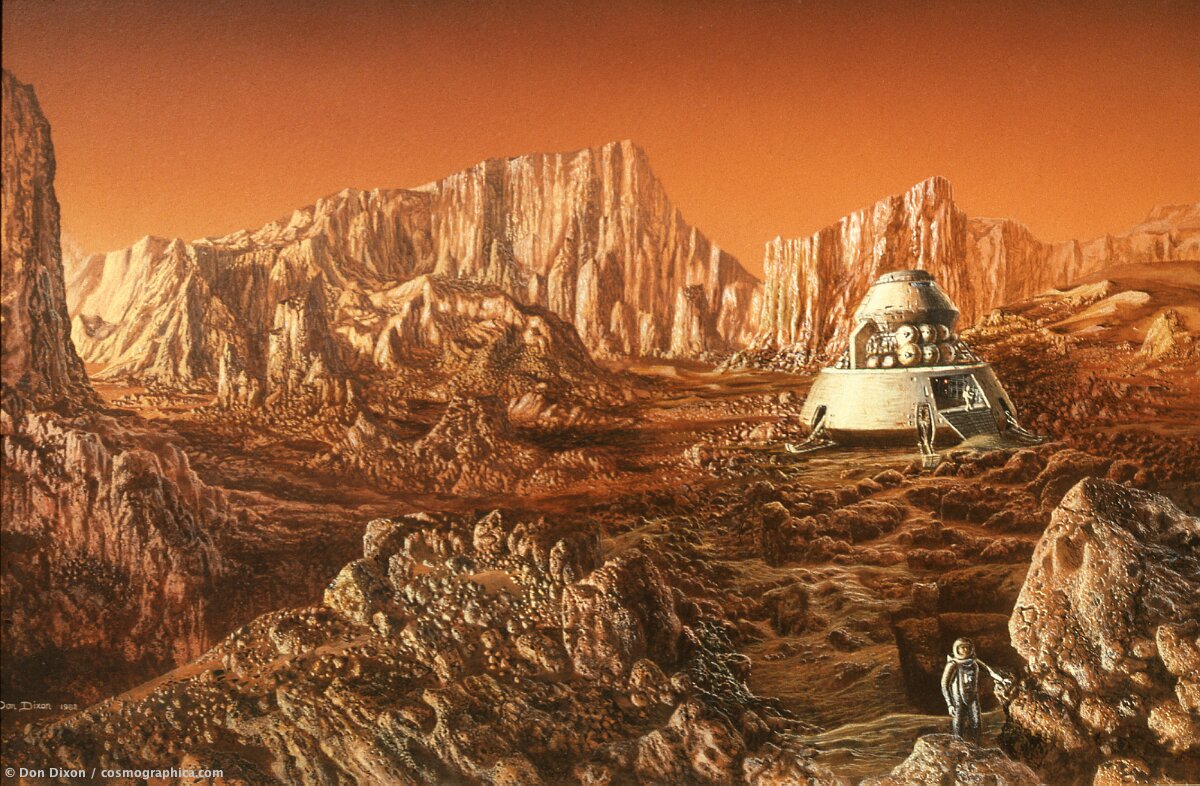
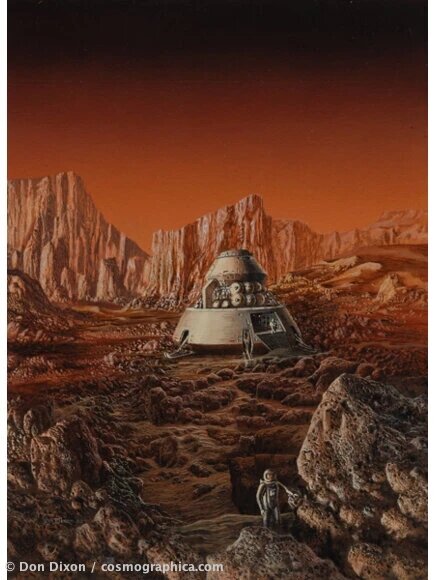
440-exploring-mars-dixon – A manned expedition unfolds on the rugged floor of a Martian canyon, featuring steep, layered cliffs and boulder-strewn terrain typical of Valles Marineris. A conical landing spacecraft sits parked in the middle distance with its egress ramp extended, while an astronaut in a full pressure suit stands in the lower right foreground surveying a large rock formation. The expansive landscape is bathed in a distinct, pale orange illumination under a thick, dust-laden Martian sky. Acrylic and gouache, 1983.
405-Mars-Colony-02
405-Mars-Colony-02
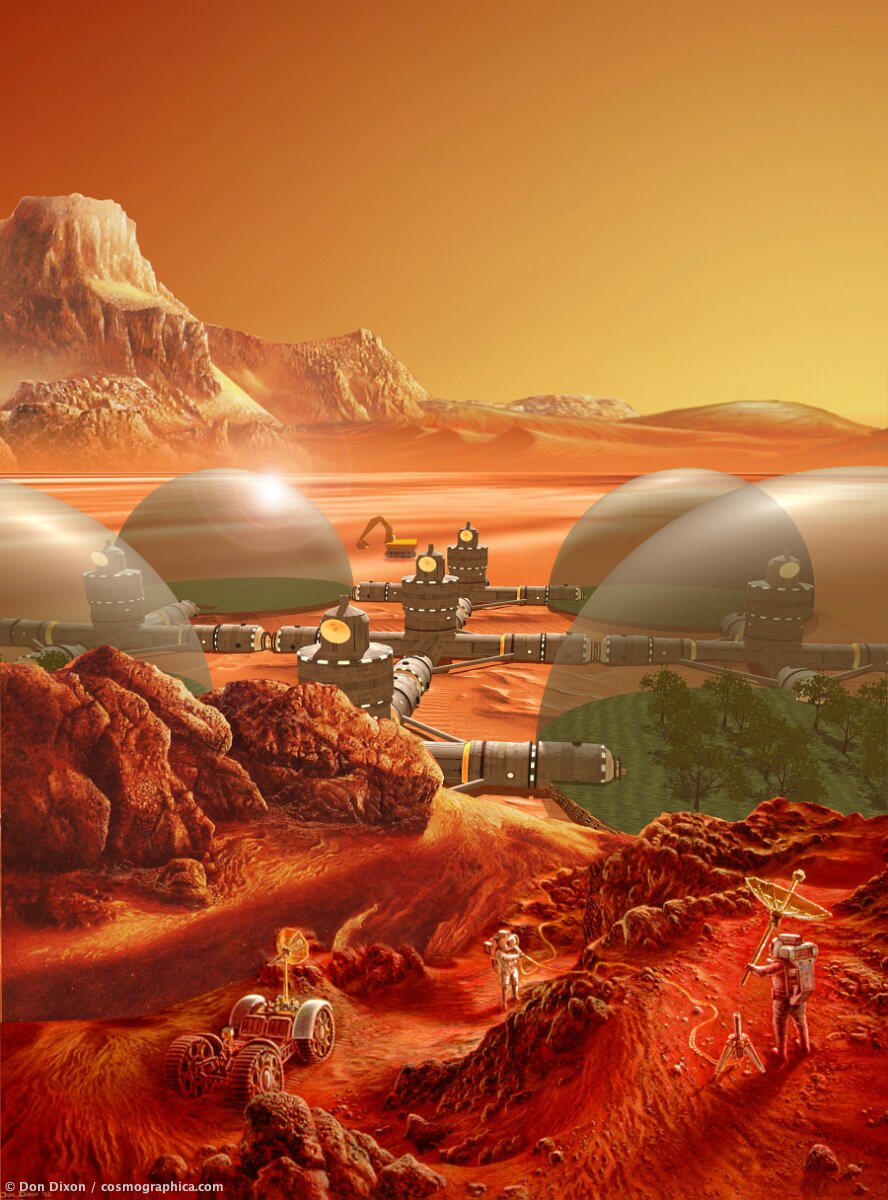
405-mars-colony-02-dixon –This vertical space art composition visualizes a future human outpost establishing a permanent presence on the Martian surface. A network of pressurized habitats and transparent agricultural domes containing green trees is built into a flat desert plain, linked together by enclosed transit tubes. In the foreground, two astronauts in pressure suits deploy scientific gear next to an exploration rover. Version 2. Digital, 2005.
404-Mars-Colony-01.jpg
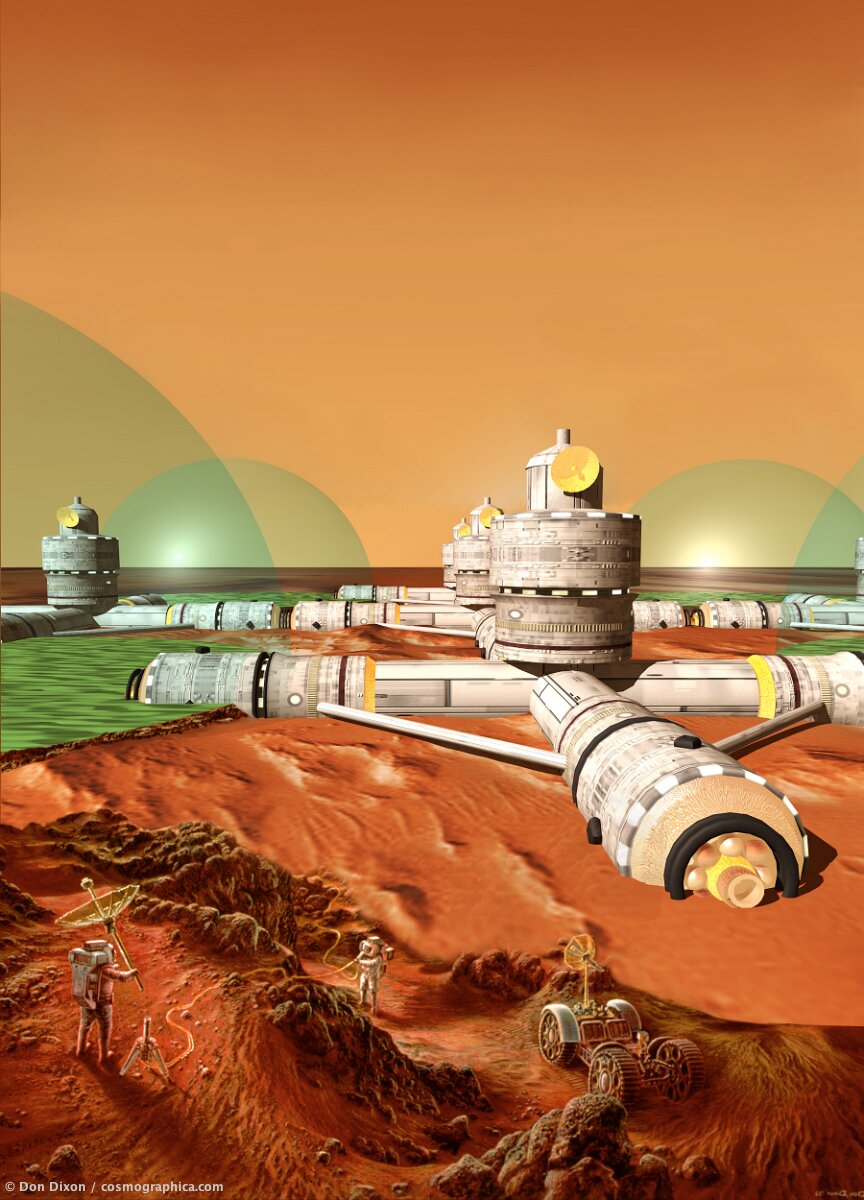
404-mars-colony-01-dixon – This vertical space art landscape provides an alternative foreground perspective of an expanding human settlement on the Martian surface. Cylindrical habitation modules and central command towers branch across the orange plains, flanked by large, translucent environmental biodomes showing internal greenery. From a rocky red vantage point in the lower left, two suited astronauts set up communications gear near a parked rover beneath a hazy, uniform salmon sky. Digital, 2005
370-Aldrin-Mars-Cycler

370-Aldrin-Mars-Cycler

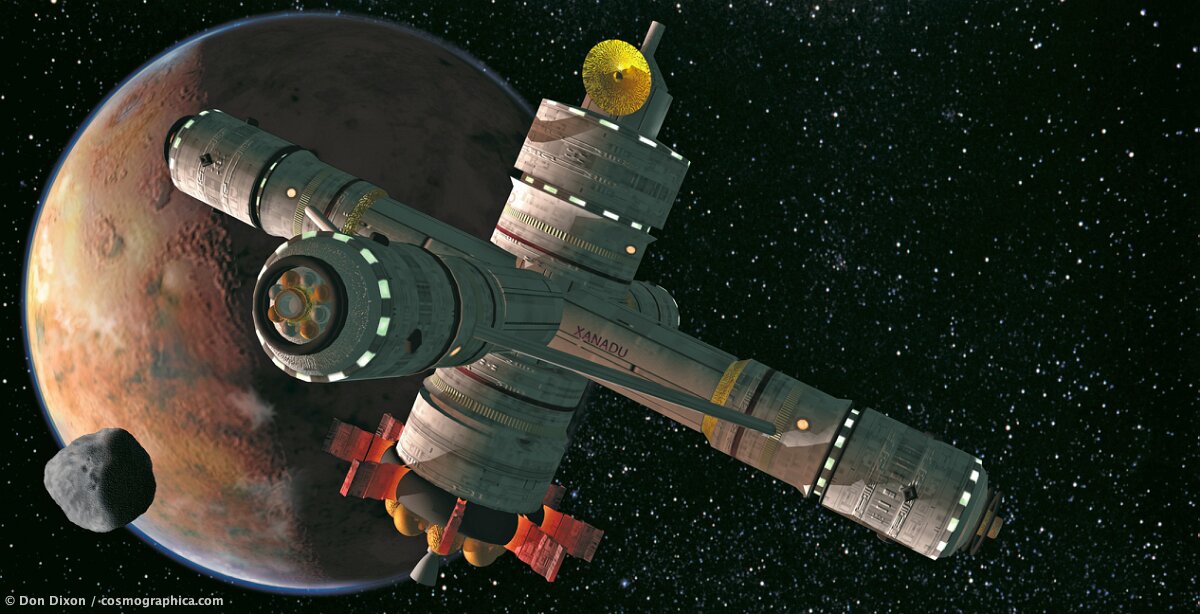
370-aldrin-mars-cycler-dixon – This astronomical illustration depicts the "Xanadu," a massive interplanetary spacecraft utilizing an Aldrin Mars cycler trajectory to transport crew and cargo between Earth and Mars. The modular, cross-shaped cycler vehicle dominates the foreground, featuring long cylindrical habitat bays and a large parabolic communication dish on its central axis. The planet Mars looms in the background, showing distinct surface markings and a thin atmospheric limb, flanked by its small, irregular moon Phobos. - painting by Don Dixon for Scientific American
357-Mars-Impact
357-Mars-Impact
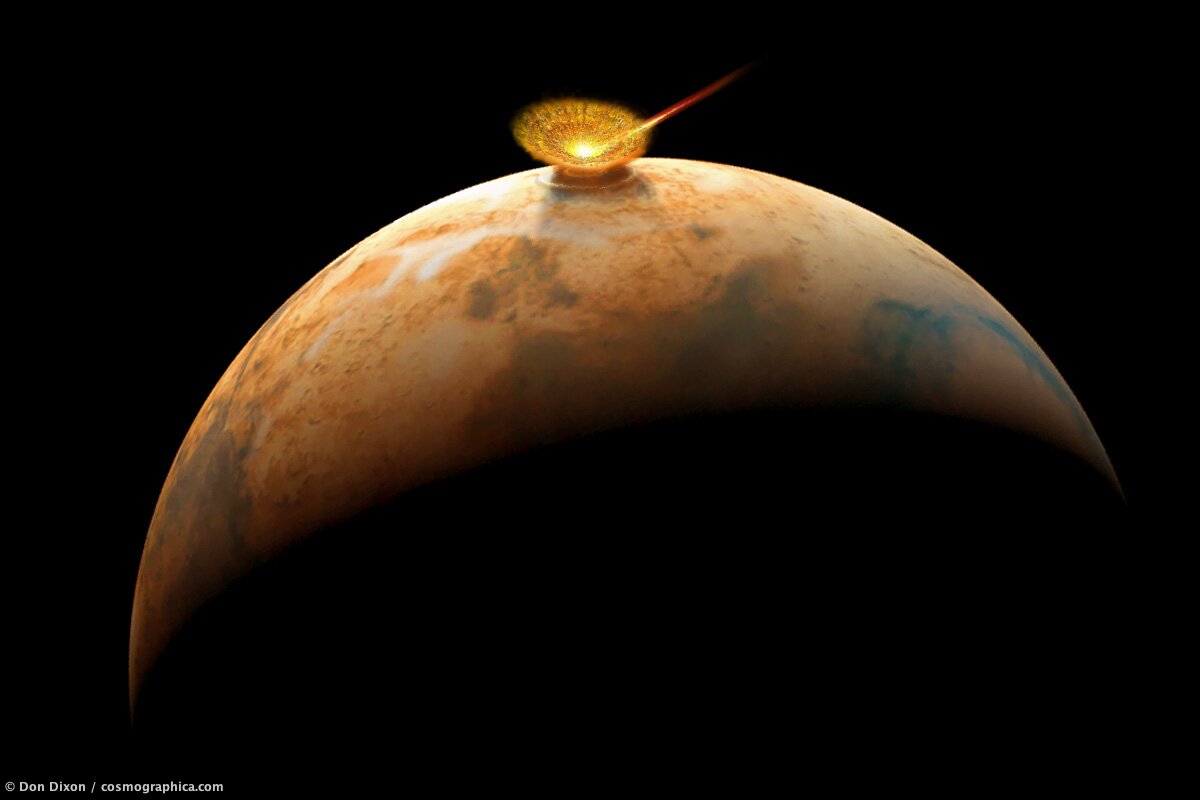
357-mars-impact-dixon – An asteroid Impact on Mars ejects meteorites to Earth. This space art rendering illustrates a high-energy impact event occurring on the northern hemisphere of Mars. A large asteroid or comet strikes the planet at a shallow angle, creating a brilliant, self-luminous impact crater and lofting a high-velocity plume of superheated rock vapor and ejecta into the vacuum of space. The crescent Mars displays a dusty, mottled surface texture, partially illuminated against the absolute blackness of the background. - digital, 1997, © Don Dixon
351-Mars-Launch

351-Mars-Launch

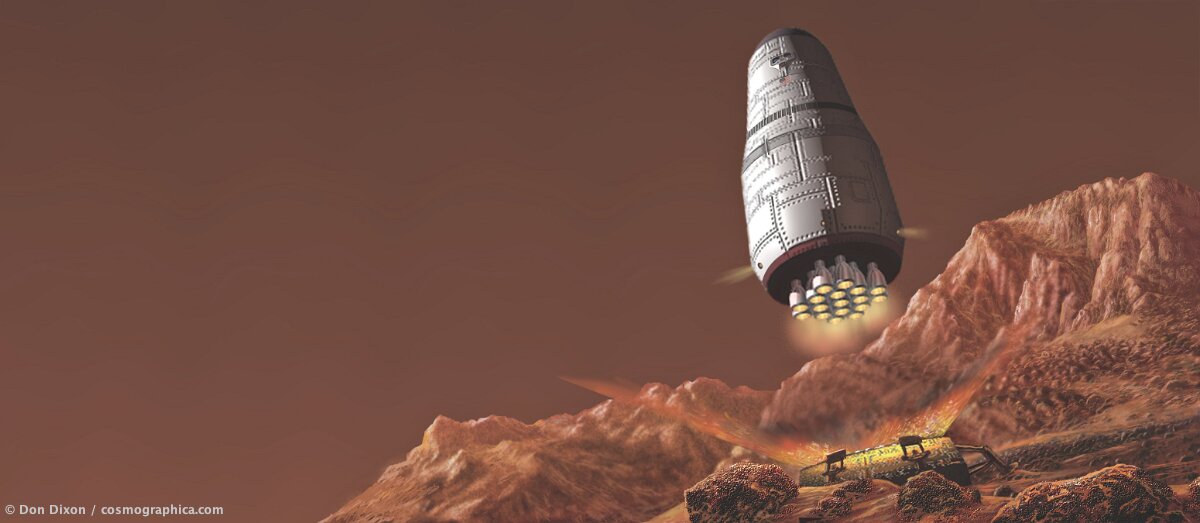
351-mars-launch-dixon – Mars Direct Earth Return Vehicle Launches From Mars. A biconic Martian ascent vehicle blasts off from a rugged, dust-covered mountain ridge, its clustered engine bells firing with intense incandescent thrust. The rocket power kicks up a violent exhaust plume of surface dust and flame against the rocky topography below. The landscape and the wide, open sky are drenched in a uniform, deep monochromatic rust tone, capturing the thin, dusty atmospheric conditions of the Red Planet. digital, for Scientific American
319-approaching-deimos-dixon
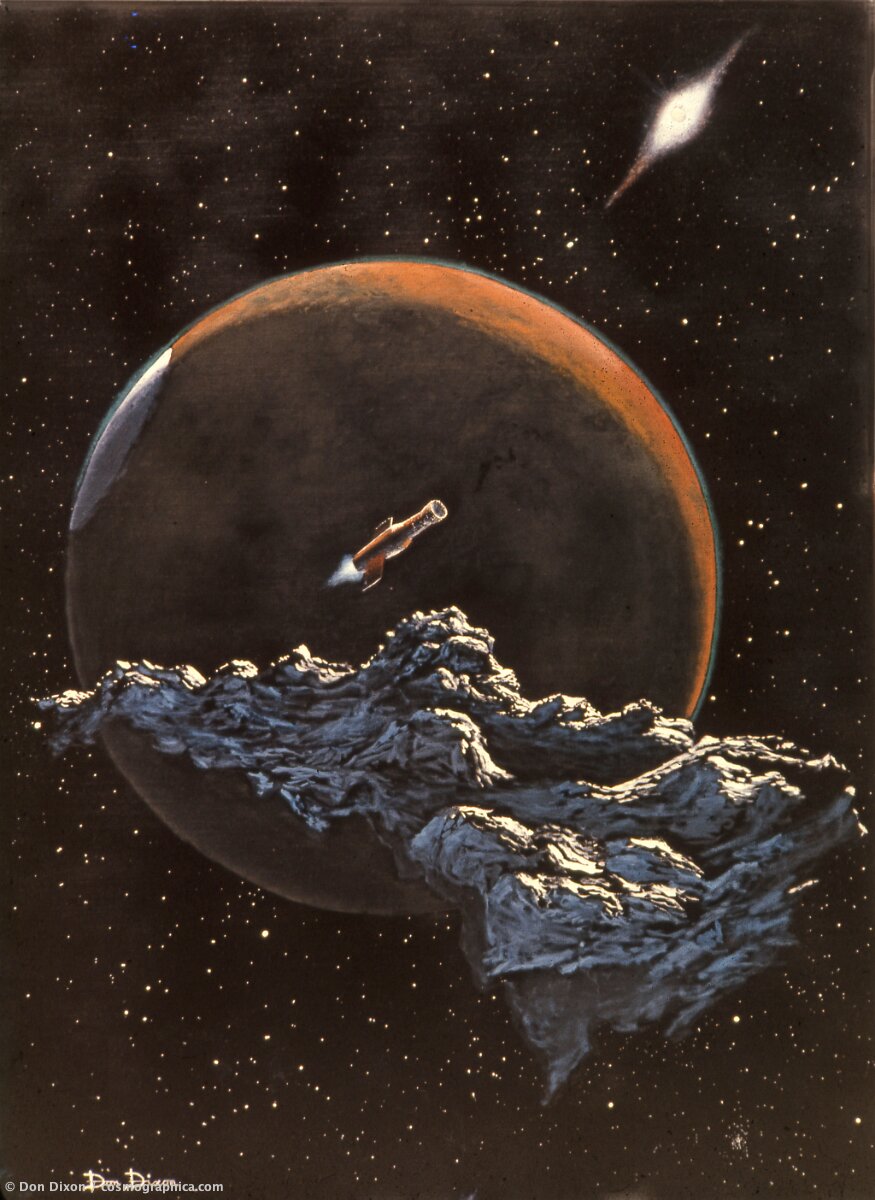
319-approaching-deimos-dixon – A recently discovered very early oil on canvas painting dating from 1972 shows a spacecraft maneuvering near Mars's outer moon. Outdated concept of Deimos. This striking space art composition looks across the jagged, irregular ridges of Mars’ outer moon, Deimos, as a nuclear rocket fires its attitude thrusters to approach the small moon. Mars fills the background as a massive, dark crescent, its illuminated limb revealing a thin orange haze layer. The sun blazes in the distance.
308-Mars-Base-Detail
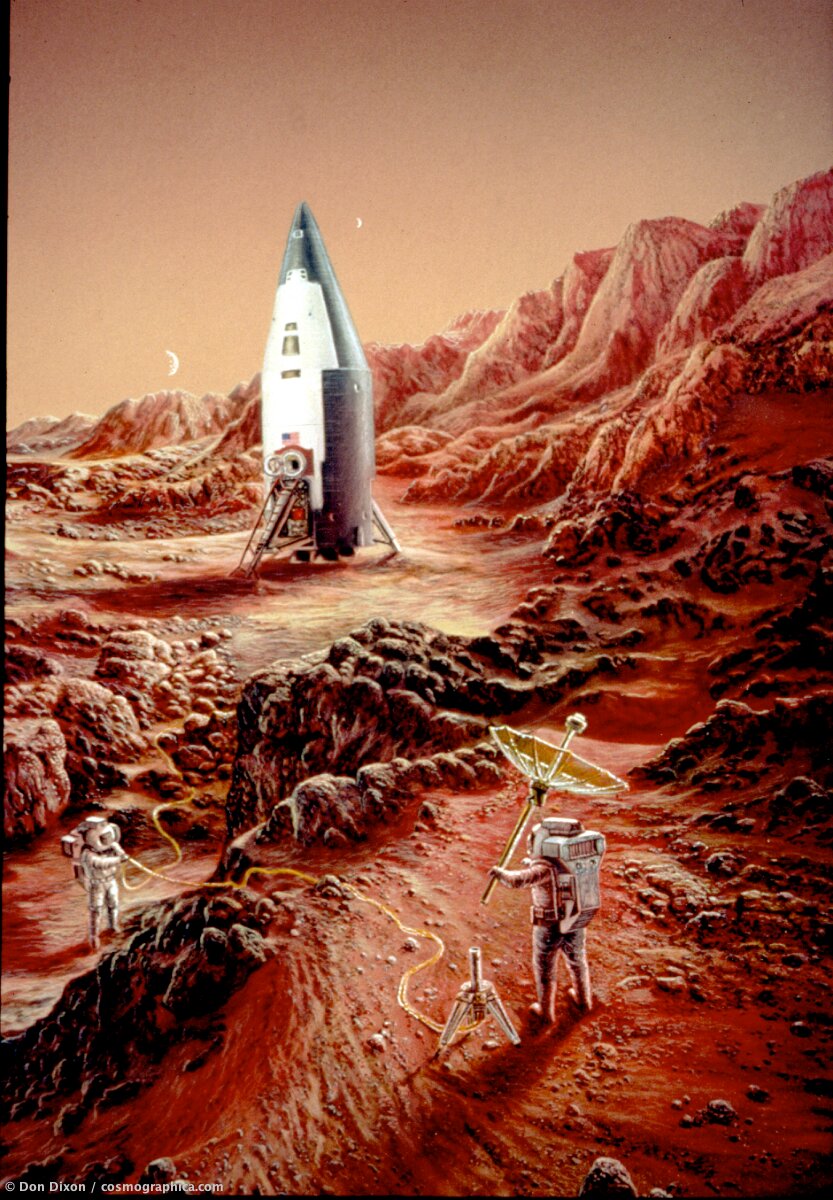
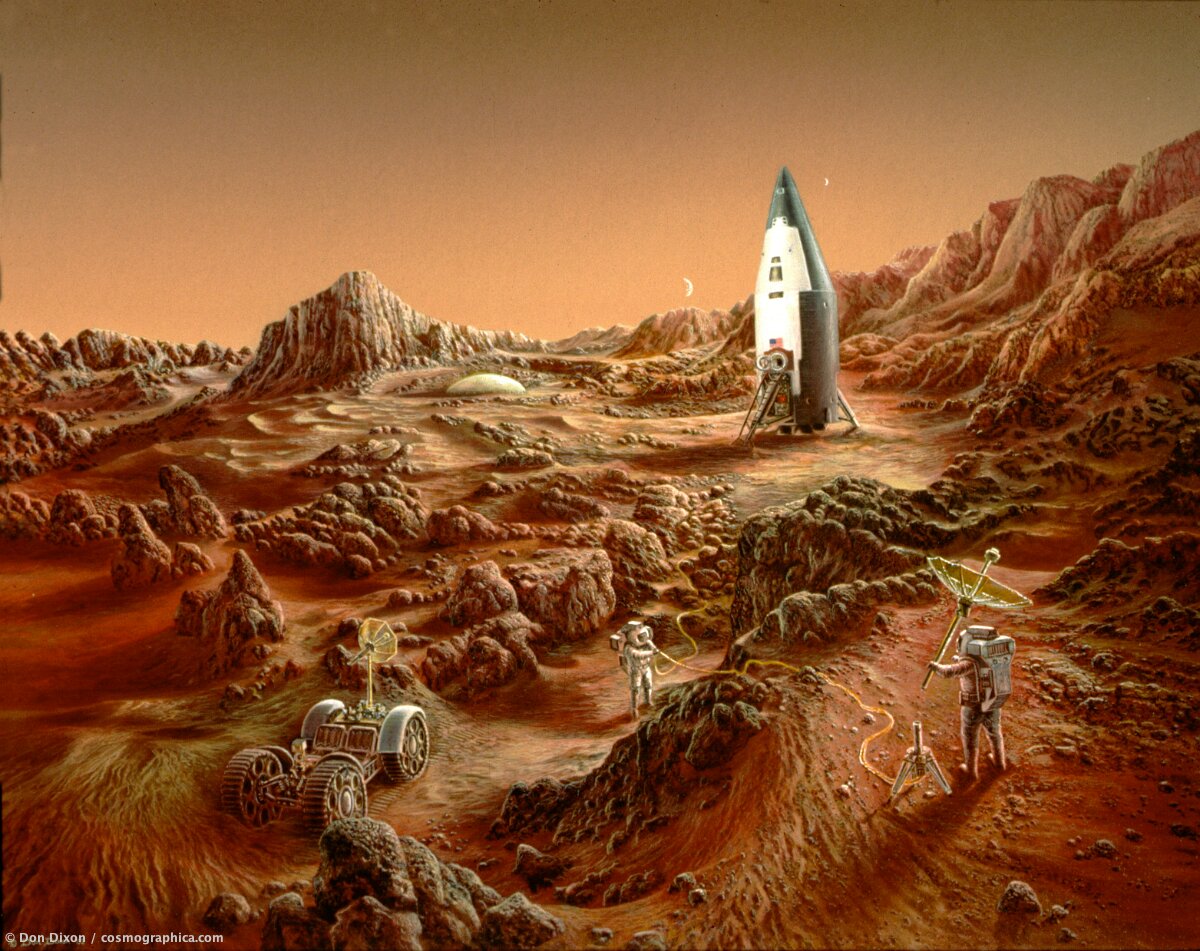
308-mars-base-detail-dixon – This vertical space art landscape documents an early human reconnaissance mission on Mars, focusing on surface communications and transportation infrastructure. In the foreground, two astronauts in heavy pressure suits assemble a portable parabolic satellite dish on a rugged, deep red rocky ridge. In the middle distance valley below, a sleek, black-and-white biconic rocket lander sits parked on its landing legs with an egress ladder extended. The background features steep, highly eroded crimson mountains under a hazy pinkish-tan sky, where two tiny crescent moons, Phobos and Deimos, are visible.
306-Red-Mars-Ship

306-Red-Mars-Ship

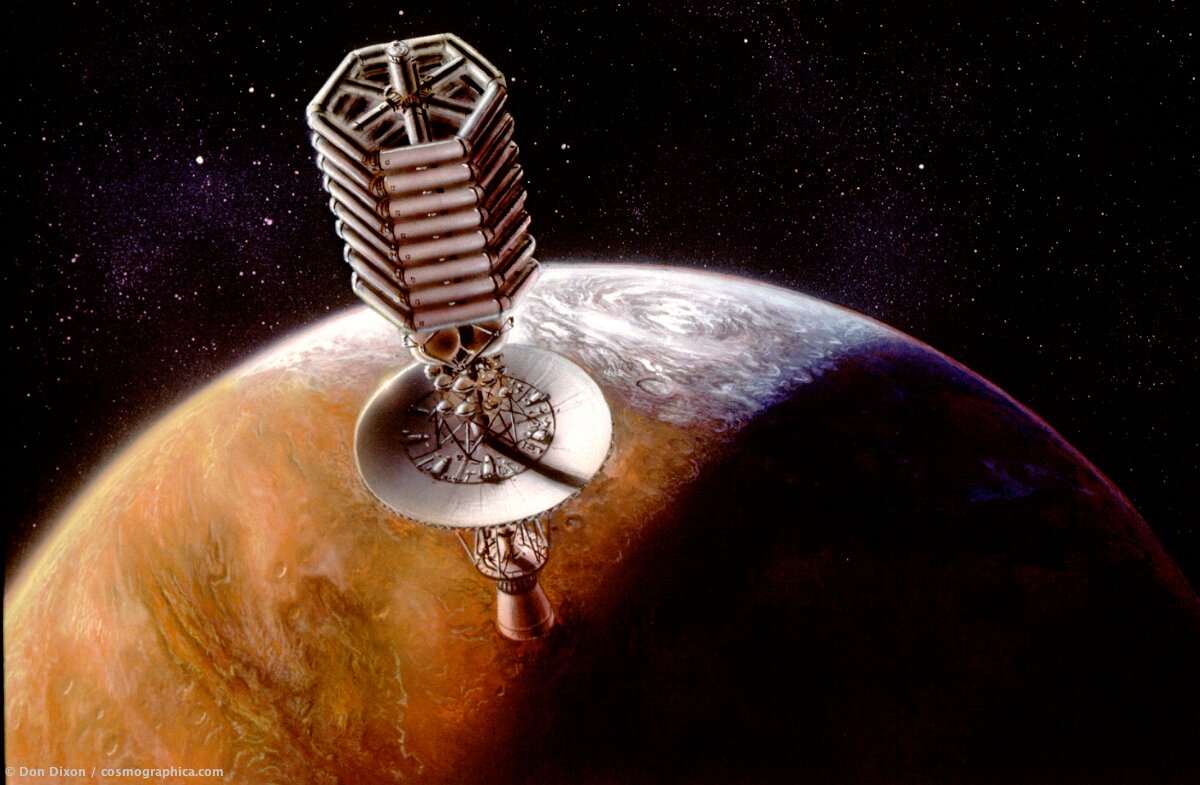
306-red-mars-ship-dixon – detail of colony ship from cover of Red Mars. This striking orbital perspective showcases a massive, complex interplanetary exploration vehicle arriving in Mars orbit. The vessel features a stacked, hexagonal array of cylindrical fuel tanks or habitat modules at its forward section, connected by a structural truss to an immense radiation shield. A large nuclear thermal nozzle terminates the stack. Below, the mottled, rust-colored globe of Mars curves dramatically into darkness. acrylic, around 1991
283-phobos-base-dixon
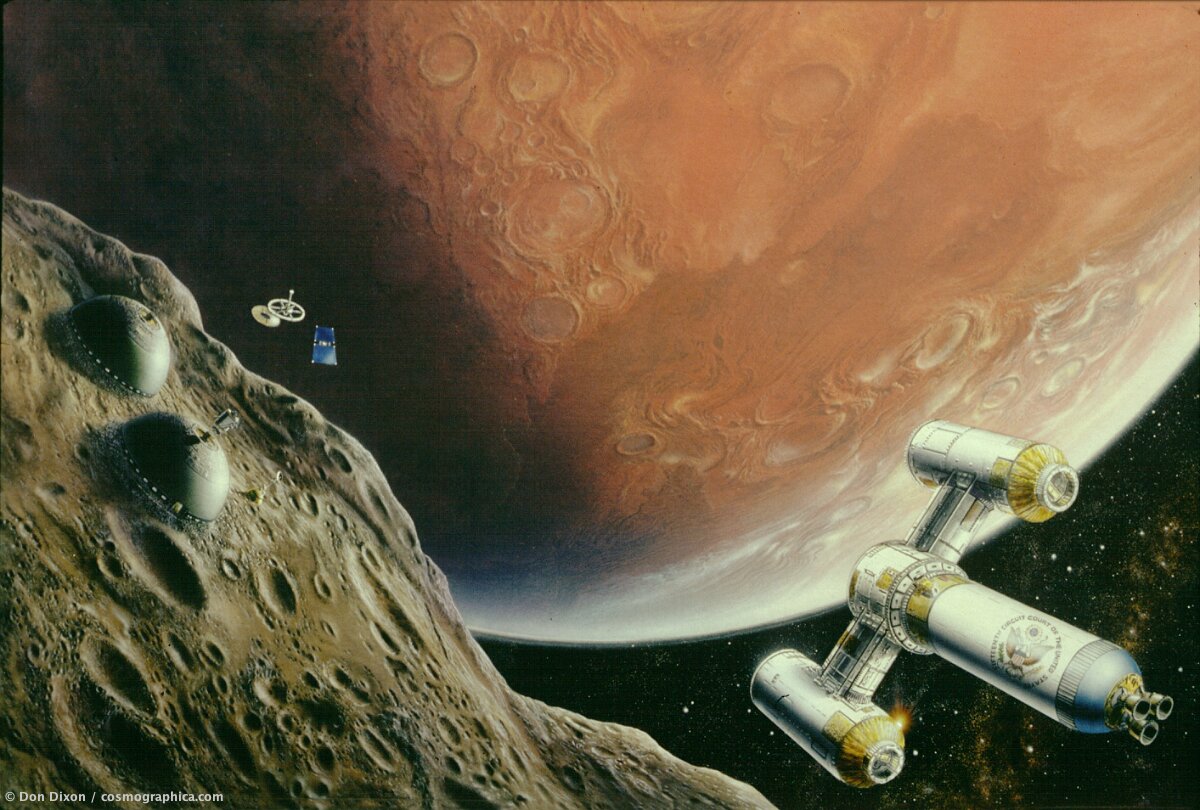
283-phobos-base-dixon –This dramatic orbital perspective looks across the craggy, crater-pocked landscape of Mars' innermost moon, Phobos, where a permanent human outpost has been established. Two large, dark pressurized habitat domes are anchored directly into the rocky surface near a cluster of support equipment. In the foreground, a modular, T-shaped transfer vehicle floats in zero gravity, its hull bearing a detailed circular emblem. The background is dominated by the colossal, beautifully textured sphere of Mars, showcasing intricate cloud patterns, massive volcanic plains, and a sweeping atmospheric limb that curves against a dense star field. covert art for "Circuit Breaker" by Melinda Snodgrass, 1987
255-Mars-Base.jpg
255-Mars-Base.jpg
255-mars-base-dixon – This wide, expansive space art landscape documents an early human reconnaissance mission on the Martian surface, establishing the full traditional canvas from which later compositions were derived. In the right foreground, two astronauts in heavy pressure suits assemble a portable parabolic communication dish on a rugged, deep red rocky ridge, with a cable trailing toward an uncrewed exploration rover parked on the left. In the middle distance valley, a sleek, black-and-white vertical biconic rocket lander sits resting on its landing legs with its egress ladder extended. The background features steep, highly eroded crimson mountains and a smooth, pale orange sky where the two tiny crescent moons, Phobos and Deimos, hang low. acrylic and gouache, around 1993
167-Deimos-First-Step

167-Deimos-First-Step

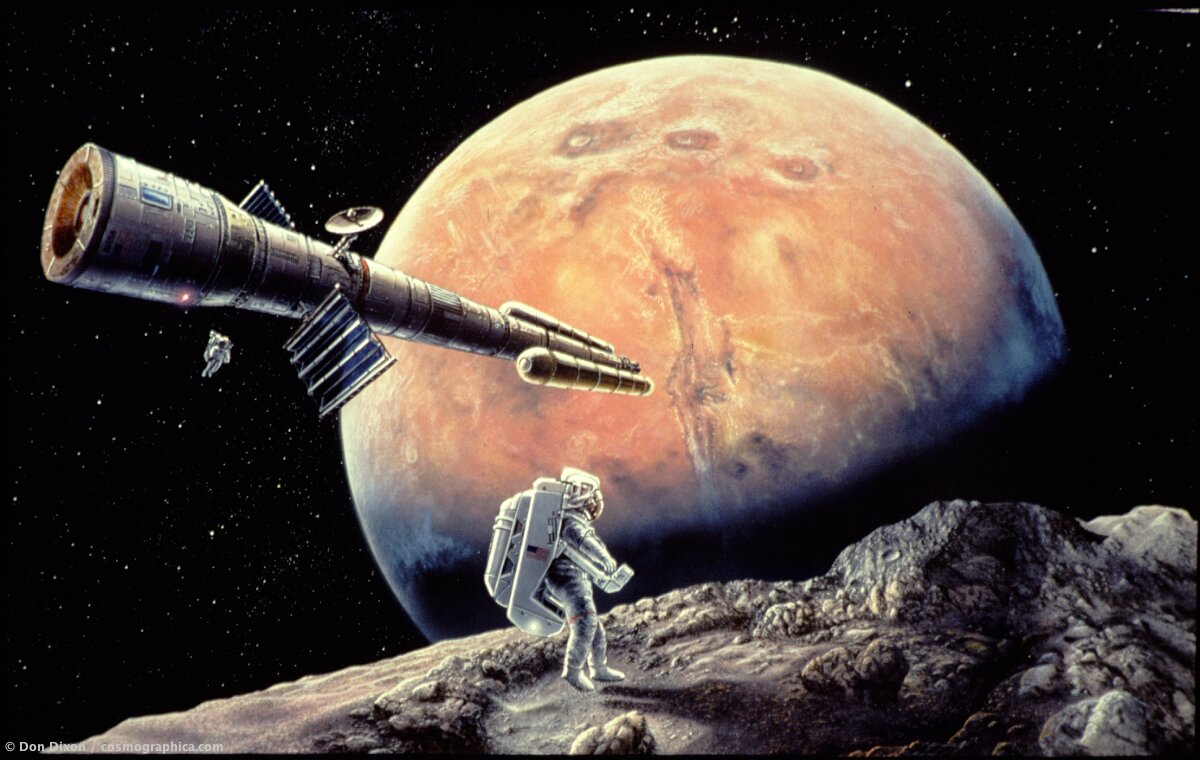
167-deimos-first-step-dixon –This low-angle orbital perspective captures a historic moment of human exploration on the craggy, fractured surface of Mars' smaller moon, Deimos. An astronaut wearing an advanced life-support pressure suit cautiously maneuvers in the moon's ultra-low gravity field along a rock-strewn ridge. In the blackness above, a long, modular interplanetary exploration cruiser drifts in orbit with a second astronaut floating nearby in a manned maneuvering unit. The immense globe of Mars dominates the background, revealing the intricate chasms of Valles Marineris and massive dust features across its illuminated desert disk. acrylic and goauche, around 1988
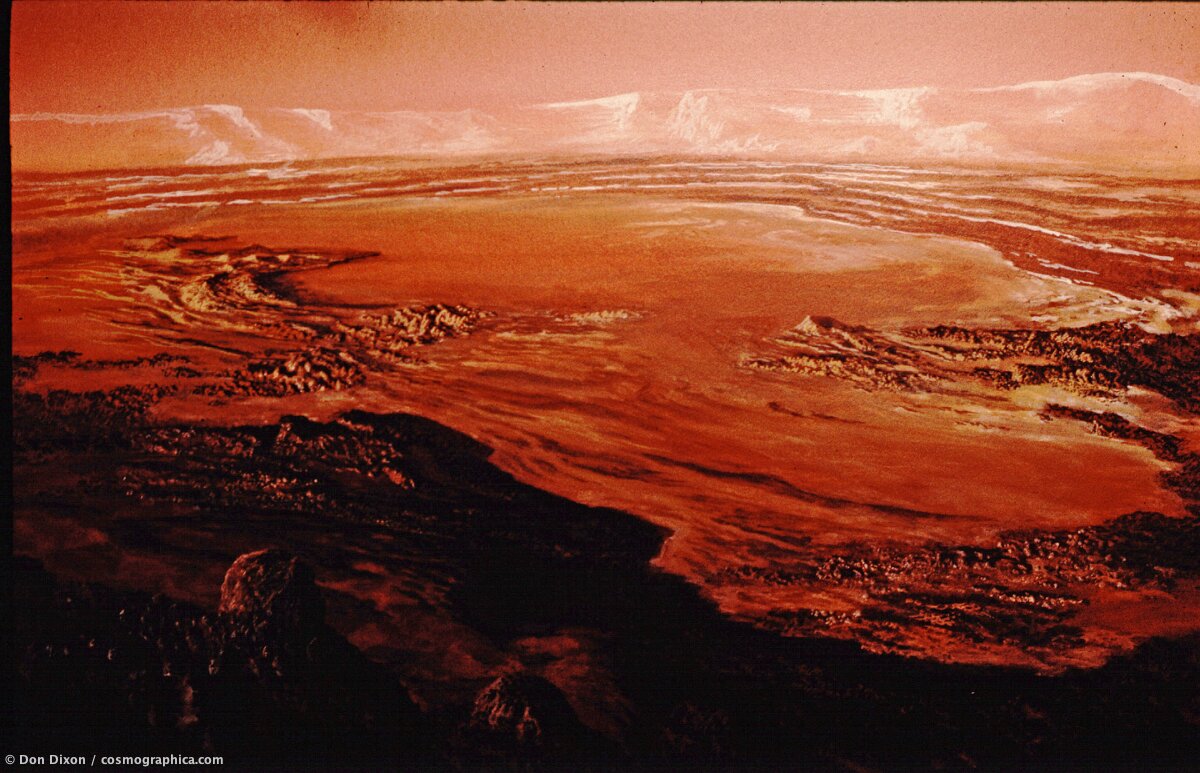
165-mars-polar-region-dixon.jpg

165-mars-polar-region-dixon – This astronomical study depicts a wide panoramic vista of a Martian polar landscape, highlighting the characteristic layered terrain and ice cap structures. A massive, relatively flat basin or impact crater dominates the middle ground, framed by terraced, step-like concentric rings formed by alternating strata of dust and volatile ice. In the far distance, a high, expansive wall of white polar ice rises beneath a hazy, salmon-colored atmospheric sky. The foreground features rugged, dark rock formations and shadows, emphasizing the dramatic topography of the high-latitude martian environment.
159-Martian-Mists
159-Martian-Mists
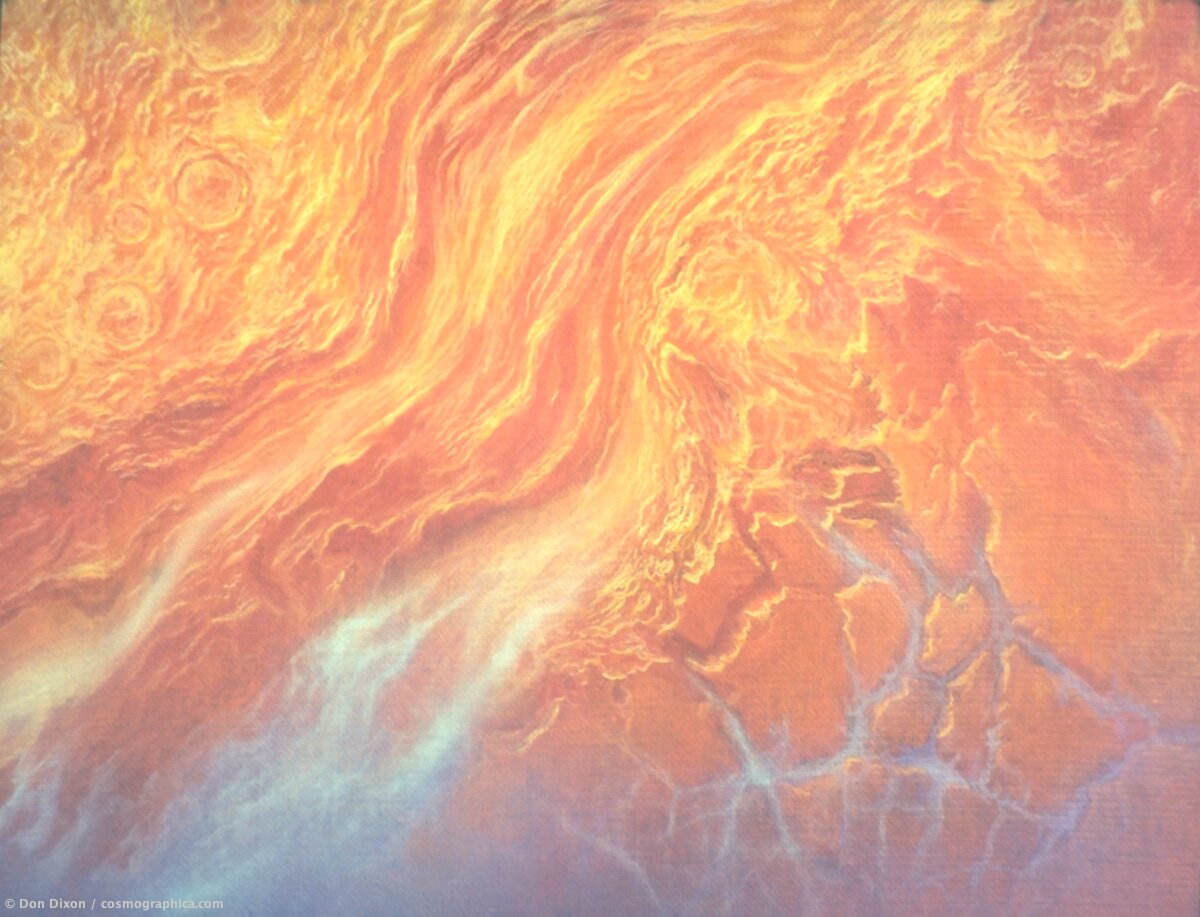
159-martian-mists-dixon – This orbital astronomical illustration captures a dynamic meteorological event above the surface of Mars, showcasing a dense system of pale blue and white water-ice mists moving through canyon systems. The upper-left quadrant reveals heavily cratered highlands bathed in warm, golden sunlight, while a complex network of chasmata or tectonic fractures carves through the lower right. A massive, swirling dust storm or atmospheric front dominates the central diagonal axis, creating a vivid contrast between the fiery ochre tones of the Martian dust and the cool, ethereal hues of the low-altitude morning mists. Acrylic on canvas, 1990
163-Mars-Telescopic
163-Mars-Telescopic
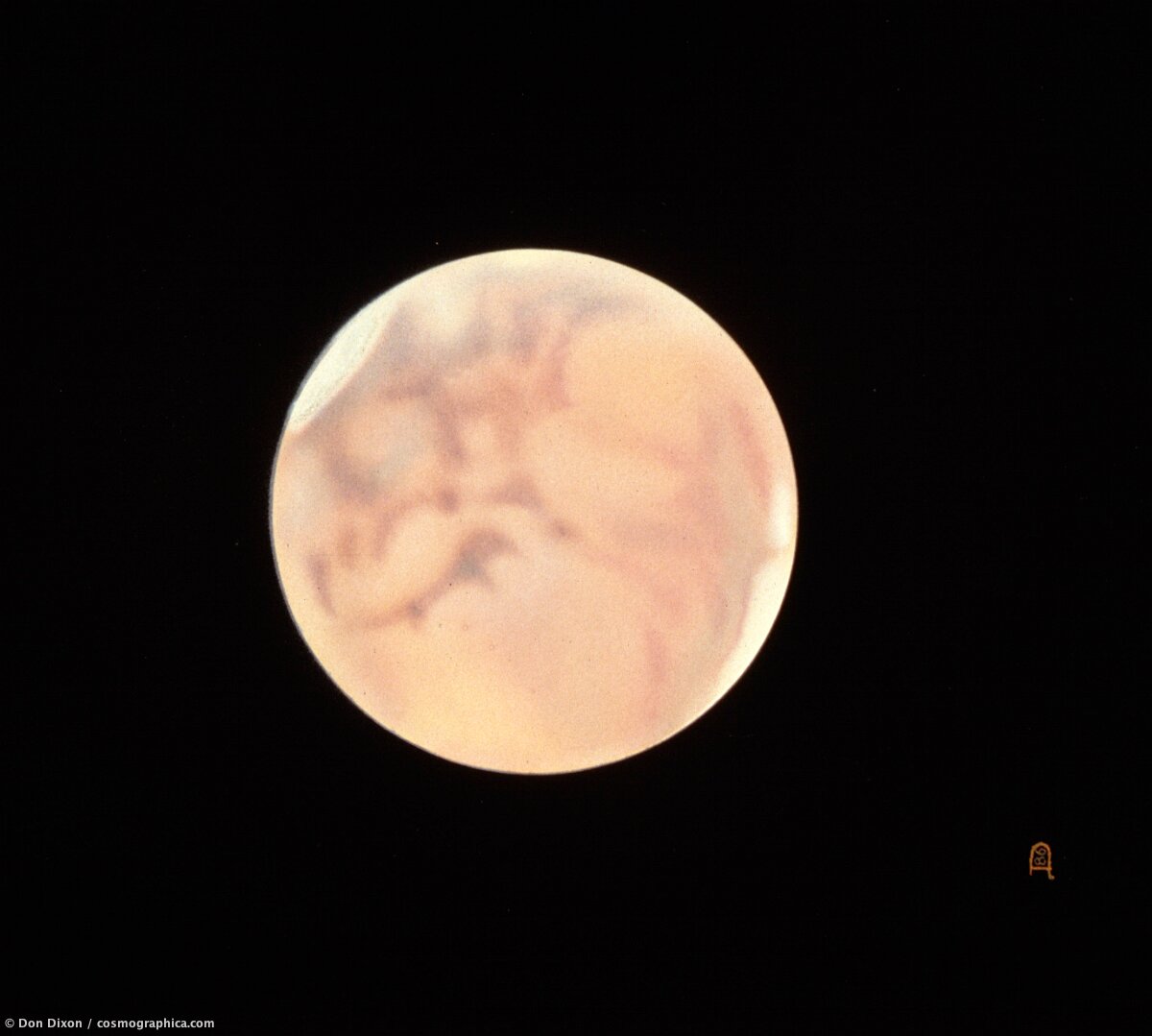
163-mars-telescopic-dixon – Mars sketched while observing through a 6" Newtonian reflector telescope under excellent conditions. The planetary disk displays prominent surface albedo features, including the dark, sweeping markings of Meridiani Sinus and surrounding terrae contrasted against brighter, ochre-colored desert plains. A brilliant white polar ice cap is clearly visible at the upper left limb, accompanied by a subtle, pale blue atmospheric haze along the planetary edge. 1986
161-valles-kasei-1-dixon
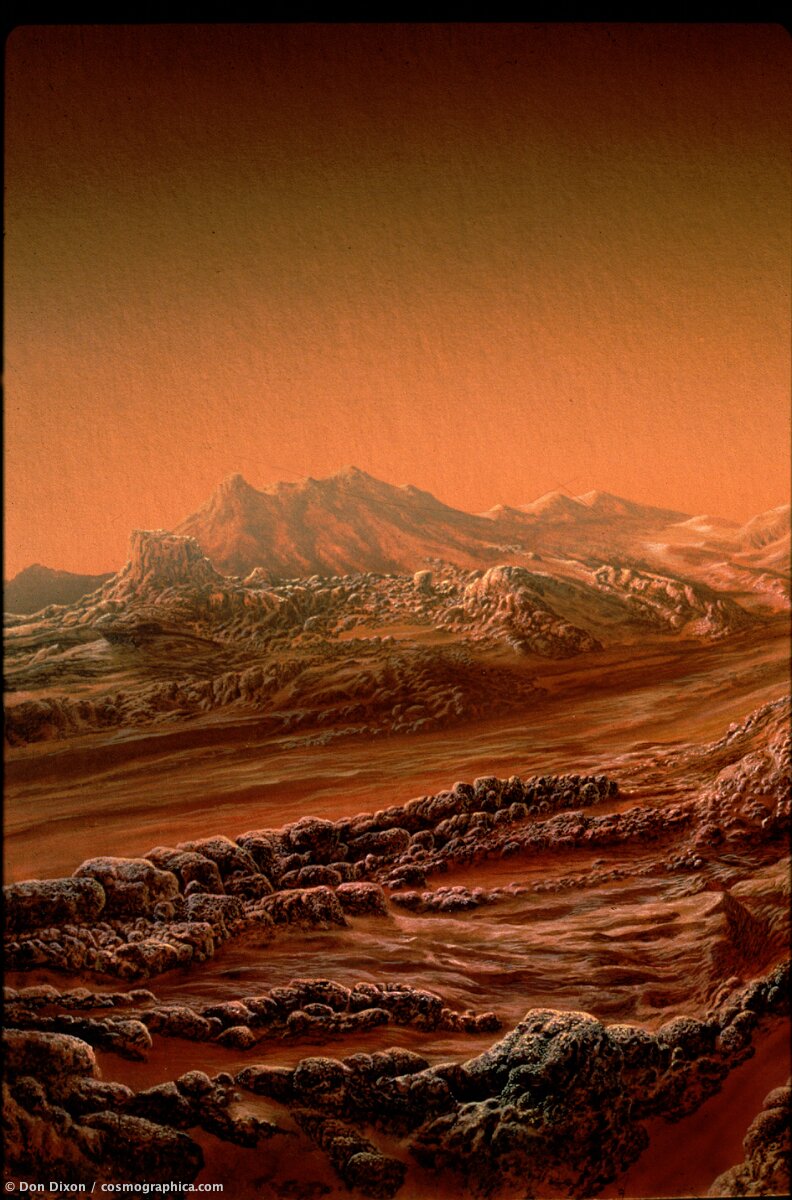
161-valles-kasei-1-dixon – This astronomical illustration presents a dramatic vertical view of Kasei Valles on Mars, a massive outflow channel system carved by ancient liquid floods. The composition is dominated by a smooth, wide channel bed cutting diagonally across the middle ground, flanked by rugged, heavily eroded rock terraces and dark, craggy boulder fields in the foreground. In the distance, prominent mountain ridges and flat-topped mesas rise beneath a deep, gradients-of-ochre Martian sky, showcasing the vast scale of martian cataclysmic geology., based on a sketch made below Zabriskie's Point in Death Valley, 1988
160-valles-kasei-2-dixon.jpg

160-valles-kasei-2-dixon – A dry river valley on Mars, based on sketches made below Zabriskie's Point in Death Valley. This astronomical illustration offers a sweeping panoramic view of the ancient outflow channel system within Kasei Valles on Mars. A prominent, curved ridge line covered in rugged, fractured rock textures runs along the left foreground, dropping down into a vast, smooth channel bed sculpted by primeval fluid erosion. acrylic and gouache on Masonite panel, 1989
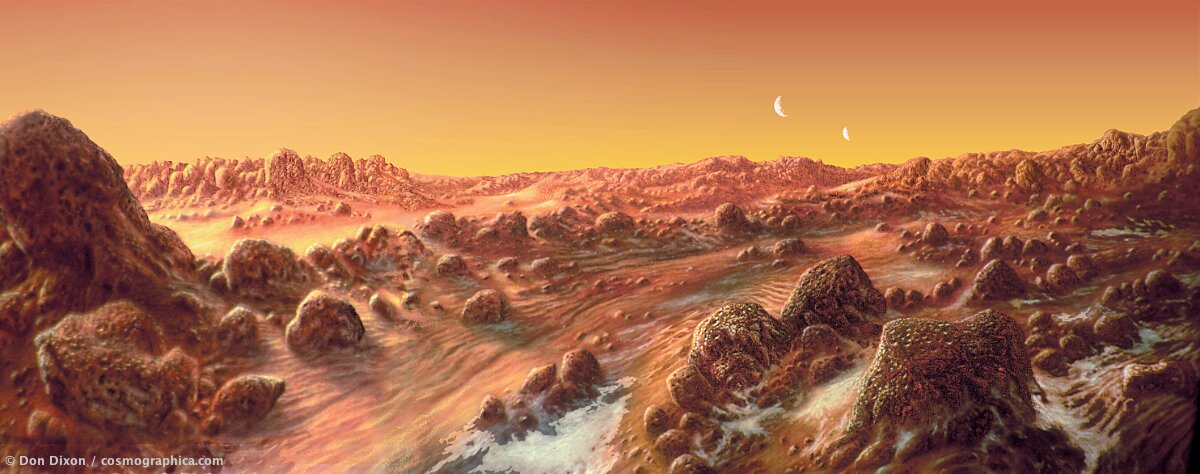
157-Mars-Panorama

157-Mars-Panorama

157-mars-panorama-dixon – cover for Gregory Benford's novel The Martian Race, this panoramic astronomical illustration depicts a rugged Martian plain strewn with dark, heavily textured boulders and undulating sand drifts. Patchy, bright white surface frost clings to low-lying depressions in the foreground, catching the ambient light. Above the distant, uneven horizon, the two small crescent moons, Phobos and Deimos, hang close together in the upper-right sky. acrylic and gouache, around 2004
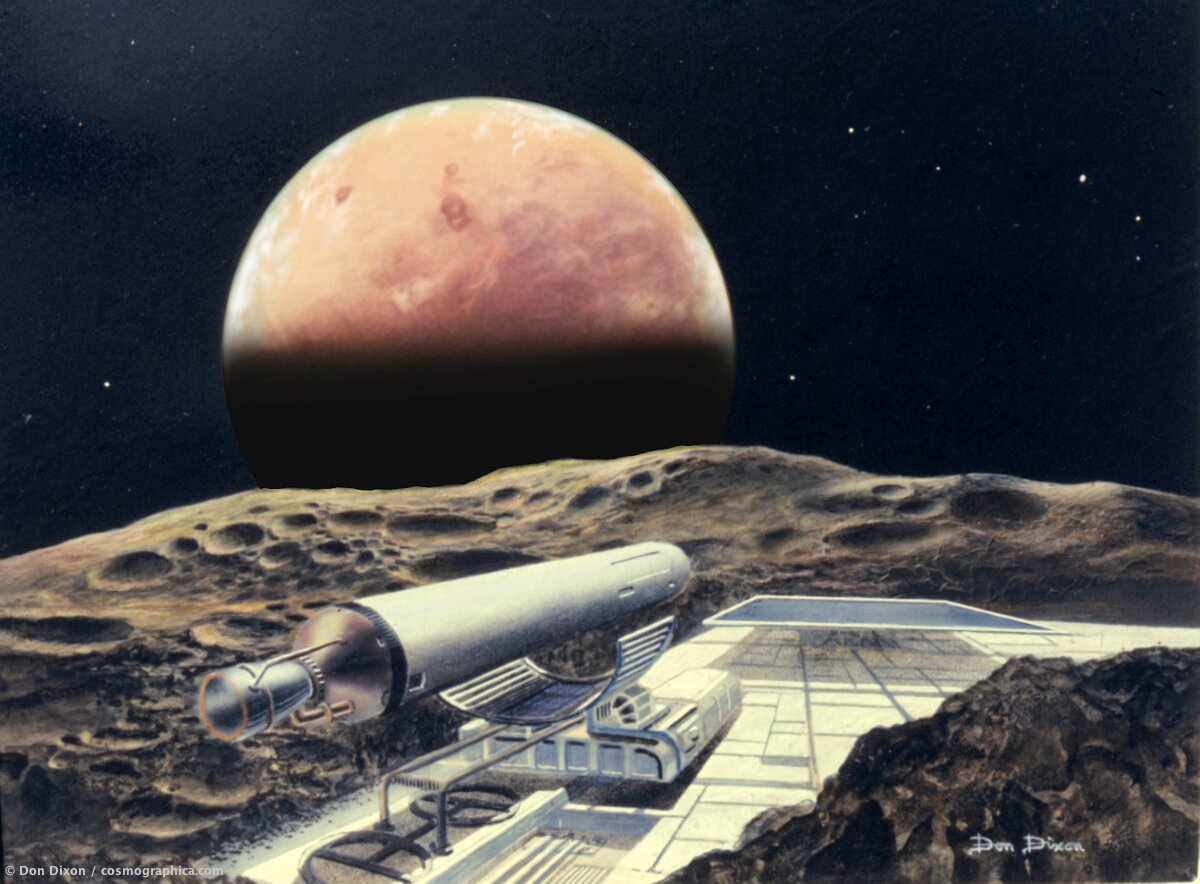
089-Landing-On-Deimos
089-landing-on-deimos-dixon – Landing at a base on Deimos - a spacecraft settles into a landing cradle on Mars' outer moon ; 8x10 inches, acrylic on board, 1982. copyright Don Dixon
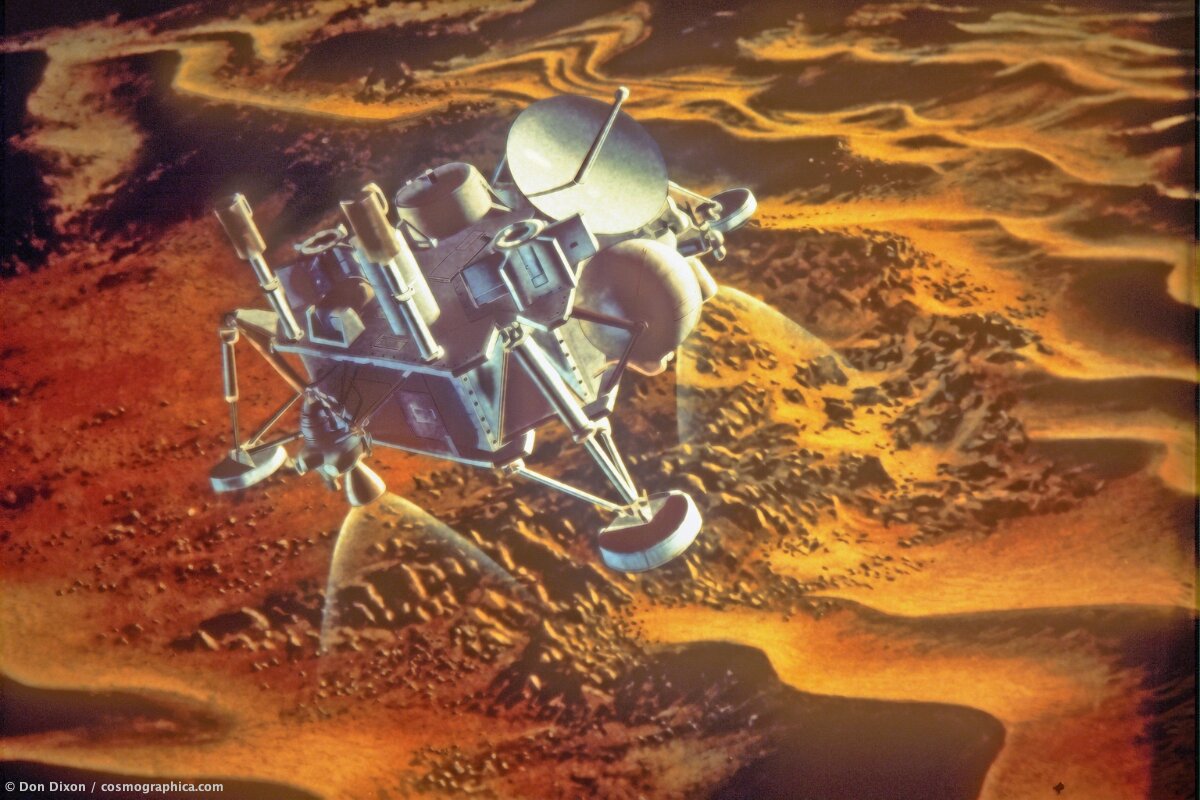
073-terminal-descent-dixon
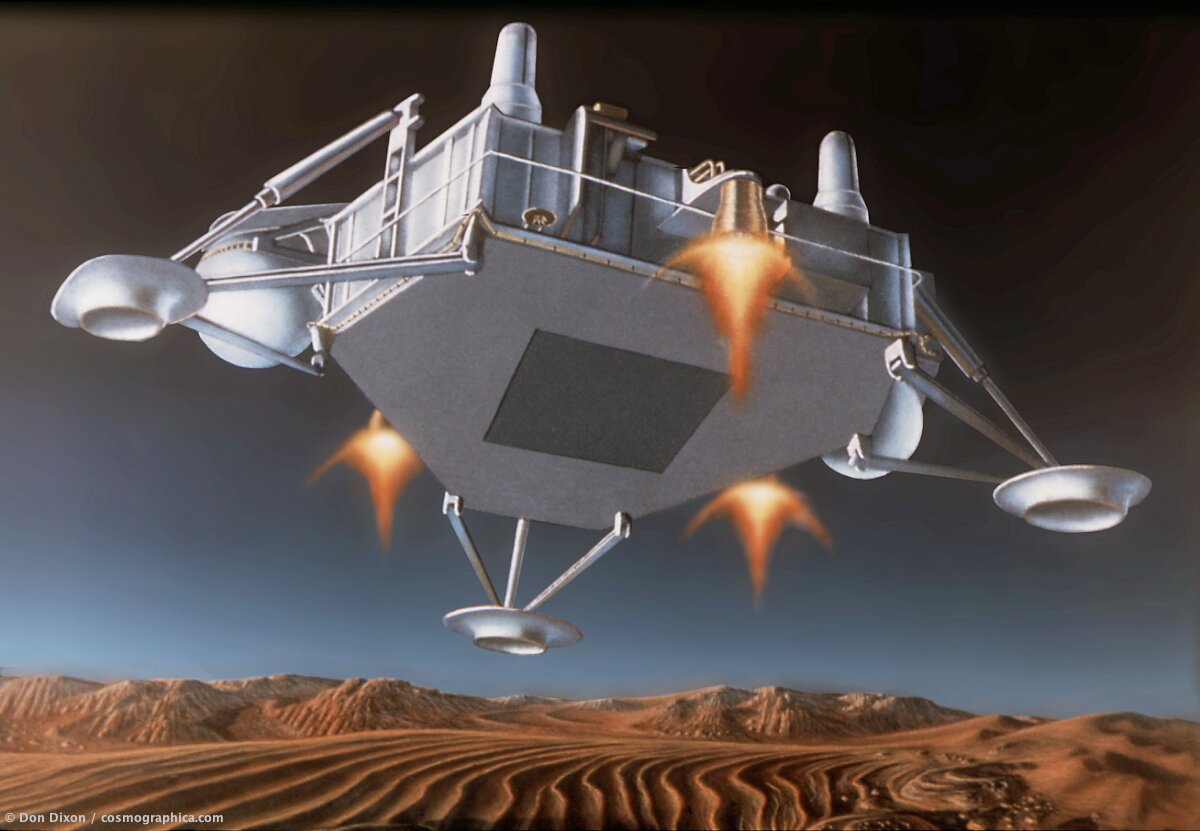
073-terminal-descent-dixon –A few miles above Mars, Viking's engines fire to slow its descent (dated concept of spacecraft) ; Viewed from an elevated perspective looking downward, the spacecraft has its radar altimeter and high-gain dish antenna deployed as its retrorockets fire cone-shaped exhaust plumes to decelerate. Far below, the alien topography of Mars unfolds, characterized by golden, sunlit fields of shifting sand dunes interspersed with dark, rocky crags and ancient eroded geological formations. gouache on illustration board, 1975
074-Ten-Feet-Over-Mars-Viking-landing
074-ten-feet-over-mars-viking-landing-dixon – Viking's engines shut off and it drops to a soft landing. Color of the Martian sky is as conceived prior to first landing ; acrylic and gouache on masonite, 1975.
075-Sunrise-At-Chryse
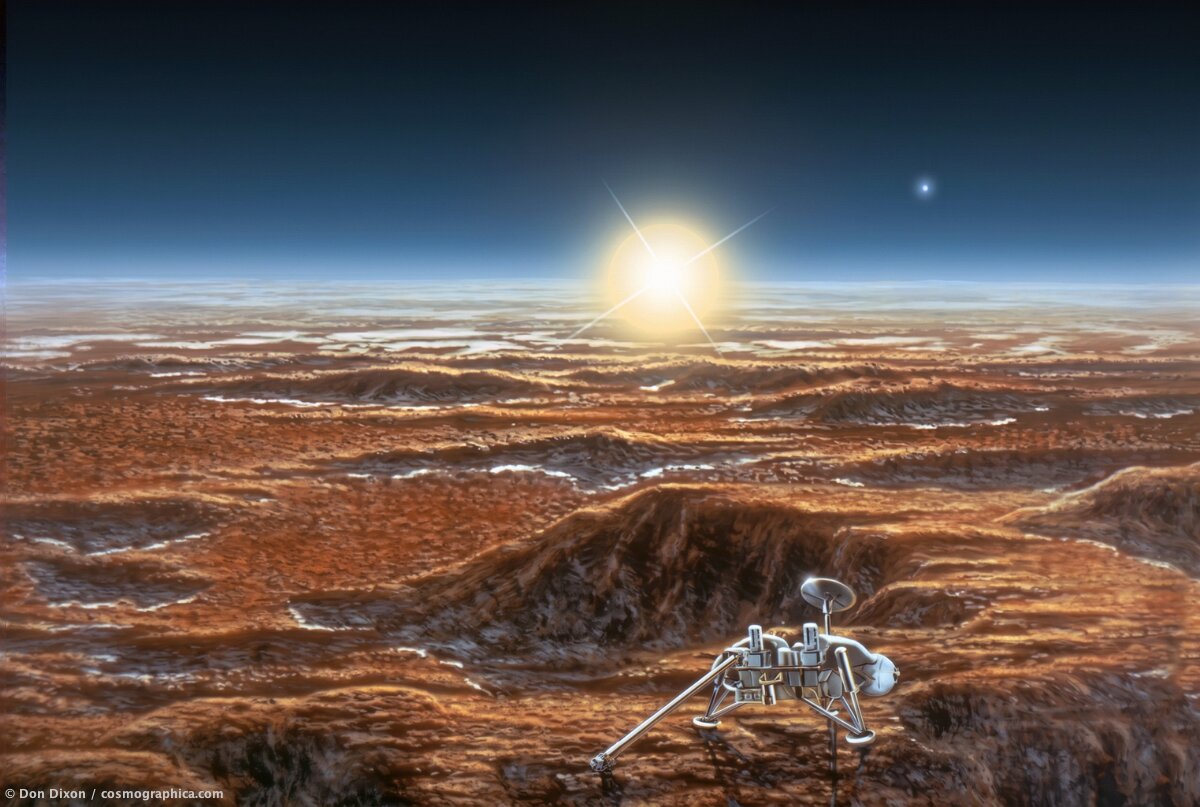
075-sunrise-at-chryse-dixon – Sunrise At Chryse Planitia - Viking One greets the dawn on the Martian surface (dated concept of Martian environment) ; gouache on illustration board, 1975
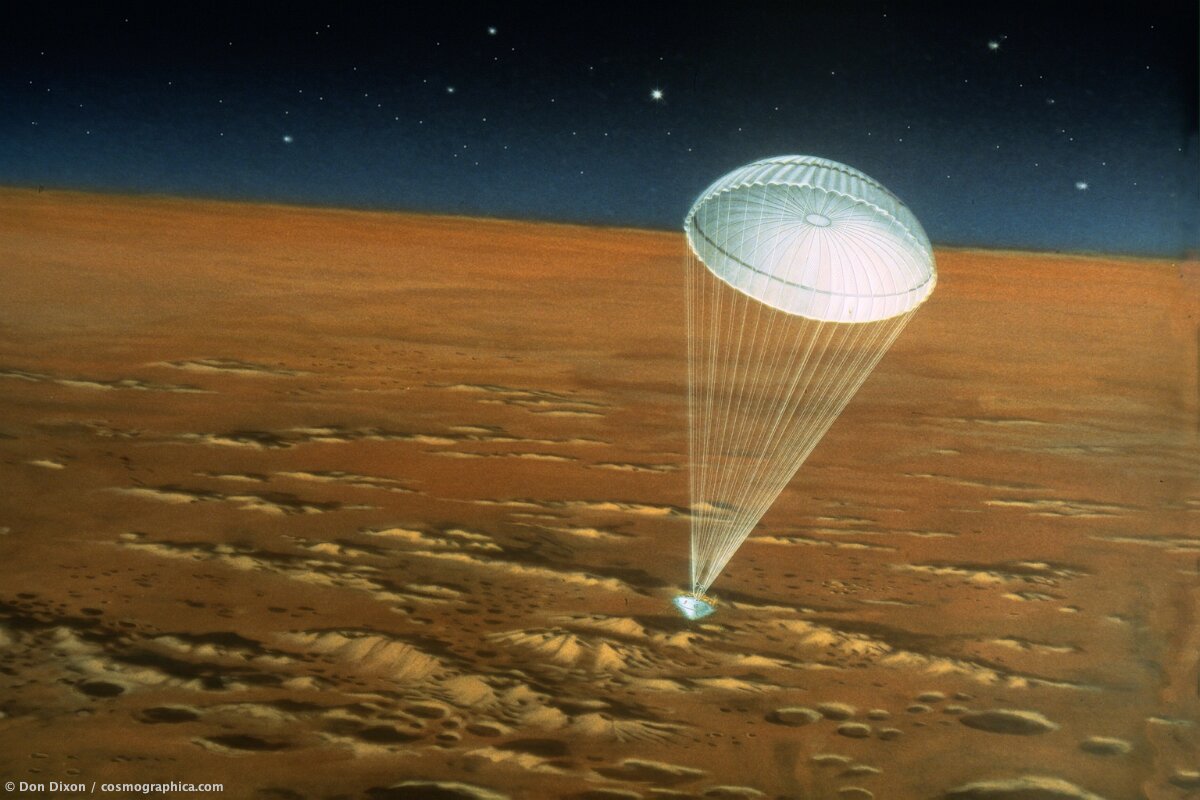
072-parachute-braking-dixon – a huge parachute helps slow Viking's descent toward the Martian surface ; gouache on illustration board, 1975
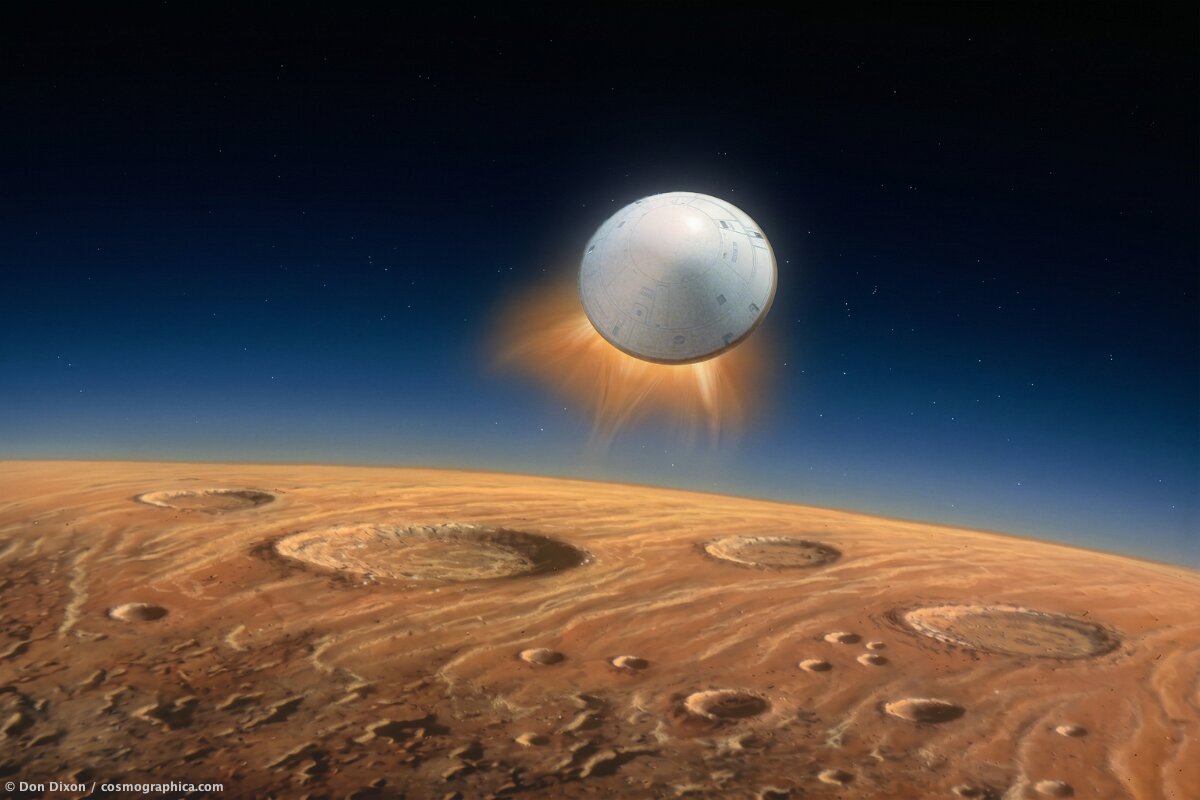
071-mars-atmosphere-entry-dixon – The Viking lander makes a fiery plunge through Mars' atmosphere in this painting created prior to the first landing, when we discovered that the atmosphere of Mars is orange ; Compression of the thin atmosphere generates a glowing, orange thermal plasma wake beneath the heat shield. Far below, the curved horizon reveals a detailed expanse of the rusty Martian desert, heavily scarred with large impact craters and wind-swept ripples under a dark, star-flecked sky.gouache on illustration board, 1975 (digitally remastered)
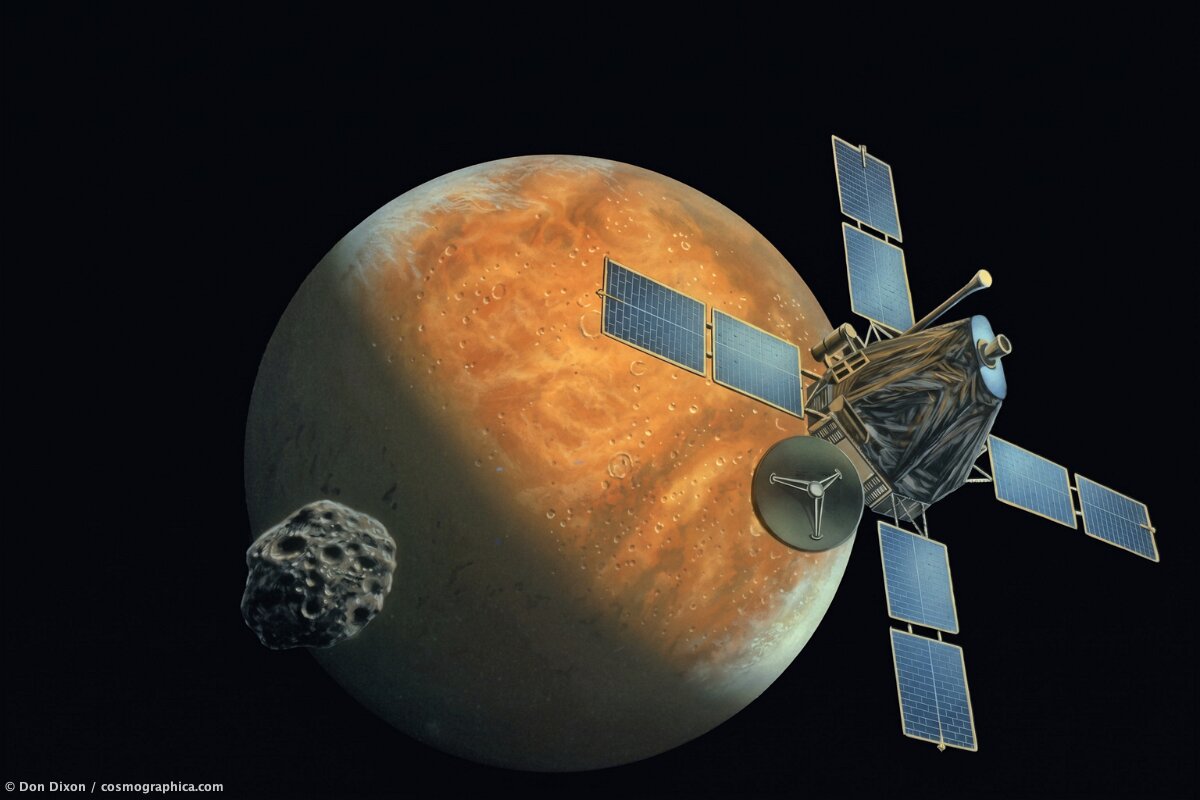
076-viking-orbiter-dixon – As the lander explores the surface, the Viking Orbiter photographs Mars and its moons and serves as a radio relay ; This astronomical illustration features the Viking Orbiter spacecraft in high orbit above Mars, showcasing its extended solar panels and prominent high-gain dish antenna. The background is dominated by the gibbous disk of Mars, revealing a cratered orange surface partially shrouded by an atmospheric limb haze. In the lower-left foreground, the planet's small, irregular, and heavily pockmarked inner moon Phobos drifts against the blackness of deep space. gouache on illustration board, 1975
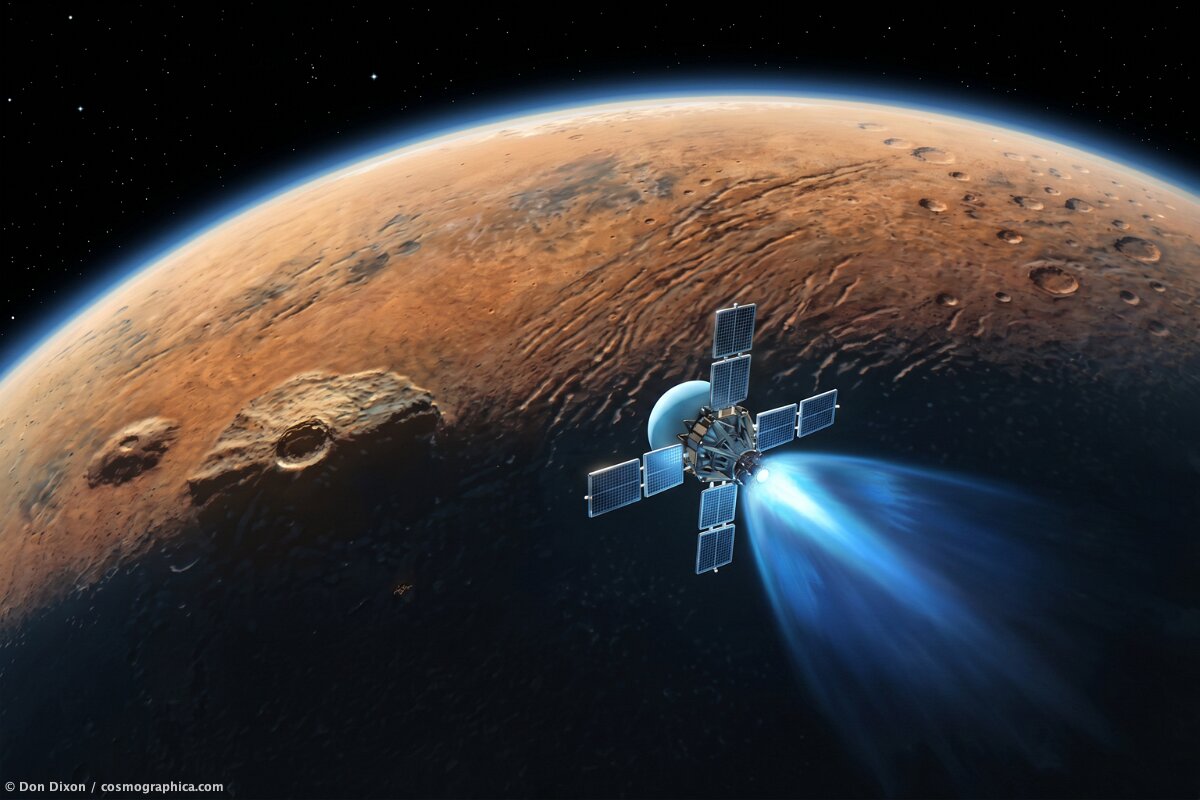
070-mars-orbit-insertion-dixon – This illustration depicts The Viking One spacecraft executing its orbit insertion burn above Mars to slow down and become the first spacecraft to orbit another planet. A brilliant blue exhaust plume expands into the vacuum of space from the rocket nozzle, silhouetted against the dark, unilluminated hemisphere of the planet. Below, the sunlit Martian surface displays majestic geological features, including massive volcanic shields, canyon complexes, and cratered highlands under a thin, blue atmospheric haze along the curved horizon. ; gouache on illustration board, 1975 (digitally remastered)
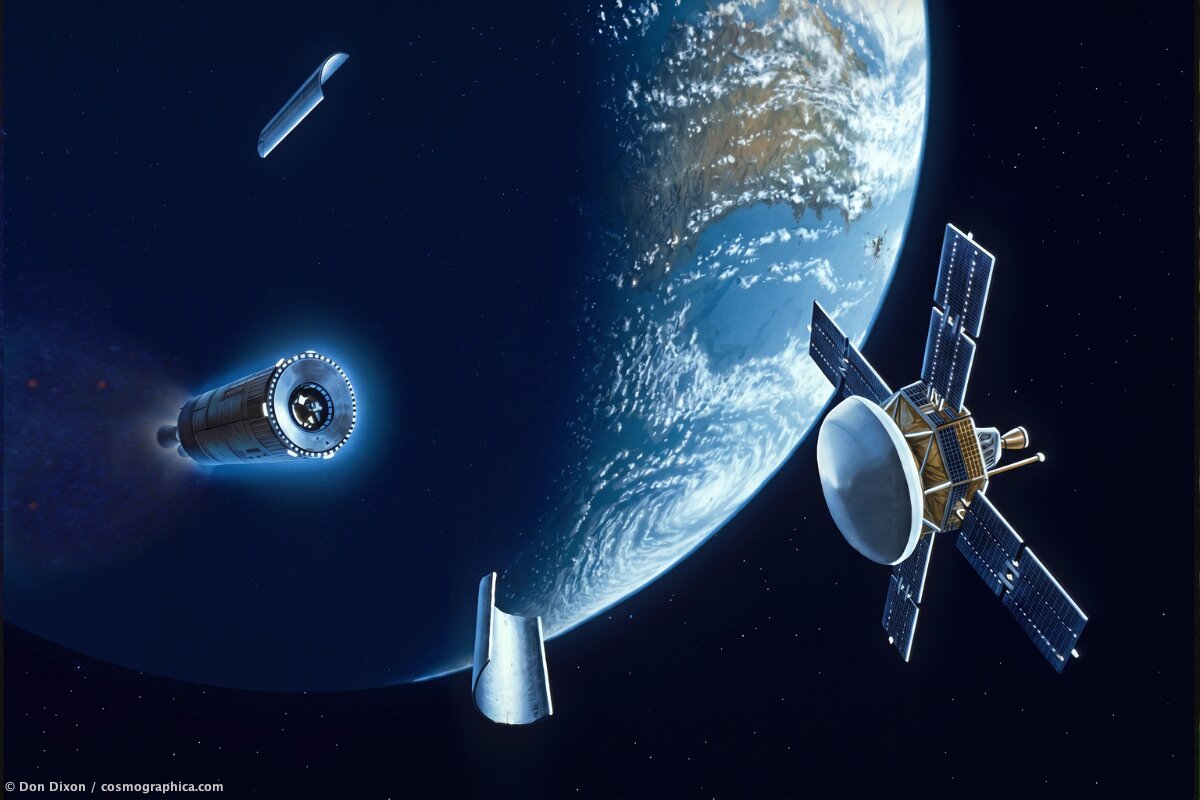
Viking One departs earth enroute to Mars, venting fuel from the discarded booster creates a blue glow ; gouache on illustration board, 1975
043-valles-marineris-dixon – Mars' grand canyon stretches for nearly 3,000 miles - gouache on illustration board painting by Don Dixon, 1974. The Martian sky is incorrectly depicted as deep blue, as was currently believed. © Don Dixon
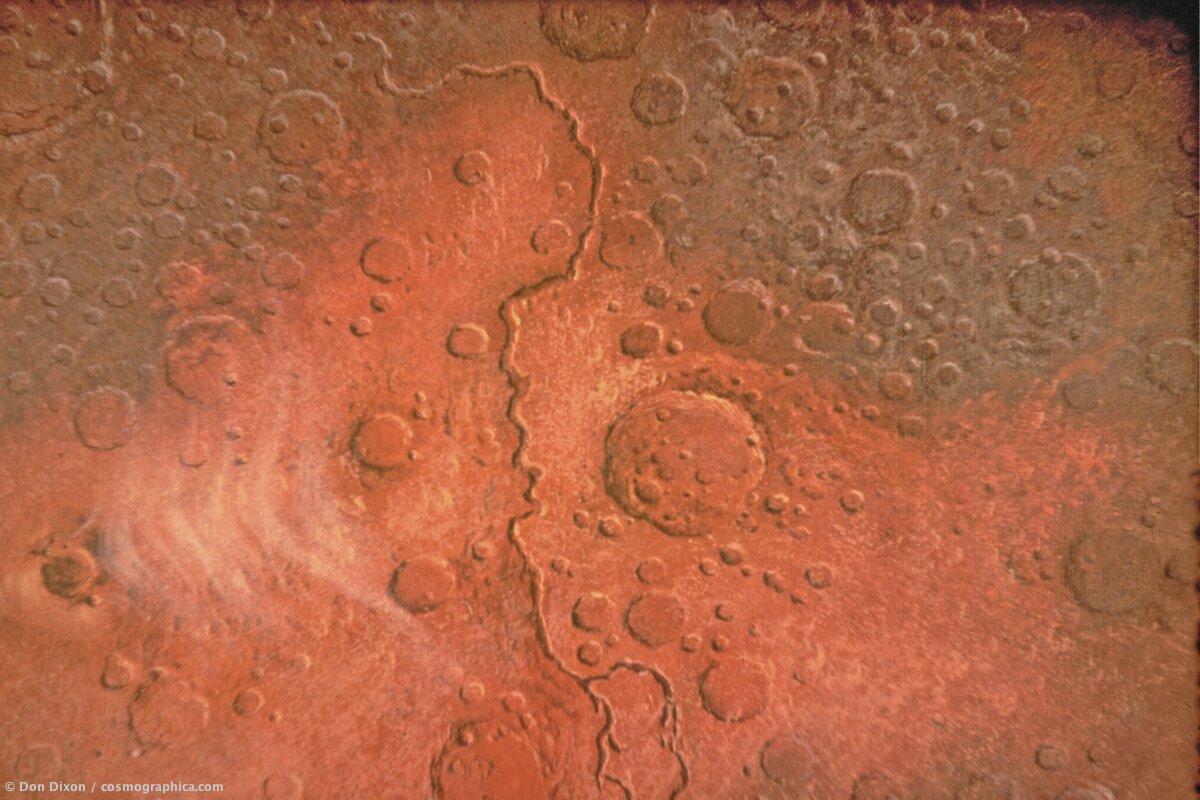
042-mars-vertical-view-dixon – This illustration presents a top-down, nadir perspective of the heavily cratered Martian surface, simulating an orbital overhead view. A prominent, winding sinuous channel or graben cuts vertically through the ancient, orange-red terrain, showing complex bank structures and fracturing. The surrounding landscape is densely pockmarked with impact craters of varying sizes and degradation states, partially obscured in areas by wispy, white atmospheric clouds or surface frost.. Gouache on illustration board, 1975.
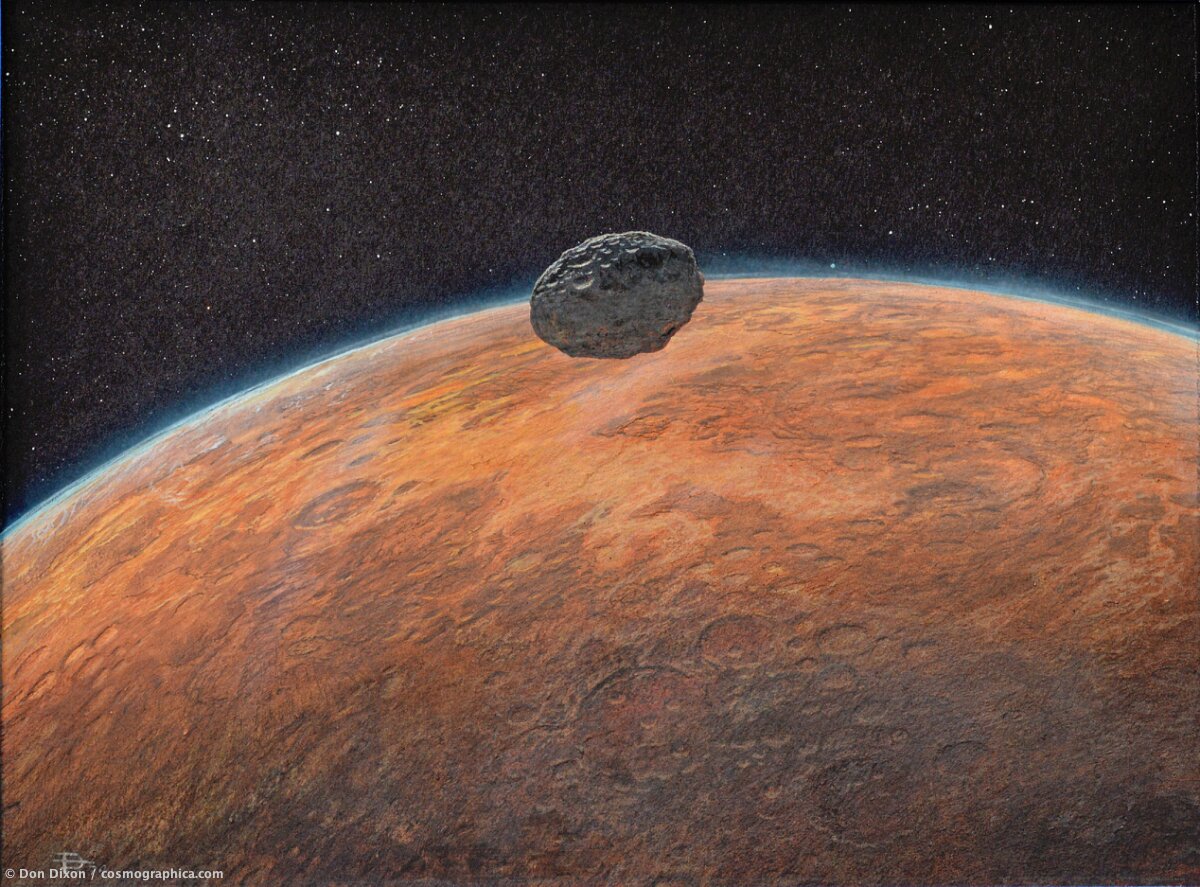
041-phobos-dixon – The larger Martian moon Phobos, known at the time of this painting to be a dark, potato shaped asteroidal body, orbits about 3,700 miles above Mars. Gouache on illustration board, 1974
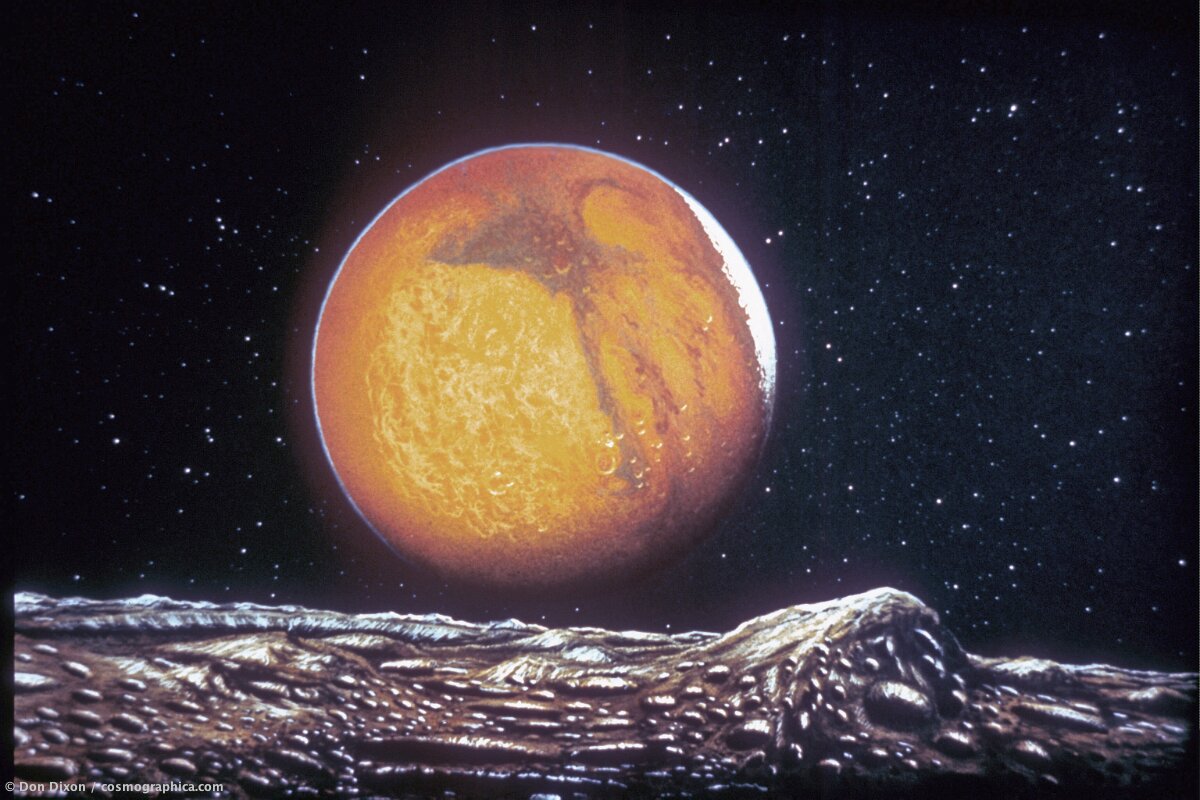
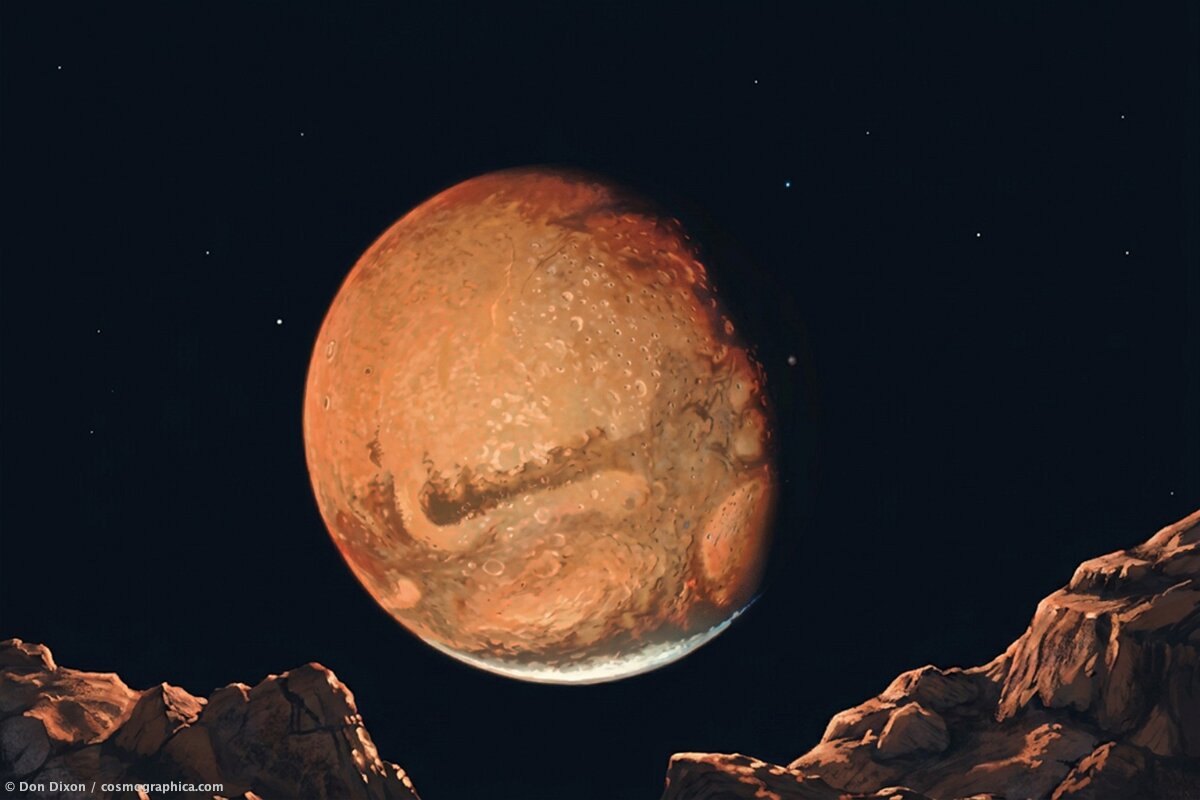
040-mars-dixon –The Red Planet dominates the sky of Deimos, its outer moon, in this gouache-on-paper painting from 1974. The Martian disk displays classic albedo features, including Syrtis Major and the bright northern polar cap, with subtle variations in surface coloration across its deserts. In the foreground, the low-gravity moon's landscape is highly textured, filled with deep depressions and rough rocky ridges illuminated by a distant sun.
033-mars-from-deimos-1-dixon – Mars hangs above the nearby horizon of its outer satellite Deimos - painting by Don Dixon, gouache on paper, 1971 (digitally remastered)
022-portrait-of-mars-dixon – An early study of Mars as revealed by Mariner Nine. Oil on masonite, 1973.
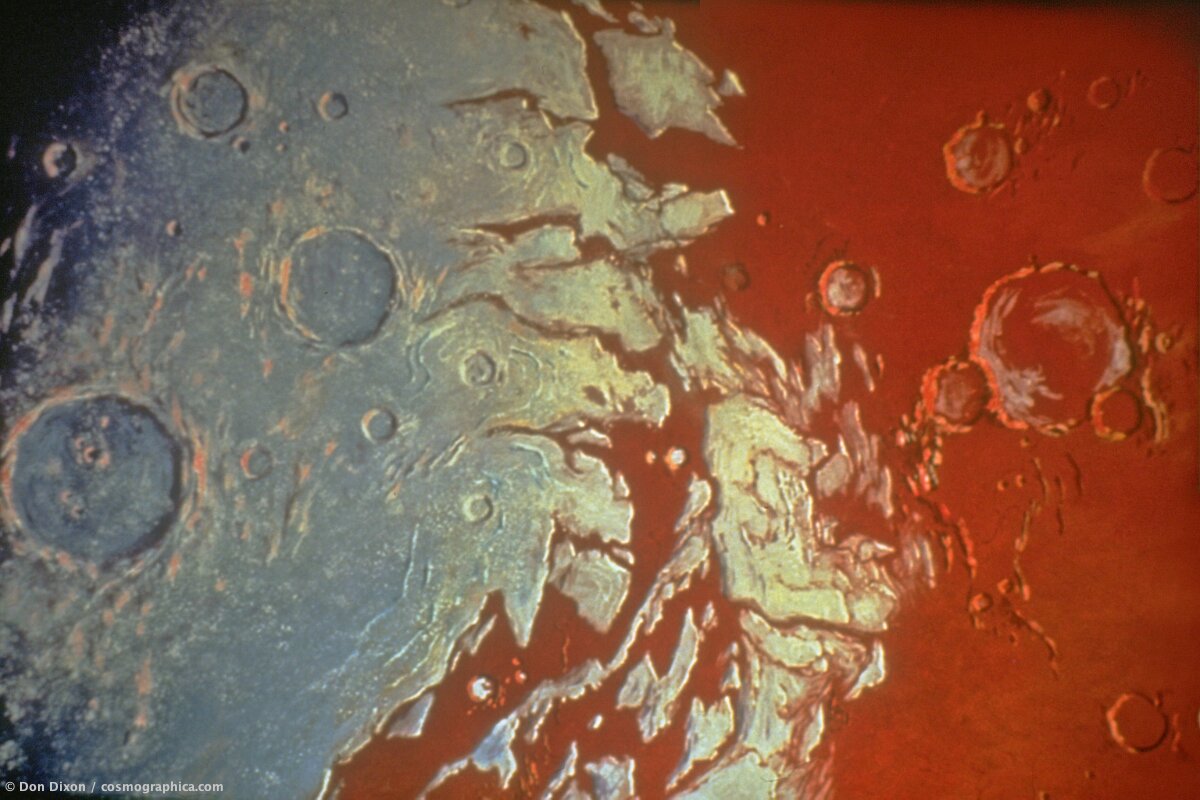
020-mars-polar-cap-dixon – This illustration presents a striking overhead, close-up perspective of a Martian polar cap region, showcasing the stark interaction between ice and dust. The left portion of the frame features heavily textured, pale-toned frosted terrains pockmarked with ancient craters and etched with complex, stepped valleys. This icy sheet gives way along a highly irregular, fractured boundary to the deep, rust-red basaltic plains of the Martian desert, which are scattered with sharp-rimmed impact craters on the right. An early oil on Masonite study, 1974
012-Mars-Rasena-Valley
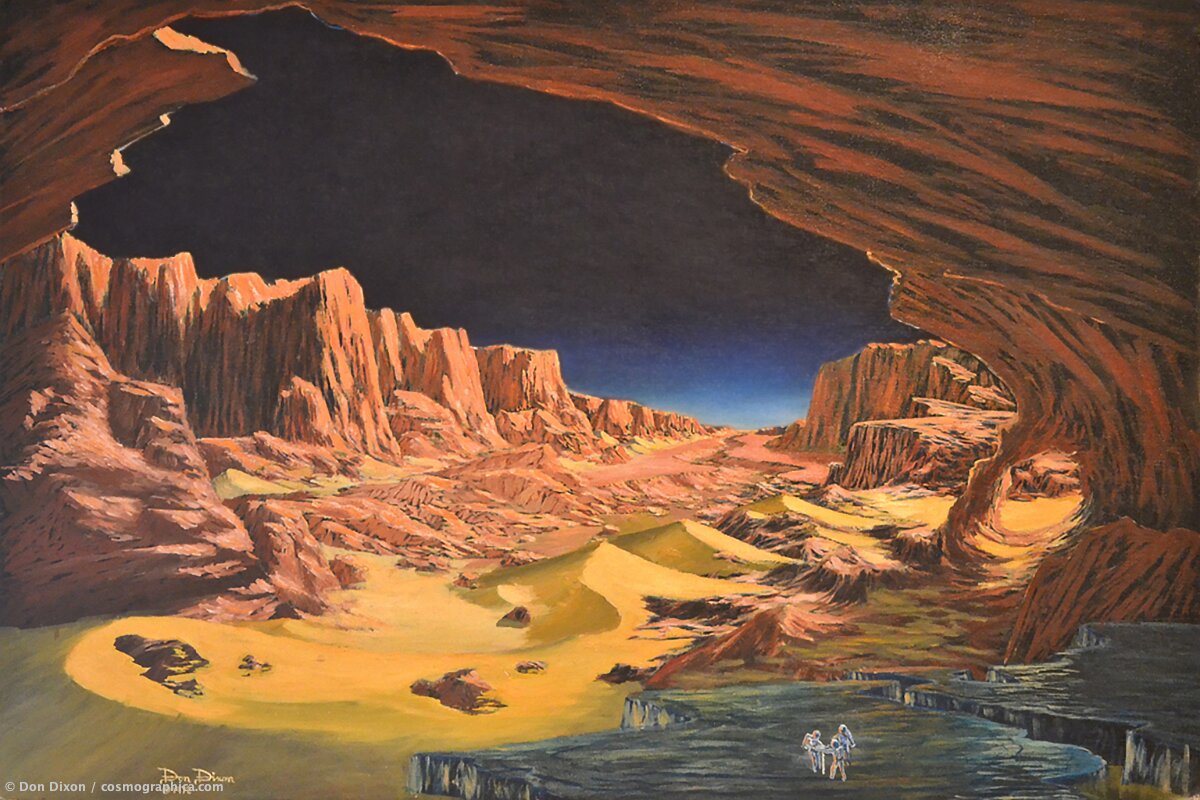
012-mars-rasena-valley-dixon – Astronauts explore an ancient river valley on Mars, discovering ice deposits. (Dated sky treatment). Oil on canvas, 24x36 inches, 1972.
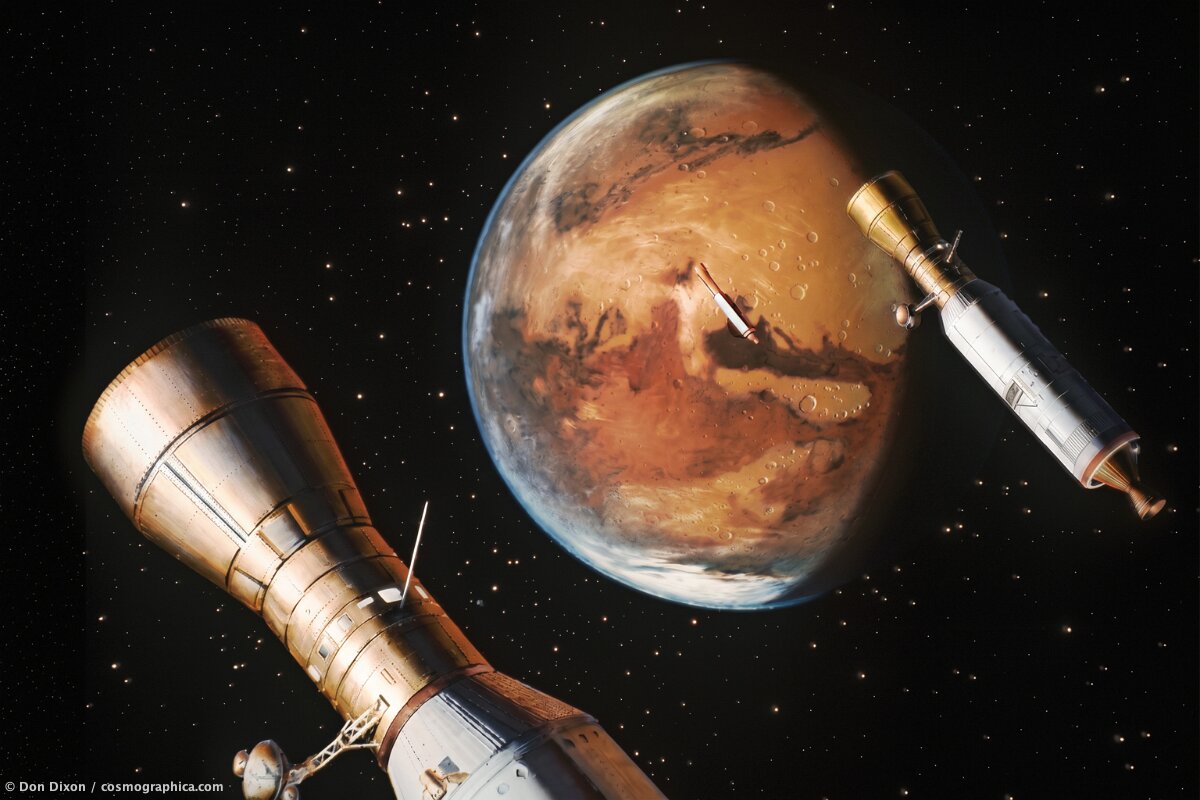
011-approaching-mars-dixon – This early painting depicts an interplanetary expedition approaching Mars, featuring three large, multi-stage spacecraft coasting through deep space. In the background, the detailed, marbled globe of Mars displays prominent dark albedo features, scattered cratering, and a delicate blue atmospheric limb against a vast field of distant stars. Oil on masonite, 1973.
The Mountains Of Mitchel on Mars
004-the-mountains-of-mitchel-mars-dixon –Patches of snow or ice that persisted into late spring suggested the presence of mountains in the south polar region of Mars to early telescopic observers. (Dated concept). 22x28 inch oil on canvas panel, 1972.
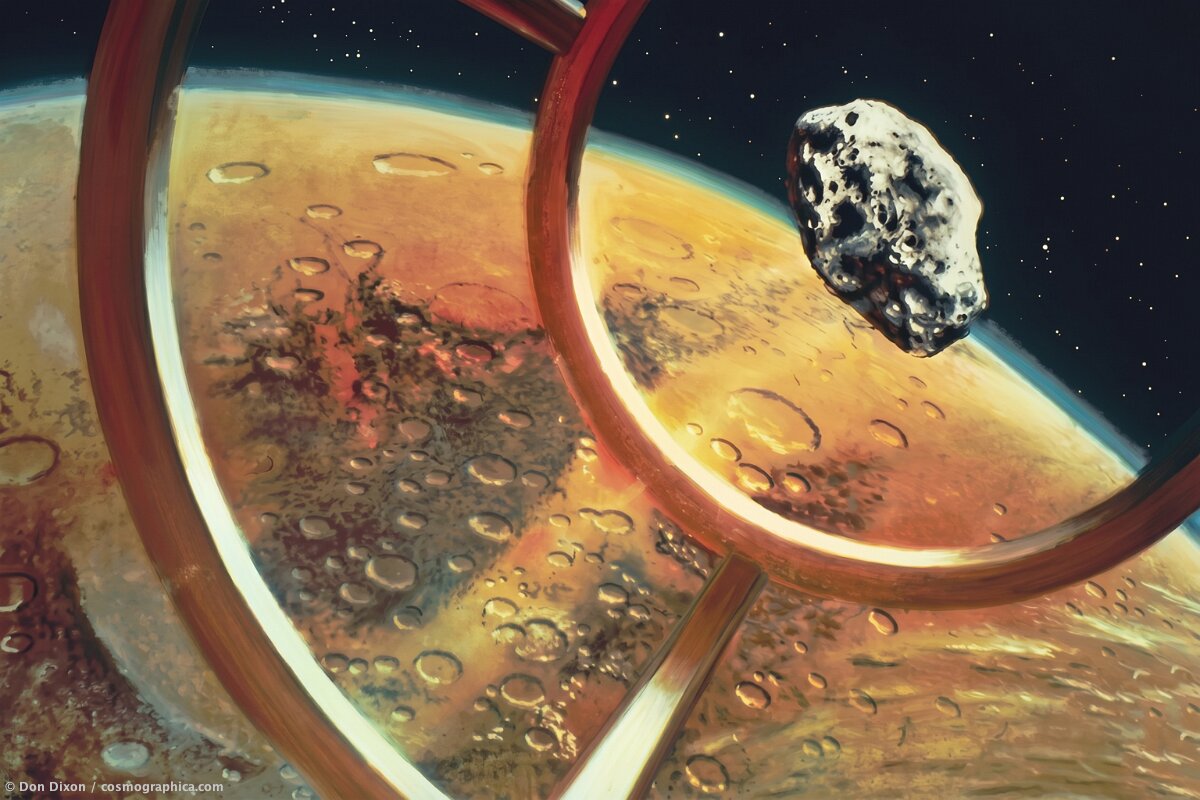
001-phobos-dixon – Mars' inner moon, Phobos, based on first photo by Mariner Nine. This illustration presents an orbital perspective of the irregular, crater-pocked moon Phobos moving across the sweeping, sunlit horizon of Mars. The composition is uniquely framed through the large, circular structural rings of an interplanetary transit vehicle in the foreground. Below, the detailed Martian surface reveals an ancient, heavily cratered terrain blending into localized dust storms and atmospheric haze along the planetary limb. oil on panel, 1971

469-mars-nanedi-valles

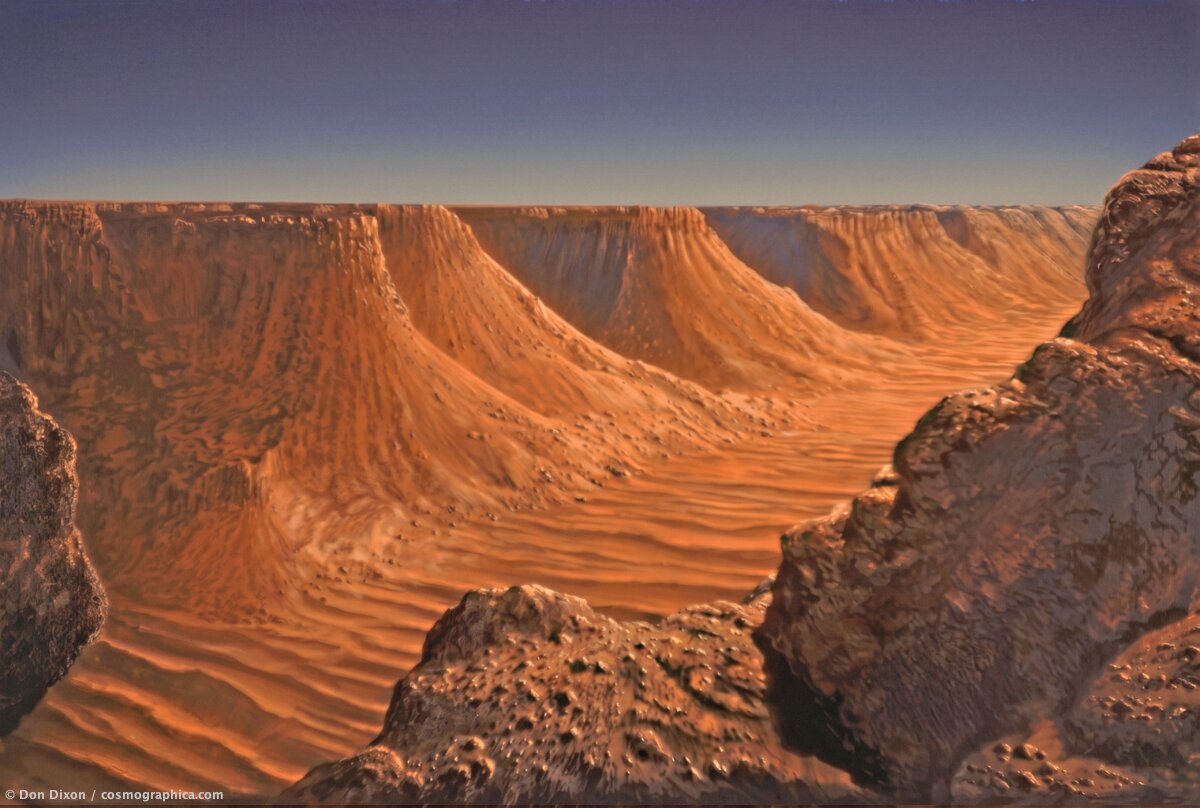
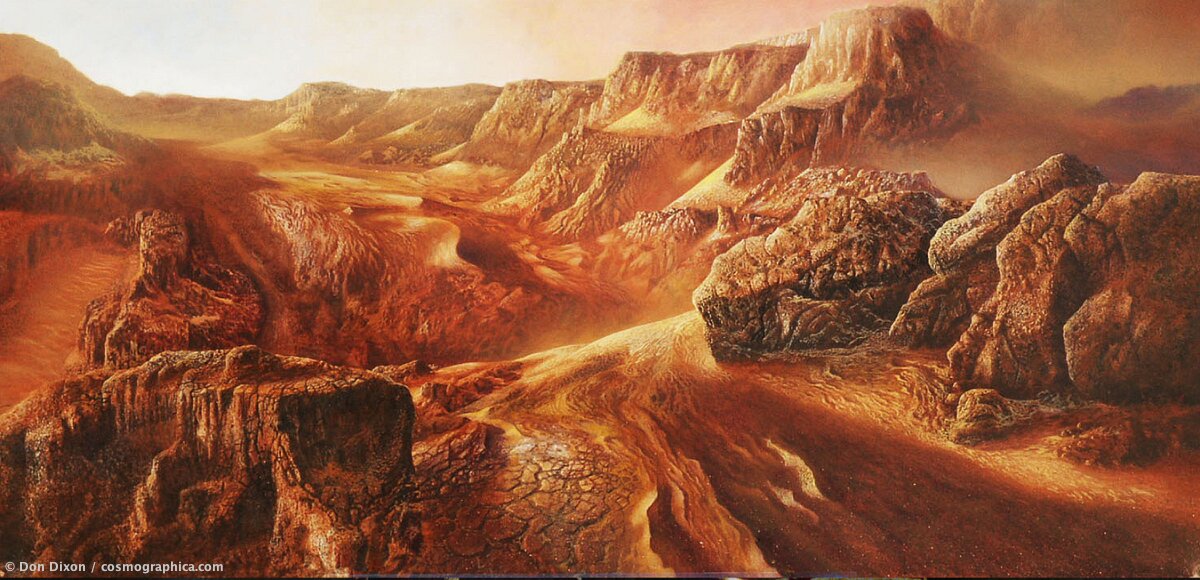
469-mars-nanedi-valles-dixon – This wide-angle panoramic vista depicts the rugged interior of Nanedi Valles, a large sinuous valley located in the Lunae Palus quadrangle of Mars. The Martian canyon features steep, deeply eroded layered alcoves and terraced rocky walls, indicating ancient liquid water flow or collapse events. The arid valley floor is covered with fine wind-blown sand dunes and fractured, desiccated mud cracks beneath a dusty, salmon-colored atmospheric sky. Oil on masonite. © 2013 Don Dixon
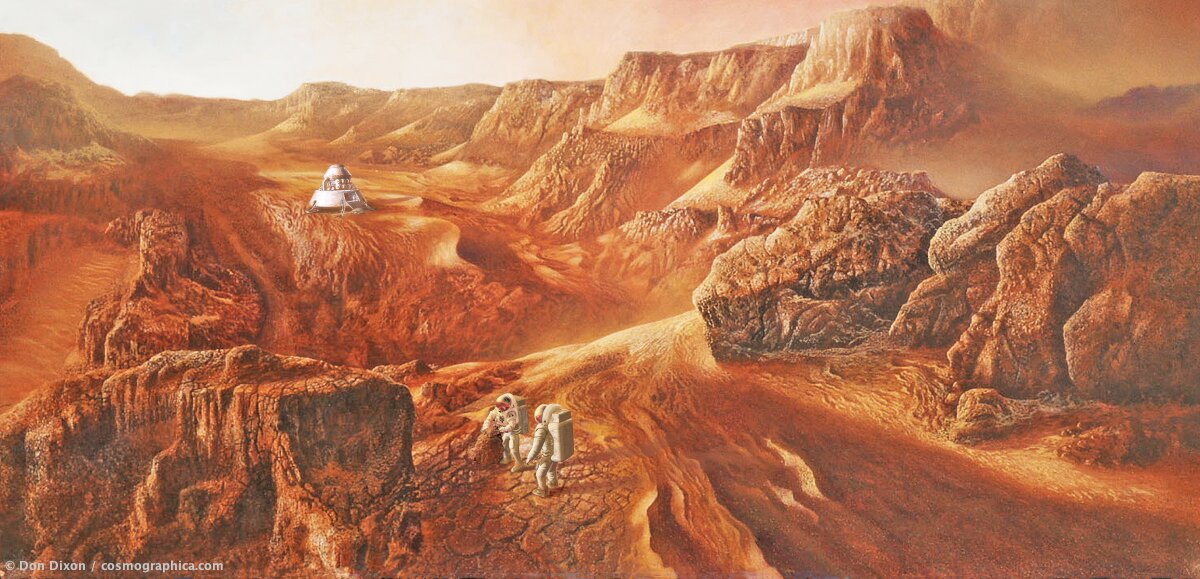
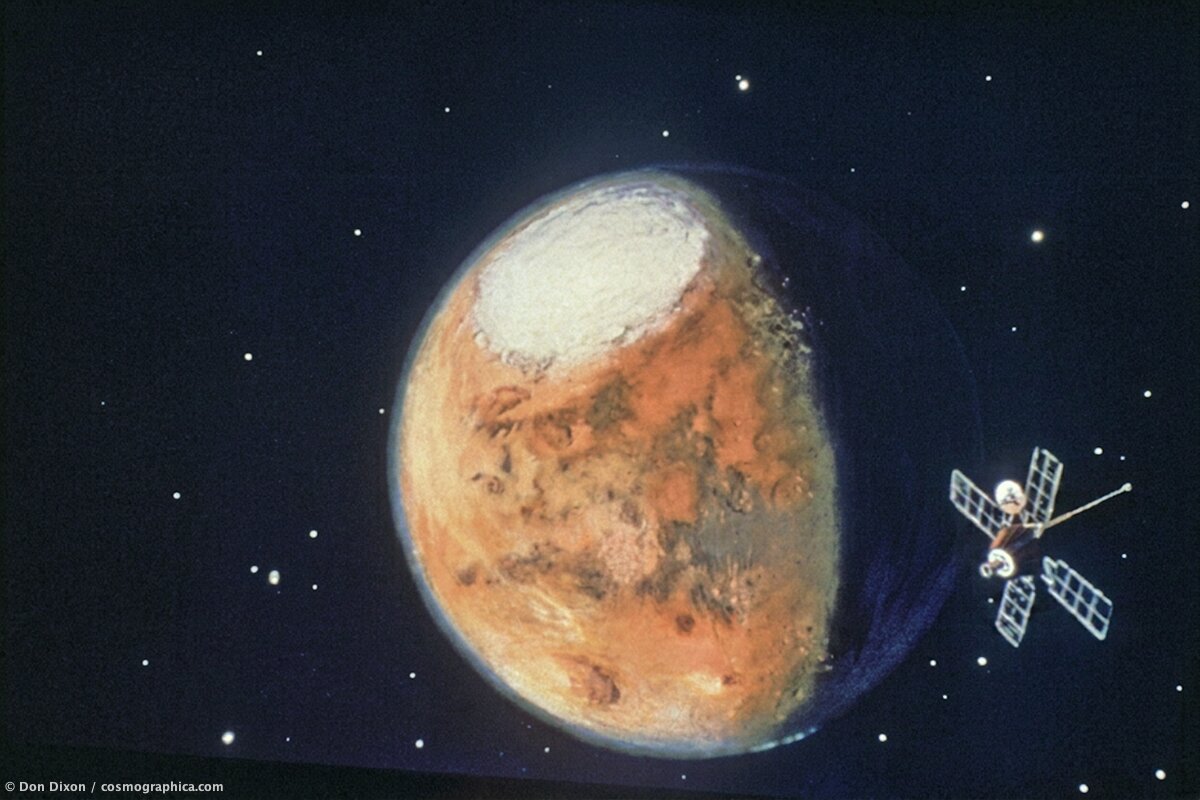
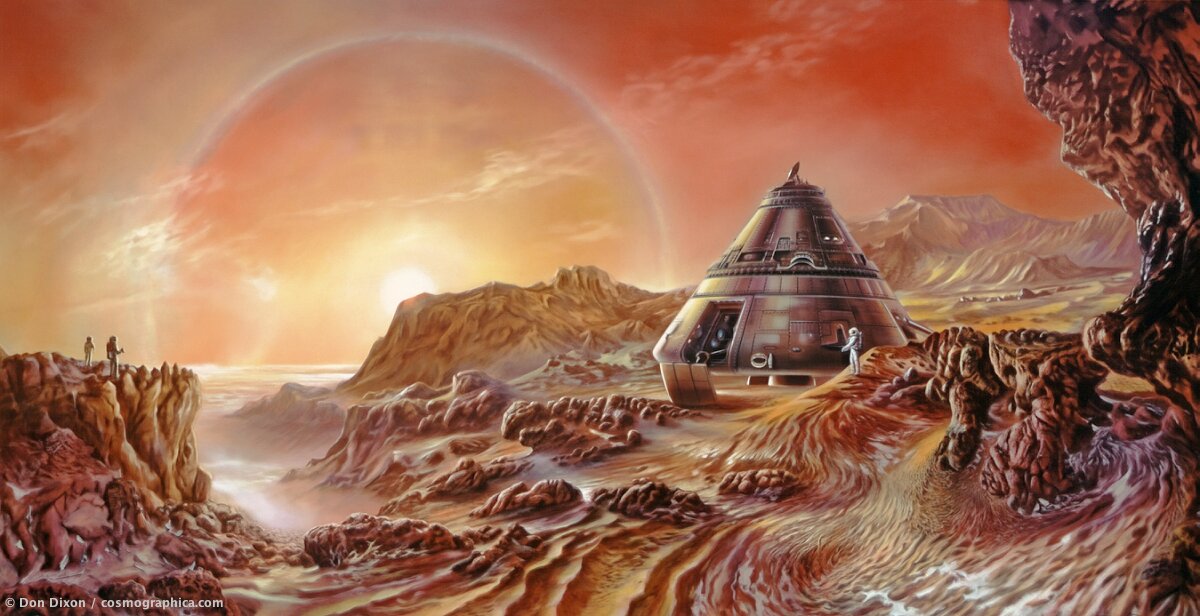
551-exploring-nanedi-valles-dixon – This illustration depicts a view across a rugged, deeply eroded Martian canyon floor. The landscape is dominated by rich, multi-textured shades of rust-red and ochre rock formations, with wind-carved channels and debris fields sweeping toward towering, stratified canyon walls in the background. In the mid-ground, a landing module rests on a smoother, sandy terrace. In the foreground, two astronauts investigate a rocky outcropping, adding a dramatic sense of scale and human presence to the immense geologic features. oil on Masonite, 2013
323-VikingLanding
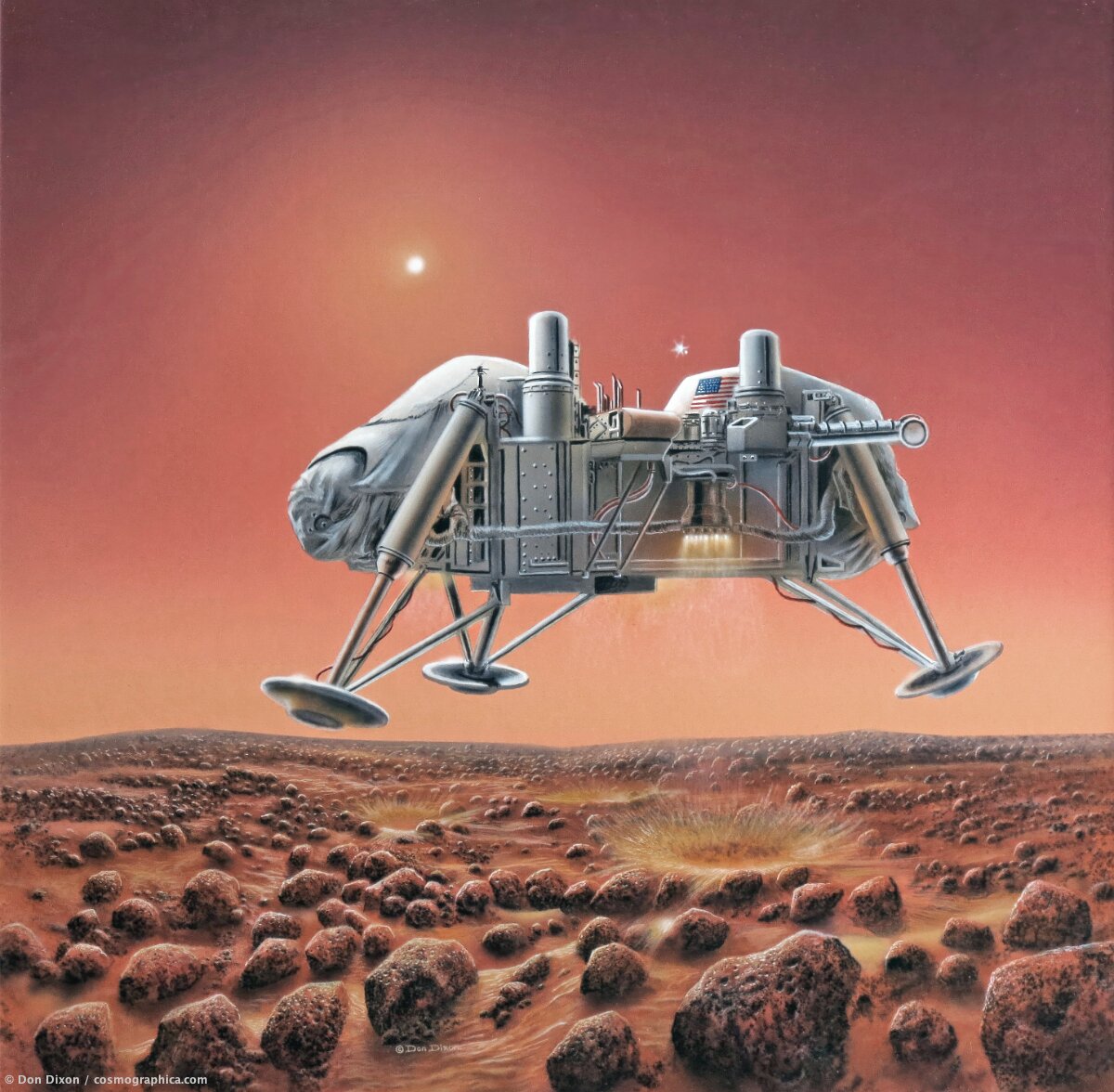
323-viking-landing-dixon –Hamilton Collection plate commemorating landing of Viking One on Chryse Planitia, Mars, July 20, 1976. This classic space art painting captures the historic moment of a Viking lander hovering just moments before touchdown on the Martian surface. The spacecraft’s terminal descent engines fire downward, scouring the rock-strewn desert floor and kicking up localized dust circles. The landing site is covered in dark, iron-rich volcanic boulders under a smooth, pale pinkish-orange sky, with a small, bright Sun hanging low near the horizon. acrylic and gouache, 1994

311-Mars-Lander.jpg

551-exploring-nanedi-valles-dixon – This illustration depicts a view across a rugged, deeply eroded Martian canyon floor. The landscape is dominated by rich, multi-textured shades of rust-red and ochre rock formations, with wind-carved channels and debris fields sweeping toward towering, stratified canyon walls in the background. In the mid-ground, a landing module rests on a smoother, sandy terrace. In the foreground, two astronauts investigate a rocky outcropping, adding a dramatic sense of scale and human presence to the immense geologic features. oil on Masonite, 2013 (digitally remastered)
307-Port-Lowell-Mars
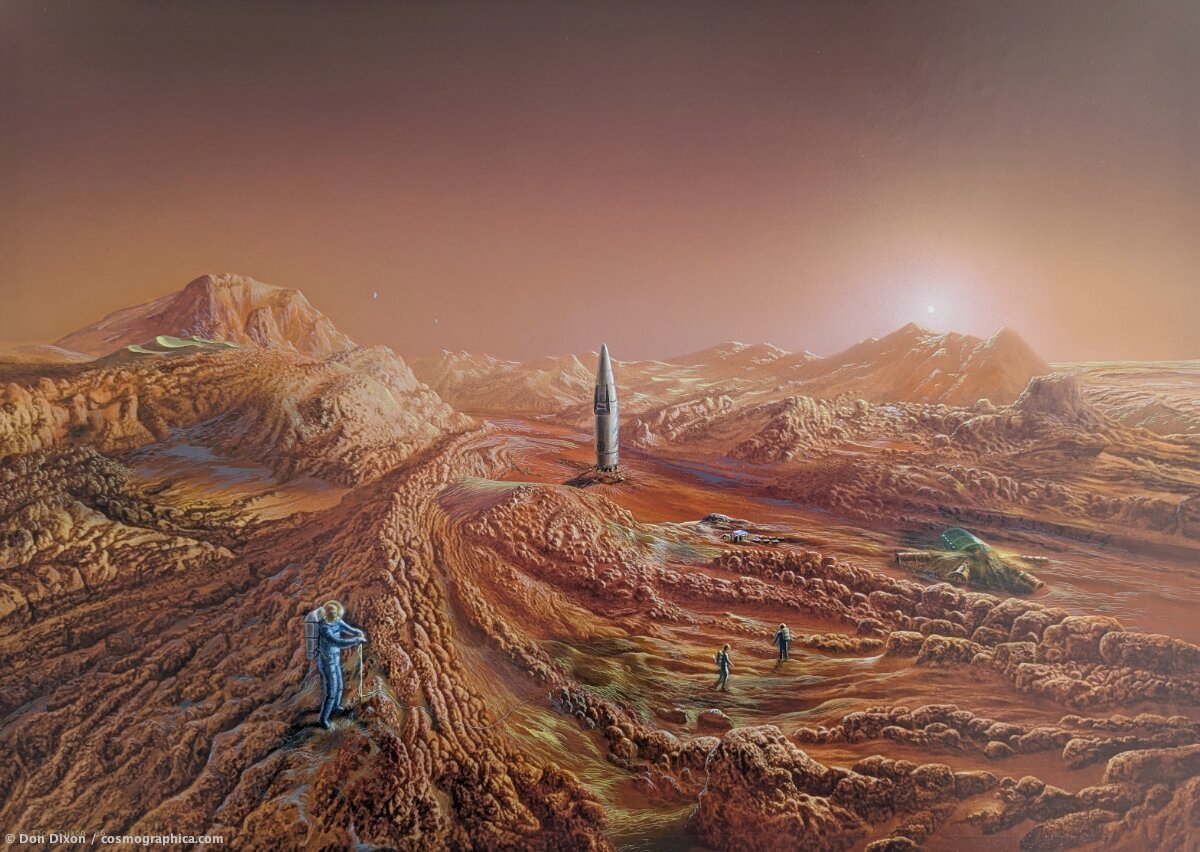
307-port-lowell-mars-dixon – astronauts survey site for a base in an ancient river valley on Mars. This sprawling panoramic space art landscape captures an early human exploration base, designated Port Lowell, nestled within a wide Martian valley. painting by Don Dixon